The Hare with Amber Eyes by Edmund de Waal describes his exploration and discovery of his forbears, the vastly rich Ephrussi family. I am enjoying this best-selling book enormously, and using it to form my picture of secular-Jewish Paris before and during the Dreyfus affair and of secular-Jewish Vienna in the early 20th century, at least of certain high social strata of the cities.Monday, February 13, 2012
Vienna
The Hare with Amber Eyes by Edmund de Waal describes his exploration and discovery of his forbears, the vastly rich Ephrussi family. I am enjoying this best-selling book enormously, and using it to form my picture of secular-Jewish Paris before and during the Dreyfus affair and of secular-Jewish Vienna in the early 20th century, at least of certain high social strata of the cities.Monday, February 6, 2012
"Klezmer" by Joann Sfar
As the musicians catch sight of the city, Sfar draws a series of images with quotations from Isaac Babel's description, "Odessa is a horrible town. It's common knowledge that people there butcher the Russian language," he wrote. "And yet I feel that there are quite a few good things one can say about this important town, the most charming city of the Russian Empire. If you think about it, it is a town in which you can live free and easy. Half the population is made up of Jews... "
And here we see how Sfar imagines it. I also enjoyed his quotations from many Klezmer songs, as the musicians entertain first one another, and then begin to perform for audiences in little towns. I also liked the sort of philosophical aspects of the musicians' struggle with their own misfortunes and their lost faith, though sometimes Sfar is a little too clever about this.
Thursday, February 2, 2012
Norton Simon (February 2, 1907)
Simon came from a West-Coast Jewish family. However, his Jewish background seems to have little or nothing to do with either his great success as a businessman or as an art collector. According to the museum website, "In 1929, at the start of the Great Depression, Norton Simon invested $7,000 in a floundering juice bottling company. He eventually turned his investment into the highly prosperous Hunt Foods, Inc. ... He built Norton Simon Inc., a multi-industry, multinational corporation that included Hunt-Wesson Foods, McCall’s Publishing, Saturday Review of Literature, Canada Dry Corporation, Max Factor cosmetics, and Avis Car Rental."
I place Norton Simon on my hero list because I really respect his accomplishment in developing the Norton Simon Museum. The museum website offers this quote, which I quite like:
"I am not essentially a religious person, but my feeling about a museum is that it can serve as a substitute for a house of worship. It is a place to respect man's creativity and to sense a continuity with the past. It is a place to give us a feeling of the dignity of man and to help us to strive towards our own creativity and fulfillment. - Norton Simon, 1974"
Tuesday, January 31, 2012
Food can be funny
Anything – even hunger -- can be funny in Ilya Ilf and Evgeny Petrov’s sprawling satire of early Soviet times, The Little Golden Calf. Bumbling bureaucrats, resource shortages, redistribution of possessions, and redefined relationships on all levels provided the two writers ample opportunities for broad humor. The novel is episodic: more or less centered around an informal group of con men and opportunistic thieves who take to the road in a car called the Antelope-Gnu. Published in 1936, and now somewhat culturally a bit alien, the novel is still full of really funny scenes.
Some chapters in The Little Golden Calf consist of sketches involving other people besides the road trippers -- people who are about to come in contact with the main group. One such diversion is titled “Vasisualy Lokhankin and His Role in the Russian Revolution” (The Little Golden Calf, transl. Fisher, p. 170 -177) It begins: “At exactly four-forty in the afternoon, Vasisualy Lokhankin went on a hunger strike.”
Vasisualy’s cause was simple: his wife Varvara had just told him she was leaving him with her lover, Pitburdukov. He says she can’t: “One person can’t leave another person if the other person loves her.” Varvara’s response: “She can too.” He vowed not to eat until she comes back, not “for a whole day. A week. A year. … I’ll lie here just like this, in my suspenders, until I die.”
She began to walk away: “I’m leaving. Farewell, Vaisisualy I’m leaving your booklet of bread vouchers on the table.” Now things are clearer even to a 21st century American: food was rationed, but he was going on a hunger strike. As she walked toward the door, he ripped up the booklet and shouted “Save me!” She began to take him seriously: “Don’t you dare keep on this hunger strike! … This is stupid Vaisisualy. This is rebellious individualism.”
He replied, “You don’t fully comprehend the meaning of individualism, or of the intelligentsia in general.” In response, she took off her hat “and quickly made an open-faced sandwich with eggplant caviar, muttering ‘crazed animal,’ ‘tyrant,’ and ‘private property owner’ all the while.”
She demanded that he eat the sandwich. He refused. “Taking advantage of the hunger-striker’s momentarily open mouth, Varvara deftly shoved the open-faced sandwich into the aperture between his little pharaonic beard and trim Moscow-style mustache.” He spits it out. “Eat, you good-for-nothing!... You intellectual!”
Wait a minute, 21st century reader. How did such political jargon get into a quarrel between a couple as they are splitting up? What’s really behind this? Lokhankin’s next gesture, while brushing the crumbs out of his beard, was to lie back down on the couch: “He really did not want to part with his wife. As well as a multitude of shortcomings, Varvara had two key advantages: a large white bosom and a job. Vasisualy himself had never worked anywhere. Work would have kept him from thinking about the significance of the Russian intelligentsia, a social group of which he considered himself a member. Thus Lohankin’s extensive ponderings all came back to the same pleasant and deeply personal theme: ‘Vasisualy Lokhankin and his significance,’ ‘Lokhankin and the tragedy of Russian liberalism,’ ‘Lokhankin and his role in the Russian Revolution.’”
Later that evening, Varvara’s lover Ptiburdukov arrived, determined to convince her to leave despite the hunger strike. She explained: “There he is! Just lying there! Animal! Vile private property owner! The thing is that this feudal landlord, this serf-owner, has gone on a hunger strike because I want to leave him.” She tried and again failed to force the now-stale eggplant-caviar sandwich on him: “Eat, you vile man. Eat, you serf-owner.”
The next morning, he said: “There, now the sharp pains in the stomach have started. … And then there’ll be scurvy caused by malnutrition, with loss of hair and teeth.” Wait a minute, modern reader! We are picking up a reference to the real results of real starvation; such starvation had been widespread during the growing pains of the Soviet system a few years before this publication.
Ptiburdukov’s brother, a doctor, was called in for a visit. His recommendation: “the patient didn’t need to adhere to any particular diet. He could eat everything. Soup, for example, or meatballs, or compote. He could also have bread, vegetables, and fruits. Fish was also a possibility. He could smoke, within reason, of course. He wouldn’t recommend that the patient start drinking, but it wouldn’t be a bad idea to introduce a shot of good port into his system... the doctor didn’t really understand the Lokhankins’ spiritual drama. Puffing up importantly and treading heavily in his boots, he left, declaring in parting that the patient was also not prohibited from bathing in the ocean or riding a bicycle.”
How do we read this? Surely we are being told that the doctor is not only not understanding the family drama, but also not understanding what foods would be available even if the “patient” were not on a hunger strike.
As time passed, the hunger strike continued. Varvara continued to stay in the apartment with her husband instead of running away. But one night she awakened from a bad dream about the doctor and discovered Vasisualy “standing in front of the open cupboard of the buffet, his back to the bed, chomping loudly. … Having ravaged an entire jar of preserves, he carefully took the lid off the pot, plunged his fingers into the cold borscht, and extracted a piece of meat from it. Even if Varvara had caught her husband at this game during the happiest days of their marriage, Vasisualy would’ve had a bad time of it. Now, however, his fate was sealed.”
She left him for good. “Lokhankin suffered openly and majestically. He luxuriated in his woe… His great sorrow gave him the chance to devote even more thought to the significance of the Russian intelligentsia, as well as to the tragedy of Russian liberalism.”
I wrote this for my food blog, but have posted it here as the final Odessa post.
Monday, January 30, 2012
Saul Alinsky (January 30, 1909)
"Maybe, despite his blah debate performances in Florida, Newt will do well in this week’s primary, and go on to win the nomination, become president and build lots of moon colonies while saving America from Shariah law and the corrosive effects of the writing of Saul Alinsky."As I wrote last year, Saul Alinsky was a founder of modern community organizing. He wrote several books on the subject, and was the head of an influential community organization in Chicago. The commitment to social justice that inspired many secular Jews in the past -- and still does, I would say -- is among my greatest criteria for choosing my heroes.
I consider it to their credit that Obama and Hillary Clinton were associated with Alinsky's group. The fact that extreme right wing nuts find that alarming just makes me like Alinsky (and Obama and Clinton) better. Hillary Clinton received a job offer from Alinsky in 1968 when she was in college; she turned it down, though she wrote her senior thesis about him. Obama worked for an offshoot of Alinsky's group; however, Alinsky had died by the time Obama arrived in Chicago.
Alinsky, according to Marian Wright Edelman, the Children's Defense Fund leader, "was brilliant. He was working for underdogs. He was trying to empower communities, which we still need to do. He spoke plainly. He had his outrageous side, but he also had his pragmatic side. Both Hillary and Barack reflect that understanding of community-organizing strategy. Both just know how to leverage power." (Quote from "For Clinton and Obama, a Common Ideological Touchstone," Washington Post, March 25, 2007.)
I don't ordinarily use Wikipedia, but I found it interesting regarding his view of his Jewish background. According to what I found there, Alinsky considered himself to be a devout Jew until the age of 12, after which time he began to fear that his parents would force him to become a rabbi. "I went through some pretty rapid withdrawal symptoms and kicked the habit. . . . But I'll tell you one thing about religious identity," he added. "Whenever anyone asks me my religion, I always say—and always will say—Jewish."
Saturday, January 28, 2012
Odessa Wrap Up
Evidently, 1912 was an interesting year in Odessa. In Tales of Old Odessa by Roshanna Sylvester, events and conditions in 1912 often features in her narrative. Here are a few examples:
"I.P. fon-Kliugel'gen, head of the local investigative police squad, declared in 1912 that more than thirty thousand 'suspicious characters' lurked in Odessa. While 'shady types' could be found 'in every quarter of the city,' the chief inspector continued, they lived 'primarily in Moldavanka,' where on some blocks 'ever single resident is a criminal.' Moldavanka -- if even a tiny fraction of the stories were true it was unsavory terrain, a quarter filled with dark alleys, filthy streets, crumbling buildings, and violence." (p. 48)
"Old Free Port was one of Odessa's most important avenues, having until the mid-nineteenth century marked the edge of the city limits. In 1912, Old Free Port was the site of 'a mass of charities and other civic establishments that follow each other endlessly around it.' ... the Sretenskii Philanthropic Society.., the city almshouse, the foundling home, the Massovskii night shelter, more than a dozen schools, the civic auditorium, a children's clinic and other such establishments." (p. 50)
"In his 1913 guide to the city, Grigorii Moskvich wrote that the dream of the'essential Odessan' was to strike it rich and immediately acquire a house, a carriage, and eveything else he needed in order to 'transform himself (by appearance, of course) into an impeccable British gentleman or blue-blooded Viennese aristocrat." (p. 106)
"... in the fall of 1912 ... Odessans were treated to an unusual entertainment event involving fifty-five 'Somalians' who arrived in town for a month-long engagement at the club Oginski. Even though Odessans were used to a great deal of diversity in their cosmopolitan city, the presence of the Somalians added to the mix an element of racial difference to which they wre less accustomed." (p. 126)
All the examples play up the wide social variety in the city, including character of the many neighborhoods, inner-city and suburbs; the contrast between those who saw themselves as intellectuals or as westernized Europeans and those who were still Russian; differences between the rich and the poor, and variance between the honest and the criminal. The short era between the 1905 violence and the drastic end of Tsarist times was a fascinating one in the city.
The books I read about Odessa continue the story through World War I, the Russian Revolution, the early Soviet era, and World War II. The large and assimilated Jewish community continued to be productive until the Nazi takeover during the war. The Nazis put the Romanians in charge of the city and in charge of the liquidation of the Jewish community, which was done quite efficiently, as documented in Charles King's book Odessa: Genius and Death in a City of Dreams.
As for my reading project, I enjoyed the rewards of reading the historic background before trying to read the famous works of fiction by Odessa authors Babel, Jabotinsky, Ilf, and Petrov. I also feel as if I received some new insights into a sort of experiment in old Russia – what would shtetl Jews have done differently if given more freedom within their native land? The answer is they responded pretty much the way they did when they immigrated to other places, especially to the US. It’s pretty clear that the old regime in Russia didn’t have the potential to sustain a free society within its severe limitations. And I really don’t understand all the things that happened in Russia later. However, I liked my exploration of the Odessa community a century ago and the writers that emerged from it.
Thursday, January 26, 2012
Ilya Ilf and the Twelve Chairs
"In Soviet Russia the insane asylum is the only place a normal person can live. Everywhere else is worse than bedlam. Nope, I can't live with those Bolsheviks. I'd rather live here, with the regular crazies. At least they aren't building socialism. And they feed you here, too." (The Little Golden Calf, transl. Fisher, p. 217)
"In those restless times, nothing made by human hands worked as well as it had before: buildings didn't protect you from the cold, food didn't make you full, electricity was only turned on for massive round-ups of deserters and looters, plumbing only provided running water to the first floor, and trams didn't run at all. At the same time, the elements turned meaner and more dangerous: the winters were colder than before, the wind was stronger, and the chill that used to make a person take to his bed for three days now took those same three days to kil him stone dead. Young men who had no steady employment stolled the streets in groups..." (p. 83)
Wednesday, January 25, 2012
Isaac Babel's Odessa Tales
Isaac Babel was the creator of famous stories about the thieves and rogues of Odessa and still more famous tales about the Russian Revolution. Babel was born in the Jewish Moldavanka district of Odessa in 1894. His grandfather was a victim of the 1905 pogroms which accompanied the failed revolution.
While educational opportunities were more open in Odessa than elsewhere, there were quotas on the number of Jewish students in Odessa's universities and on Jewish enrollment at all Russian institutions of higher learning. Babel was unable to enroll at the University of Odessa, so left in 1911 to further his education in Kiev. In 1913 he published his first story “Old Shloyme.”
Like Jabotinsky’s novel (which I wrote about yesterday), Babel’s stories are mined for historic details by social historians writing about the city and about the Revolution. "More than anyone else, Isaac Babel popularized the image of Odessa as a city of swashbuckling Jewish swindlers and sinners, who all at once embodied the physical strength, revelry, and wit for which Odessa was famous. The larger-than-life Jewish gangster emerged as the prevailing icon of Odessa in Soviet culture, and he was depcted in stark contrast to the stereotypically passive shtetl Jew of Eastern Europe..." (Jarrod Tanny, City of Rogues and Schnorrers, location 78 Kindle ed.)
Odessa historians especially cite Babel's rogue character Benya Krick the hooligan. Babel captured the atmosphere of contrasting poverty and wealth in the stories that took place before the Revolution, and captured the utter disorganization of the various revolutionary forces whose power shifted constantly and who killed one another ruthlessly. As historian Charles King says, "While Vladimir Jabotinsky was busy trying to create a fighting force for Palestine, his fellow Odessan was sitting on a horse in a Cossack cavalry regiment. It was an unlikely place for a Jew, to say the least." (Odessa: Genius and Death in a City of Dreams, p. 183)
Babel’s Odessa stories and war stories are episodic and often broken off in what might be the middle of a longer development of character and plot – but the stories are about chaotic times with limited commitments; sometimes it seems as if only choppy stories can do justice to the unpredictable lives and times depicted. Or maybe Babel was just a little ahead of Hemmingway as a stylist, I don’t know -- he was a very near contemporary.
For example a story in the collection Benya Krik, the Gangster, is titled “In the Basement.” It begins: “As a boy I was given to lying. It was all due to reading.” The narrator's imagination combined with what he reads makes him well-liked, as he embellishes the historic narratives that he reads. His schoomate, the son of a rich man, finds him likable and invites him to his suburban villa.
The wealth and possessions of the friend’s family are vast: “His father … was one of those men who were making Odessa another Marseille or Naples. There was in him the mettle of the Odessa merchant of the old days.” And the villa was pure luxury, close to a beach with carefully tended flower gardens. Guests play cards, women come and go with “diamonds clapped on everywhere;” their host sits in a chair facing the sea and reads The Manchester Guardien.
The narrator, in contrast, came from a “destitute and freakish family.” His grandfather makes clever inventions, and his uncle is a successful rogue, but they live in a slum. However, he describes his feckless relatives to his schoolmate as widely traveled and accomplished, and invites the friend back to visit his hovel. The ensuing disaster is mitigated slightly by the efforts of his Aunt Bobka, who bakes a jam strudel and a poppy-seed cake, and helps him bribe his crazy and unmanageable uncle and grandfather to stay away. Obviously, it doesn’t work – they come back drunk and hurling Jewish curses and Russian obscenities. In the end, we readers have seen the two most extreme sides of Odessa Jewry.
Babel’s stories were widely read in the early Soviet era; then he fell out of favor and eventually died in prison.
Tuesday, January 24, 2012
Writers and Revolutionaries in Odessa
Monday, January 23, 2012
Sergei Eisenstein (January 23, 1898)
"Battleship Potemkin," about the 1905 Odessa uprising, is his most famous film. It especially memorialized the image of the landmark stairway that links the upper city of Odessa to the lower port area. Above all, the film is remembered for the image of a baby carriage rolling out-of-control down these stairs. The scene has been visually quoted in subsequent movies, notably in The Untouchables in a shootout between Eliot Ness (Kevin Kostner) and Al Capone's henchmen.
Charles King's history of Odessa states:
"Today it is almost impossible to separate our understanding of 1905 from the way in which the events were mythologized twenty years later. All of the key images, in fact, come from the skillful hands of one man, Sergei Eisenstein, the master of early Soviet cinematography. Through his 1925 silent film Battleship Potemkin, Odessa became the tocsin that heralded the coming of revolution, ground zero for the emergence of triumphant Bolshevism, and by extension the truest birthplace of the Soviet Union." (Odessa: Genius and Death in a City of Dreams, p. 189)
Sunday, January 22, 2012
A Not-so-religious Jew sees Jerusalem
In the New York times: an interesting perspective on visiting Jerusalem titled "Lost in Jerusalem." It reminded me of my several visits there under varying circumstances -- above, my photo of a lunch at a well-known hotel just outside the Old City.
"... last fall, my friend Theodore Ross — author of the forthcoming book 'Am I a Jew?' — suggested I see Jerusalem. And suddenly feeling life calling my bluff, I booked a flight. I’d spend six December days in the holiest place on the planet and, surrounded by the Old City’s 500-year-old stone walls and legions of Christians, Jews and Muslims, I would be the lone unbeliever, walking a tightrope between belonging and individualism, observing not necessarily my faith but the faithful."
Wednesday, January 18, 2012
Danny Kaye (January 18, 1913)
I wouldn't be willing to claim that his humor was Jewish, but it's possible, since you can argue that Jewish humor became American humor in a lot of ways. I do know that Danny Kaye visited Israel in 1956 and other times, where he was insanely popular.
Monday, January 16, 2012
Clement Greenberg (January 16, 1909)
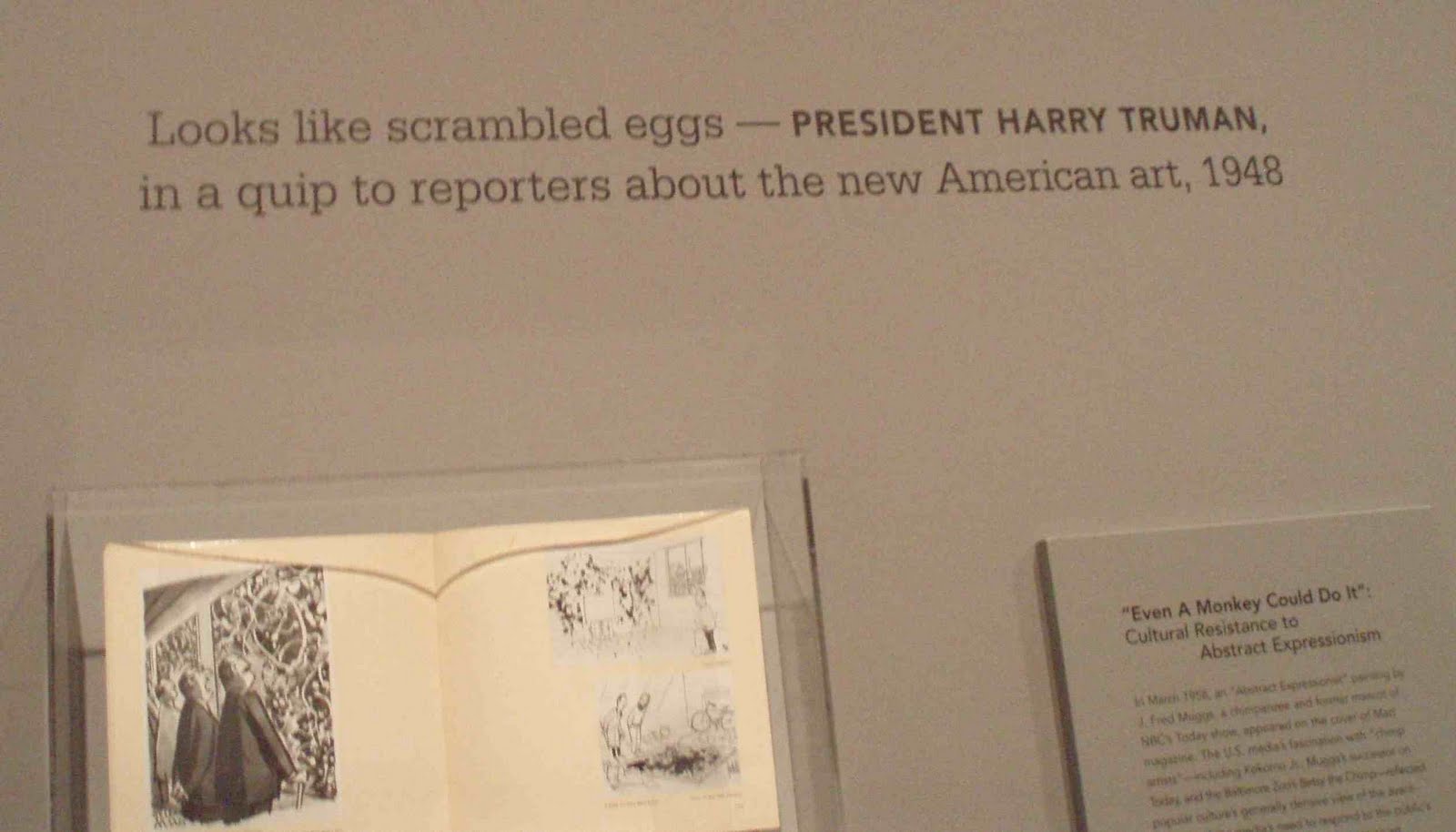
Here are two photos I took at the exhibit in St.Louis three years ago:
Wednesday, January 11, 2012
Odessa Mama
Odessa definitely had its own klezmer music before the Revolution. As Odessa humor and culture spilled over into twentieth century Russia, klezmer was part of the mix (as I read in City of Rogues and Schnorrers by Jarrod Tanny). As a legacy of Soviet Odessa, the song has lots of interesting things about it: the CD notes say it is "drawn from that same colorful period in Odessa's history when the new conditions of Socialism were infused into the thriving Jewish world of trade, talent, and the underworld." Further, according to the notes, the spoken introduction is based on a story by Isaac Babel, who wrote quite a lot about Odessa, his native city.
"Odessa Mama, dear old town of mine," say the lyrics. "Ach! Odessa -- a pearl upon the sea... you have known so much grief... Ach! Odessa -- not just a town -- a bride! ... barges full of gray mullet ... Kostya delivered to Odessa ... And the lowlife would rise from their seats. When he would enter the tavern."
A real combination of nostalgia and crime from Odessa.
Tuesday, January 10, 2012
Ach! Odessa
Monday, January 9, 2012
Kurt Tucholsky (January 9, 1890)
On a visit to Berlin a few years ago, we saw a street named after him, and we ate at Cafe Tucholsky, where the walls are covered with photos and memorabilia from his life there. As far as I can tell, he has little traction with Americans of any age.
Some of his works have been translated recently, and he's getting some attention from English speakers. Here's a quote from an anti-war poem in an article titled "I wish I had met Kurt Tucholsky"
"Lord God! If you’re really up there as we’ve been taught
Come down from Heaven or send your son.
Tear off the banners, the helmets and the medals
And tell the nations of the earth how we’ve suffered,
How we were wiped out by hunger, lice, shrapnel, and lies.
In your name, the preachers have led us to our graves.
Come down now and explain why they lied.
Those of us who have knees are kneeling before you. Listen to us.
Drive us back under the ground, but first give us an answer."
Saturday, January 7, 2012
Odessa 100 years ago
The vast majority of Jews in Russia a century ago lived under severe restrictions. Not so in Odessa. A third of its population of over half a million were Jews. Most spoke Russian; however, Yiddish from the Pale of Settlement and the eastern Austrian provinces, where most had come from, influenced the Odessa dialect which included many Yiddish words.
A large number of Jewish children in Odessa attended Russian schools. Jews were a majority of doctors and lawyers. Jewish members of a new middle class founded businesses and banks, played the stock exchange, went out to eat, listened to klezmer in taverns, and enjoyed (or pretended to enjoy) Italian opera in the city’s stylish opera house. Jewish journalists wrote both satire and serious articles in a number of newspapers, and Jewish fiction writers created a legacy of stories, leaving a nice record for modern scholars.
In Odessa, Jewish women aspired to be ladies with more freedom than they had enjoyed elsewhere – they dressed up to attend musical and theatrical performances, to drink coffee in the many cafes, and to eat in the European-style restaurants. Some worked as teachers or nurses; many led a pampered life.
And the Jews did all these things side by side with the non-Jews of the city.
A Jewish underworld was another widely noted presence in the city, especially in Moldavanka, the impoverished and overcrowded lower-class Jewish district. Odessan Jews thrived as thieves, con men, white slavers (who kidnapped young women and sent them to nearby Turkey or as far as Brazil), forgers, counterfeiters, fences of stolen goods, and other criminal types. The Jewish underworld fit well into the colorful and overheated atmosphere of the busy and multi-ethnic port city. Of course most Jews from Moldavanka worked at miserable but honest jobs: for example, they unloaded freight at the docks, provided household service, and worked in shops.
While Odessan Jews enjoyed freedom to worship in the city’s synagogues, they often dropped more committed religious practices, shocking visitors from villages by their casual attitudes towards dietary laws and Sabbath observances.
I’m currently at the beginning of what I hope is an ambitious project about Odessa and eventually other cities. So far, I’m reading:
• Charles King, Odessa: Genius and Death in a City of Dreams
• Roshanna P. Sylvester, Tales of Old Odessa: Crime and Civility in a City of Thieves
• Jarrod Tanny, City of Rogues and Schnorrers: Russia’s Jews and the Myth of Old Odessa
• Steven Zipperstein, The Jews of Odessa: A Cultural History, 1794-1881
Coming soon: Jewish writers and revolutionaries in Odessa a century ago.
Monday, January 2, 2012
André Aciman (January 2, 1951)
Sunday, January 1, 2012
Resolutions
Saturday, December 31, 2011
Ben Kingsley (December 31, 1943)
He just did it again, playing Georges Méliès
the film maker in the new film “Hugo” (image at right). I loved "Hugo," and I think he’s an amazing actor.
Of his life and ethnic identity, Kingsley said:
“I think one in four of the students at my school was Jewish. Every single one of my friends was Jewish. My mother was half-Jewish, so I felt a part of exotic, cosmopolitan Manchester.”He described his parents:
“'My mother was basically an abandoned child. She wasn't brought up by her own mother, who was, to put it mildly, extremely difficult. If we were trying to be really kind we would call her "a character". Murderous. Terrifying. So my mum had no role model in terms of maternal instinct and intuition.' “His grandmother was an East End rag trader who fell pregnant by a Jewish immigrant. When he ran away back to Russia she became virulently anti-Semitic. Kingsley once said that when he portrayed 'great heroic Jews and heroic dark people' such as Simon Wiesenthal and Gandhi he was 'sticking two fingers up' at her. So it must have been difficult for this fearsome matriarch when her daughter married a young man of Indian descent.
“Rahimtulla Bhanji, Kingsley's father, was a Gujarati like Gandhi, but was brought up in Kenya, the son of a spice trader. He came to England to study medicine before going on to work as a GP in Yorkshire, where his second son, Krishna Pandit Bhanji, the future Ben Kingsley, was born.” -- quotes from "The dark family secret that drove Ben Kingsley to success"
Wednesday, December 28, 2011
Stan Lee (December 28, 1922)
Jewish comic-book author Stan Lee (Stanley Martin Lieber) co-created the Fantastic Four comic series in 1961 for Marvel Comics. He's responsible for Spider-Man, the Hulk, Thor, Iron Man, and X-Men. Surely that makes him a hero to a lot of comic readers!
Like Jewish popular music composers, Jewish comic book creators made an enormous contribution to their field. The first tabloid-sized funny paper reprints appeared in 1934, published by an unemployed Jewish novelty salesman named Max Gaines (née Max Ginzberg) and Harry L. Wildenberg, who worked at Eastern Color Printing; their idea took off. The next big thing in comic books -- Superman -- was invented by artists who also happened to be Jewish. I have not seen a credible explanation for either phenomenon, though I found a history of their role that attempts to explain the role of Jews throughout comic history up to Mad magazine. The last paragraph reads:
MAD's conversion from a comic book to a bimonthly magazine marked the end the Golden Age of comic books, which, for its creators, was like a drama in two acts. In act one, Jews seeking to escape poverty invented a new genre that melded popular art and storytelling, and projected Jewish (and adolescent) power fantasies onto their "all-American" superhero creations. During the shorter second act, the five-year reign of EC Comics was marked by an overriding concern about morality, sometimes emanating from a Jewish sensibility. In the words of The X-Men creator Stan Lee: "To me you can wrap all of Judaism up in one sentence, and that is, 'Do not do unto others...' All I tried to do in my stories was show that there's some innate goodness in the human condition. And there's always going to be evil; we should always be fighting evil."
Saturday, December 24, 2011
Latkes
Tonight's latke dinner with Elaine and Larry. We had leg of lamb, latkes, and for dessert, lemon layer cake.
Friday, December 23, 2011
Yasmin Levy (December 23, 1975)
Levy’s inspiration partly comes from her father Yitzhak Levy, thus described at her website:
“Born in Turkey in 1919, he worked as both a composer and cantor. After the creation of the State of Israel, Yitzhak was appointed head of the Ladino department at Israel's national radio station. His life's work was devoted to the collection and preservation of the songs of Sephardic Jews: these songs had been passed down orally from generation to generation over a period in excess of 500 years. During his lifetime he published four books containing Sephardic romances and another ten volumes of liturgical songs. He also recorded many of these same songs for the national radio.”
Tuesday, December 20, 2011
Happy Hanukkah!
Andrei Codrescu (December 20, 1946)
“My family fled Hungarian-occupied Transylvania to escape the Nazis to Romania, where I was born after the war. Being a poet, I work with language, which is something we Jews are very good at. We have survived by means of a book, the perpetuation of one language and the invention of another. Hebrew words still maintain a potent link to the sacred, just as Yiddish, our other language, keeps us rooted to the bitter ironies of the human world. Of course, any language can connect to the divine under the ministrations of a poet, but there is something in our use of it that transcends both education and prayer. We offer the world a model of survival for thousands of years without a bureaucratic state (until Israel) or an official language. We are a shining and tragic example of what happens to the powerless when the powerful need scapegoats, and we provide at the same time a model for existence through learning and community. We possess a stubborn sense of justice born out of being the perennial subjects of injustice. Our moral history consists largely of reflection on the laws of men and the Law of God, a subject of existential urgency to all humans.”
Monday, December 19, 2011
Italo Svevo (December 19, 1861)
Italo Svevo was the pen name of a Jewish businessman and novelist from Trieste named Ettore Schmitz. When we were in Ireland an Irish/English friend, discussing Leopold Bloom, wondered if James Joyce knew any Irish Jews. I said I didn’t know, but he did know Italo Svevo in Trieste. Svevo first employed Joyce as an English tutor, but became his friend.Svevo's most famous novel is The Confessions of Zeno. When first published, it received little recognition, but is now admired for its early use of psychoanalysis and Freudian thought in fiction. Joyce's influence helped to make it better known and respected. I read it long ago.
From an article in the Guardian about the story of Svevo:
"What gives the story its piquancy is the way Svevo's very acquiescence in his apparent destiny as a businessman brought about his rebirth as a writer. With the expansion of his father-in-law's firm, he began travelling to London on business. Feeling the need to improve his English, he hired a young Irishman in Trieste to tutor him. James Joyce at this point was 25 and more or less unknown, but his words of praise to his middle-aged pupil, who had diffidently handed him his two long-forgotten novels, were enough to regalvanise Svevo's literary ambitions. And many years later, when The Confessions of Zeno was completed, it was Joyce - now famous - who engineered the triumphant French publication that finally brought Svevo the recognition he deserved; a wonderfully old-fashioned ending for a story involving two such uncompromising modernists.
"Zeno, like his creator, is a compulsive renouncer - most comically of cigarettes, but of other pleasures, too. The secret of the happiness he derives from his various relationships lies in the way he is constantly giving up (in his mind at least) one for another. In the charmingly devious byways of his psyche, the problem of the transitoriness of pleasure is resolved by incorporating the idea of its destruction into the experience of the pleasure itself. Enjoyment and valediction are miraculously suspended there together, at least for a period."
Sunday, December 18, 2011
Hanukkah Starts in Two Days
To begin: Hanukkah was invented, some say, in a secular way – imitating the habits of the Hellenists in proclaiming a festival to celebrate a military victory, instead of getting the holiday directly from God. For another thing, it provides an alternative to secular Christmas: we have candles, they have trees. Even in the shtetl, it was kind of secular – a chance to gamble and give treats to the kids, maybe.
American Jews might see the Hanukkah story as a reinforcement of American values – religious freedom, standing up to tyranny, self-determination. We are free to ignore the elements of religious fanaticism in the actual Maccabee family as presented in the sources: they were rejected as part of the Jewish canon a long time ago anyway. And skeptics among us naturally can deal with the miracle of 8 days of oil in a variety of ways.
The Maccabees have always provided lots of ambiguity – something for anyone. Here are eight ways various people have seen Judah Maccabee as a hero – one for each night of Hanukkah.

Sound the trumpets, beat the drums.”
Thursday, December 15, 2011
Hyman Feldman (December 15, 1905)
Last year I wrote a fairly long post about my father, Hyman Feldman, on his birthday. This year, I'll just post a photo of my father in front of our Chevrolet that he drove from around 1950 until 1960.Wednesday, December 14, 2011
A Wandering Jew
Monday, December 12, 2011
Helen Frankenthaler (December 12, 1928)

Helen Frankenthaler was a central figure in the New York School of painting, a movement that emerged in the early 1950s. She was involved with the art critic Clement Greenberg, and later married and divorced the painter Robert Motherwell.
Frankenthaler was widely recognized when she was in her early twenties, especially for a work titled Mountains and Sea (shown above). "The color field painting that came to prominence during the later 1950s and 1960s, by Frankenthaler, Louis, Noland, Dzubas, and Jules Olitski, among many others, can be said to have had its origin at that moment." In an art world that discriminated against women, she managed to create and maintain a distinctive reputation.
Friday, December 9, 2011
Christmas by Jewish Songwriters

One subject that intrigues me is the high number of Jews in American popular music. Of course there are books about this subject, which I haven't read, and might get around to reading some time. Meanwhile, there's Tablet magazine and it's continued coverage of popular culture.
Today: a list of Christmas songs by Jews, reprinted from 2009: "Have Yourself a Jewish Little Christmas: The top 10 Christmas Songs written by Jews" by Marc Tracy.
Here's the bare-bones list from bottom to "White Christmas" (for details see the original article) --
10. “The Christmas Waltz”
9. “Silver Bells"
8. “Winter Wonderland”
7. “Santa Baby”
6. “Sleigh Ride”
5. “I’ll Be Home for Christmas”
4. “I’ve Got My Love to Keep Me Warm”
3. “Let it Snow, Let it Snow, Let it Snow”
2. “The Christmas Song” (“Chestnuts Roasting on an Open Fire”)
1. “White Christmas”
Thursday, December 8, 2011
Delmore Schwartz (December 8, 1913)
"Schwartz ... became a central figure in the emerging group of New York intellectuals who would come into their own in the 1940s, but his writing was palpably different from theirs. Most of them were Jewish, but they showed little interest in their Jewishness, except for their urge to leave it behind. Marxist theory and the appeal of Western culture helped make them universalists, quickening their flight from their immigrant beginnings. Their facility with ideas typically made them critics rather than poets or novelists. Personal writing held little appeal for them, at least until they began to look back years later. During the Depression it seemed an indulgence, even an embarrassment. It could only drag them back to the poverty and, as they saw it, the cultural poverty of their family backgrounds.
"For Delmore Schwartz, what lay behind him was everything. His family history, and especially his Jewishness, was the medium that would help him fathom the enigma of who he was. His most ambitious work was a failed book-length autobiographical poem called Genesis. No writer believed less in the Emersonian vision of personal freedom, with its faith in the individual’s power of self-making. In one of his short plays, titled Shenandoah, Schwartz derided the notion that “a man/ Creates his life ex nihilo.” Instead, he took up Freud’s exploration of the family romance, which fed his own bleak sense that family was destiny. He never tired of musing on the cultural contradictions of his own name and the burden it placed on him. In Shenandoah, the mock-tragic verse play, his 25-year-old alter ego, Shenandoah Fish, is transported back to the scene of his own bris, the moment when he, at eight days old, received his impossible name. He blames his parents for their eagerness to gain a foothold in the gentile world while at the same time being tone deaf to its language and culture. The incongruous name came to stand for his divided being, at once comically native and ethnic."
Sammy Davis Jr. (December 8, 1925)
Tuesday, December 6, 2011
Ira Gershwin (December 6, 1896)

George and Ira Gershwin were raised as Jews in New York, but though their Jewishness is widely known and always included in their biographies, I've found nothing indicating that they recognized direct Jewish influence or inspiration for their work. Why were so many Jews successful in creating the American brand of theater music and so many popular songs of the early and mid-20th century? I've also never seen a plausible explanation. It just happened!
Marty Peretz (December 6, 1938)
Peretz married a very rich woman when he was in his 20s, and bought influence and access to power in various ways, eventually using the New Republic to further his ends. While he did hire accomplished left-wing editors to run the magazine, his contribution seems to have mainly been curmudgeonly comment becoming more and more grumpy and neocon over the years. I can’t imagine why three or four major publications devoted huge amounts of space to him in December and January of last year, but they did. Hero or anti-hero? Who cares. Secular Jew? Yes, but who cares? What’s so great about buying your way into fame and influence?
Monday, December 5, 2011
Gershom Scholem (December 5, 1897)
Before Scholem's works were published, scholars were in a weird kind of denial about Jewish mystics, because the scholars themselves were trying to invent a sort of sanitized history of Judaism, making it respectable to the rational 19th century views they themselves held. (Maybe this is an exaggeration, but there's a grain of truth in it. Anyway I find many of those pre-Scholem scholars deadly dull!) He founded the entire field of study of Jewish mystics, and his books are fundamental.
Scholem's autobiography, From Berlin to Jerusalem: Memories of My Youth, tells the really compelling story of how he became a scholar of Jewish mysticism as well as being an early Zionist and one of the founders of the Hebrew University of Jerusalem. As an adolescent, he found life in Germany uncomfortable and untenable because of the anti-Jewish climate throughout the society, especially in academia, and he committed himself to earn a doctorate and then go to Jerusalem. Obviously he wrote after the Holocaust, so he had hindsight, but the foresight that he demonstrated was clearly unusual and penetrating. His friendship with Walter Benjamin was full of contradictions, as Benjamin wasn't as forward-looking.
Calvin Trillin (December 5, 1935)

Calvin Trillin does some of the funniest food writing I've ever encountered, while still really talking about food. Although he refers to his Jewish background from time to time, I've never thought about him as a particularly Jewish writer. Like me, he's from the Midwest, although unlike me, he's a very-long-term resident of New York and his writing is quite New York-centered, especially when he's reminding the New Yorkers that the rest of the country exists. I loved his books about his wife Alice and the way she tried to get him not to eat 12 meals a day, or however many it was.
An interviewer from Forward once asked him "Would you say yours is a Jewish sense of humor?"
Trillin answered: "All of me is Jewish. You get a lot of theories about Jews deflecting pain through humor. I don’t know about that. I think there is sort of an irony built into the faith. Even in the Talmud where they argue 'maybe' and 'but on the other hand,' that I always found funny."
In the same interview, he described how he discovered he could be funny: "We were studying that section of the Bible where it says, 'If I forget thee o Jerusalem, let my right hand forget her cunning and let my tongue cleave to the roof of my mouth.' I was kind of a shy little boy. I think I was in the sixth grade, and I suddenly got up and said, 'If I forget thee O Jerusalem, let my right hand forget her cunning,' and I had my right hand dangling by my side. And then I said, 'Wet my tongue kweave to duh woof of my mouf.' That won me over to comedy, and, if you can have an epiphany in a non-Christian school, I had an epiphany."