Showing posts with label Paul Krugman. Show all posts

Tuesday, February 28, 2017

Looking for Heroes

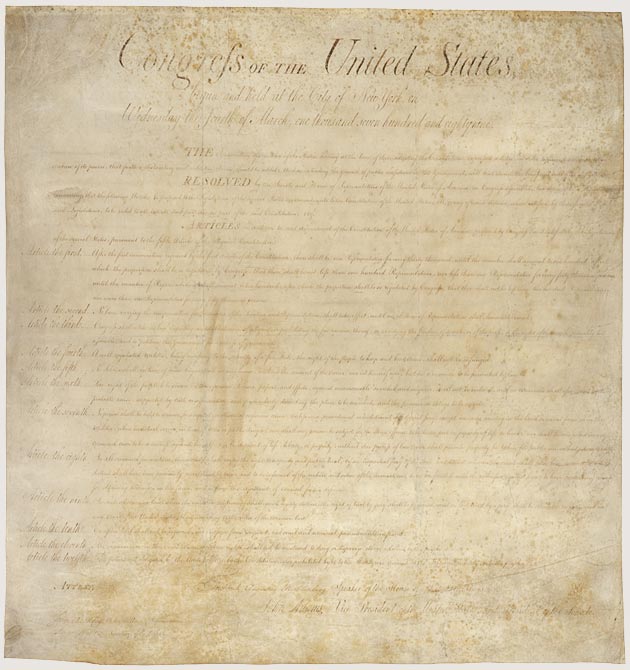
Under threat: the Bill of Rights (Image: original
Joint Resolution passed by Congress
on September 25, 1789, from National Archives.) 
I've been traveling, and then adjusting to getting home. I had one week on a boat in Peru without any internet or news, which was relaxing. Since regaining media access, I've read about lots of outrages, but I've seen very little evidence of new ideas for effective push-back.

I'm aghast at several ongoing trends, such as the horrific outbreak of antisemitism, the lack of appropriate response from politicians at the top, and attacks on virtually every provision of the Bill of Rights except the one about guns. But I don't see much new leadership in how to resist.

At least I found a couple of surprises on the part of usually right-leaning (or extremist) politicians:
  • In the matter of persecution of transgender children by denying them bathroom access, the surprise came last week from the Secretary of Education: "Ms. DeVos initially resisted signing off and told Mr. Trump that she was uncomfortable because of the potential harm that rescinding the protections could cause transgender students, according to three Republicans with direct knowledge of the internal discussions." Of course she quickly caved in to President's decision, but "Ms. DeVos’s unease was evident in a strongly worded statement she released on Wednesday night, in which she said she considered it a 'moral obligation' for every school in America to protect all students from discrimination, bullying and harassment." (source)
  • And former President George W. Bush spoke out in favor of the media, which has been under constant attack by the President: "We need an independent media to hold people like me to account," Bush said in an interview with the Today Show's Matt Lauer. "Power can be very addictive and it can be corrosive, and it’s important for the media to call to account people who abuse their power." (source)
Paul Krugman's latest column advocated the cultivation of outrage. I hope we -- as a society that voted only in a minority for the current administration -- can live up to this goal. Krugman's clear and important conclusion:
"I’m sure many readers would rather live in a nation in which more of life could be separated from politics. So would I! But civil society is under assault from political forces, so that defending it is, necessarily, political. And justified outrage must fuel that defense. When neither the president nor his allies in Congress show any sign of respecting basic American values, an aroused public that’s willing to take names is all we have."

Monday, January 16, 2017

Congressman John Lewis, Patriot

John Lewis
John Lewis, Congressman from Georgia, says that he will not attend the inauguration Friday because he regards the President-elect as an illegitimate president. The president-elect had the expected Twitter fit in response, saying that Lewis is "all talk, talk, talk—no action or results."

Lewis is a hero of the civil rights movement, having put his life on the line for civil rights in the sixties -- leading a march in Selma, Alabama where he was beaten and suffered a fractured skull. The New Yorker calls him "the singular conscience of Capitol Hill." John McCain once called Lewis 'one of the most respected men in America.' The Washington Post writes: "For a lifetime of civil rights work, Lewis was awarded the Presidential Medal of Freedom in 2011. Last year, the Navy announced it would name a ship after him, making Lewis one of just a few to get that honor." (Links: "JOHN LEWIS, DONALD TRUMP, AND THE MEANING OF LEGITIMACY" and "In feud with John Lewis, Donald Trump attacked ‘one of the most respected people in America’")

Lewis's refusal to attend the inauguration is an act of patriotism and heroism. Paul Krugman, in his column today, puts this in perspective, saying "talking frankly about how Mr. Trump gained power isn’t just about truth-telling. It may also help to limit that power." Here are a few of the paragraphs from the column:
"...let’s ask whether Mr. Lewis was right to say what he said. Is it O.K., morally and politically, to declare the man about to move into the White House illegitimate?
Yes, it is. In fact, it’s an act of patriotism. 
"By any reasonable standard, the 2016 election was deeply tainted. It wasn’t just the effects of Russian intervention on Mr. Trump’s behalf; Hillary Clinton would almost surely have won if the F.B.I. hadn’t conveyed the false impression that it had damaging new information about her, just days before the vote. This was grotesque, delegitimizing malfeasance, especially in contrast with the agency’s refusal to discuss the Russia connection. 
"Was there even more to it? Did the Trump campaign actively coordinate with a foreign power? Did a cabal within the F.B.I. deliberately slow-walk investigations into that possibility? Are the lurid tales about adventures in Moscow true? We don’t know, although Mr. Trump’s creepy obsequiousness to Vladimir Putin makes it hard to dismiss these allegations. Even given what we do know, however, no previous U.S. president-elect has had less right to the title. So why shouldn’t we question his legitimacy? ...
"What this means is that Mr. Trump must not be treated with personal deference simply because of the position he has managed to seize. He must not be granted the use of the White House as a bully pulpit. He must not be allowed to cloak himself in the majesty of office. Given what we know about this guy’s character, it’s all too clear that granting him unearned respect will just empower him to behave badly. 
"And reminding people how he got where he is will be an important tool in preventing him from gaining respect he doesn’t deserve. Remember, saying that the election was tainted isn’t a smear or a wild conspiracy theory; it’s simply the truth.... 
"So let’s be thankful that John Lewis had the courage to speak out. It was the patriotic, heroic thing to do. And America needs that kind of heroism, now more than ever."
The New Yorker writer, David Remnick, concludes:
"Trump avoided the draft by citing bone spurs in his feet. He has said he has made 'a lot of sacrifices' for his country because he has created jobs and 'built great structures.' The sacrifices that Lewis has made for his country and for the cause of justice are manifest in the scars on his skull. It is a safe bet that he will not be wounded by any tweet. And there are those who know well what he has done to advance the cause of justice and human rights. Eight years ago, at a lunch following the inaugural ceremonies, the new President signed a piece of paper for him with the inscription 'Because of you, John. Barack Obama.' John Lewis surely believes in the orderly transfer of power as a tenet of democracy, but asking him to keep quiet and sit through the inaugural ceremonies this time is asking too much."

Saturday, September 10, 2011

Stephen Jay Gould (September 10, 1941)

For years we subscribed to Natural History so that we could read Stephen Jay Gould's column about new discoveries in evolution and effective ways to struggle against the monkeys who wanted to teach and legislate creationism (or whatever they called it that year). His books and writings educated us and many others about developments in this science, and also about the challenges of coping with anti-scientific thought as it was emerging in America. Since Gould died in 2002, the situation has only grown worse -- the anti-science and anti-intellectual tone of national politics is deplorable, as documented by the current New York Times column by Paul Krugman, "Republicans Against Science" and in many other places.

Gould's scientific and personal values and accomplishments didn't depend on his own religious background -- though indeed it was secular and Jewish. Gould was proud that his Jewish ancestors had escaped tyranny to come to the United States, and conscious of a variety of ironies. For example, in his book The Mismeasure of Man he attacked IQ tests – his attack seems to have been “illuminated by the knowledge that the most popular early use of I.Q. tests had been to think up ways to keep out people like Gould's Jewish immigrant grandparents.”

A collection of obituaries for Gould indicate that he was a purely secular Jew. And a hero!

Monday, February 28, 2011

Paul Krugman (February 28, 1953)

Economics Nobelist Krugman’s NYT column and associated blog are widely influential – he was voted “Most Influential left-of-center European thinker” (Social Europe Journal) even though he’s not European. He refers to his “current role as public intellectual” – that is, a writer for the general public. And says:
"The great thing about the column is that it more or less forces me to keep learning new tricks, to keep scoping out areas I’d never thought much about before. Then it forces me to find a way to talk about those areas in plain English." (The Joy of Research)
I read Krugman's blog and column every day, and find his insights into the whole political sphere, especially with regard to economic affairs, quite important in figuring out what's happening.  Sometimes he’s ironic about being Jewish -- and his point of view as an outsider who understands what’s going on is fun to read, especially when he reminds his readers of how he predicted one mess or another that the government is getting itself into. His first triumph was understanding Enron before anyone else did.

Wednesday, February 2, 2011

Ayn Rand (February 2, 1905)

Rand was born Alyssa Rosenbaum in St. Petersburg, Russia. Her right-wing philosophy included a rejection of any religion, including that of her family. I hate to claim her for secular Jewishness, but there it is.

Paul Krugman’s favorite quote about her: “There are two novels that can change a bookish fourteen-year old’s life: The Lord of the Rings and Atlas Shrugged. One is a childish fantasy that often engenders a lifelong obsession with its unbelievable heroes, leading to an emotionally stunted, socially crippled adulthood, unable to deal with the real world. The other, of course, involves orcs.”

Monday, January 10, 2011

Gabrielle Giffords (June 8, 1970)

Gabrielle Giffords' birthday isn't for several months, but the horrifying assassination attempt on her life and the shooter's successful assassination of a federal judge and murder of several other people puts her in the news right now. The facts of her Jewish identity and synagogue membership -- and possible antisemitism of the assassin -- add to the horror.

Right wingers have repeatedly -- and nearly explicitly -- called for such assassinations. They are now saying they have no responsibility for this event because the shooter was mentally unbalanced. I don't know why anyone would expect any logical thought from them on the issue: for example, realizing that calls for assassinations are likely to be first heeded by the mentally unstable. I hope that responsiveness to their rhetoric doesn't spread to the slightly saner tiers of the population.

A large number of commentators have expressed their horror and fears for the future much better than I can. For example, Paul Krugman concluded his NYT column today thus:
"The purveyors of hate have been treated with respect, even deference, by the G.O.P. establishment. As David Frum, the former Bush speechwriter, has put it, 'Republicans originally thought that Fox worked for us and now we’re discovering we work for Fox.'
"So will the Arizona massacre make our discourse less toxic? It’s really up to G.O.P. leaders. Will they accept the reality of what’s happening to America, and take a stand against eliminationist rhetoric? Or will they try to dismiss the massacre as the mere act of a deranged individual, and go on as before?
"If Arizona promotes some real soul-searching, it could prove a turning point. If it doesn’t, Saturday’s atrocity will be just the beginning."