Late Roman objects with images of Menorah:


Falasha dolls from Ethiopia, early 20th century:


 |
| From Martinelli's article in Forward: the cover of Meyer's book. |
“'What shall I cook? This problem, the concern of housewives the world over, is particularly acute in our country. The differences in climate and the necessary adjustments arising out of these differences compel the European housewife to make many drastic changes, particularly in her cooking.'
"With these words, Dr. Erna Meyer introduced her cookbook, How to Cook in Palestine, which was published in Palestine in the mid-1930s in Hebrew, English, and German. 'We housewives must take an attempt to free our kitchens from European customs which are not applicable to Palestine. We should wholeheartedly stand in favor of healthy Palestine cooking,' writes Meyer, urging new Jewish immigrants to Palestine to shed their European identity and reinvent themselves according to the Zionist ideology. 'We should foster these ideas not merely because we are compelled to do so, but because we realize that this will help us more than anything else in becoming acclimatized to our old-new homeland.'
"Meyer’s book is widely considered the first Jewish cookbook printed in Palestine during the British Mandate."A more complete review appeared in Forward a few years ago: "Lessons From the First Israeli Cookbook" by Katherine Martinelli. From this review:
"Meyer repeatedly recommends making vegetables more central to every meal and offers meat substitutes for a variety of dishes from 'liver' made out of eggplant to 'meatballs' made out of soaked bread. Although her suggestions came from a place of economy rather than sustainability, they’d fit right in with Mark Bittman and Michael Pollan’s contemporary cries to consume less meat."One can only hope that a facsimile edition will become available!
 |
| Library copy of Hesperides. |
 |
| Title page. |
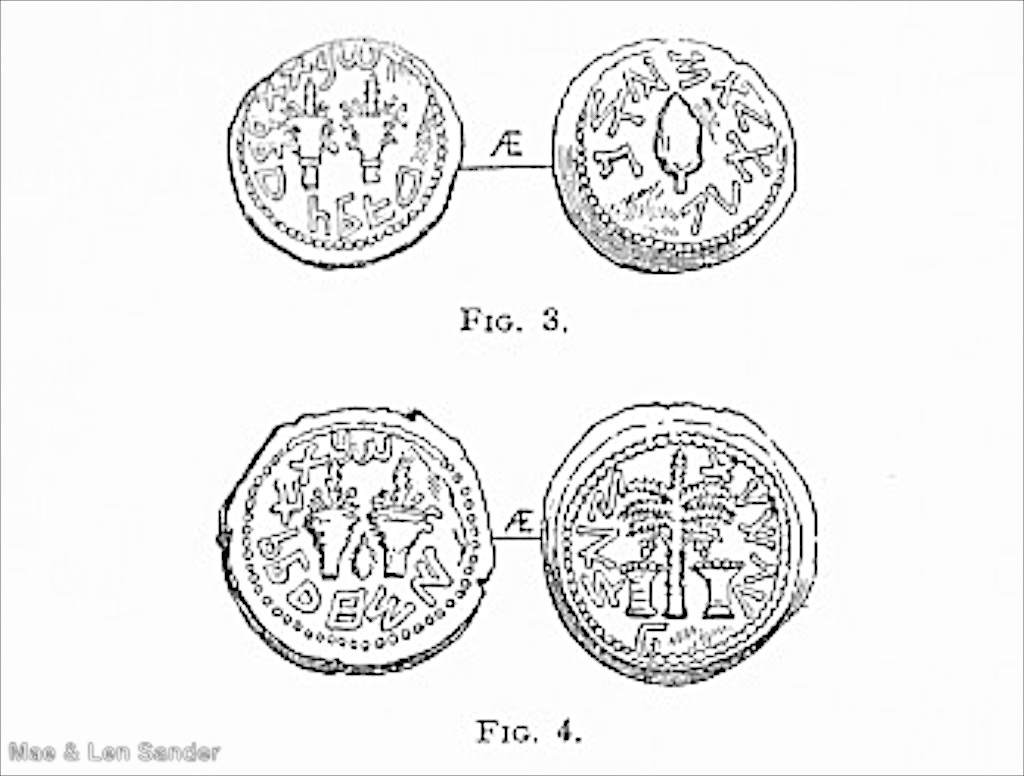 |
| Simon the Maccabee issued copper coins (above) bearing the picture of a citron together with the bundle of myrtle, willow and palm branches prescribed for use at the Feast of Tabernacles. |
 |
| Above: a bronze seal with Jewish symbols including an etrog. Below: a decorated glass vase including an etrog and other fruits. From the Roman era. |
 |
| A detail of a mosaic from Pompeii. |
Werfel’s book was translated into Hebrew as early as 1934. In an early review from the Yishuv (the Jewish community in Palestine) Dov Kimchi wrote extensively of the forthcoming book, based on excerpts published abroad. He wrote, among other things, that “we Hebrew readers … read into this book on the Armenians our very own tragedy.” A year later, in 1934, another review, by R. Seligmann in The Young Worker (Ha-Poel Ha-Tzair), expressed similar sentiments, observing, “The book is very interesting for the educated reader in general, but the Jewish reader will find it of special interest. The fate of this Armenian tribe recalls, in several important details, the fate of the people of Israel, and not surprisingly the Jewish reader will discover several familiar motifs, so well known to him from the life and history of his people.” In 1936, Moshe Beilinson wrote a more critical review. He was irritated by the fact that a Jew would erect such a monument to the suffering of another people. But he, at least partially, understood Werfel’s intentions: “This is no more than a shell, for in truth this is a Jewish book, not only because it was written by a Jew, but in a less abstract sense, simpler and more concrete, the author speaks of us, of our fate, of our struggle.”
 |
| Actual French journal from time of Dreyfus case. (From The Prague Cemetery). |
"The first place I wanted to indulge myself was Le Grand Véfour, in the arcades of the Palais-Royal. Though it was extremely expensive, I had heard it praised even in Turin, and Victor Hugo apparently used to go there to eat breast of mutton with haricot beans. The other place that had immediately seduced me was the Café Anglais, on the corner of rue de Gramont and boulevard des Italiens. It had once been a restaurant for coachmen and servants and now served le tout Paris at its tables. There I discovered pommes Anna, écrevisses bordelaises, mousses de volaille, mauviettes en cerises, petites timbales à la Pompadour, cimier de chevreuil, fonds d’artichauts à la jardinière and champagne sorbets. The mere mention of these names makes me feel that life is worth living." (The Prague Cemetery, Kindle Locations 2196-2202)
 |
| At the young-people's hostel. |
"As you entered, you were hit by the asphyxiating stench of rancid grease and mildew, and of soup that had been cooked and recooked over the years, leaving tangible traces on those greasy walls— though there was no apparent reason for this, since you had to bring your own food with you, and the house offered wine and plates only." (Kindle Locations 4771-4773)Or in another passage, where he is entertaining a Russian business acquaintance (more about the business later):
"With a feeling of relief I invited Golovinsky to dinner at Paillard, on the corner of rue de la Chaussée d’Antin and boulevard des Italiens. Expensive, but superb. Golovinsky clearly appreciated the poulet à l’archiduc and the canard à la presse. But someone who came from the Steppes may well have tucked into choucroute with the same enthusiasm. It would have cost me less, and I could have avoided the waiters’ suspicious looks at a customer who masticated so noisily." (Kindle Locations 5717-5720)

"Umberto Eco’s latest fiction, 'The Prague Cemetery,' is choreographed by a truth that is itself so strange a novelist need hardly expand on it to produce a wondrous tale. Eco forthrightly explains that all his major characters but one are historical figures; but a reader unaware of how close to the truth Eco is hewing might be inclined to award him more points for inventiveness than he earns. This is not to say that Eco doesn’t earn points for inventiveness, nor that a novel can’t succeed on other grounds. It is just to say that sometimes truth is stranger than fiction." Umberto Eco and the Elders of Zion, NYT, November 18, 2011.


"When literary dignitaries came to Russia, he was often the person they wanted to meet. But he could not get a poem published in the Soviet Union, not to speak of obtaining permission to attend literary conferences outside the Soviet Union. This is the sort of tragicomedy in which the USSR specialized. The authorities eventually tired of it, though, and one day, in June 1972, he was simply taken to the airport and put on a plane.
"He did not know whether the plane was going east or west. It went west, to Vienna, and at the airport he was met by the American Slavist Carl Proffer, whom he knew, and whose small press, Ardis, in Ann Arbor, Michigan, would publish a number of his writings in Russian. Auden had a second home outside Vienna, and the day after Brodsky’s arrival Proffer rented a car and deposited Brodsky there, to what was apparently Auden’s surprise. Brodsky stayed for four weeks. Auden got him some money and called various people to say that he was coming.
"Proffer arranged for him to be given a job as poet in residence at the University of Michigan, where he himself taught."Brodsky's Ann Arbor lodgings were just up the street from where I live, though, as I wrote in a previous post on Brodsky, I never knowingly saw him. I found Acocella's biographical sketch very intriguing. While I rarely read poetry, I think I'll add Brodsky to my list for the coming year, which so far includes the poet Yehuda Amichai. In fact, I ordered a book of Amichai's poems today. The third poet on the list will be Robert Hayden (1913-1980).

"During the course of World War II, 550,000 Jewish men and women served in the armed forces of the United States. (Another 1 million Jews served in other Allied forces - 500,000 in the Soviet Army, 100,000 in Polish Military and 30,000 in British Army.)"For the complete list of statistics about Jews in the war, see "World War II:Statistics on Jewish American Soldiers" at Jewish Virtual Library. According to this website, Jewish members of the US military suffered 38,338 casualties in the war. 11,000 were killed; 7,000 died in combat.

"In 1911, cognizant of the threat that ongoing pogroms and emigration posed to the Jews of the Russian Pale and their culture, he departed on his first expedition on behalf of the Jewish Ethnographic Society, which was funded by Baron Vladimir Ginsbourg, a Kiev banker. Traveling around the provinces of Volhynia and Podolia, he and his team of researchers, intent on compiling a record of the traditions and culture of Russian Jewry, were armed with a list of some 2,500 questions for interviewees, and collected photos, folktales, music and manuscripts in the thousands."
"After the czar was overthrown, in February 1917, and Russia was led briefly by Alexander Kerensky, Ansky was elected to the new Constituent Assembly. When the Bolsheviks ousted Kerensky, Ansky fled, first to Vilna, then, in 1919, to Warsaw, where he died, on this day in 1920."
 |
| A moment of hope, too long ago. Of course this is the Rabin image that remains in my mind. |
"The past 15 years have been everything but peaceful, particularly in this part of the world. There is no reason to believe that solving the Palestinian issue would have been any easier than any of the other intractable messes blighting the Middle East. Clinging to the notion that if only Rabin had survived, we would be living in a better place now, is just an excuse not to acknowledge how hard this is to solve and avoid re-examining tired formulas." -- Anshel Pfeffer, Haaretz Correspondent
 |
| Daniel Thompson with his father in a wonderful kitchen, 1970, from the NYT. (Aside: I still have a step-stool just like the one at right, only mine is red.) |
"Mr. Thompson’s machine proved to be a mirror of midcentury American history. For bound up in the story of its introduction is the story of Jewish assimilation, gastronomic homogenization, the decline of trade unionism, the rise of franchise retailing and the perennial tension between tradition and innovation. ...
"The tough, round heart of North American Jewish cuisine, with European roots reaching back hundreds of years, the bagel was until the mid-1960s available only in cities with thriving Jewish neighborhoods, most emblematically New York. Its shape — which sprang from dough that was rolled by hand, coiled into rings and boiled in a kettle before being baked in a wood- or coal-fired oven — was said to symbolize the circle of life.
"Such bagels, prized by purists but increasingly difficult to find now, were known for an earthy taste, an elastic crumb and a glossy, dauntingly hard crust born of their turn in the kettle."
"Whole -grain bread has been enjoying something of a renaissance. Actually, that renaissance got a first, false start during the 1960s, when the counterculture, steeped in romantic ideas about 'natural food,' seized on white bread as a symbol of all that was wrong with modern civilization. Brown bread, being less processed than white, was clearly what nature intended us to eat. They probably should have stopped there, but did not, alas. Baking and eating brown bread also became a political act: a way to express one's solidarity with the world's brown peoples (seriously), and to protest the 'white bread' values of one's parents, who likely served Wonder Bread at home. These ideals resulted in the production of some uncompromising and notably bricklike loaves of dark, seedy bread, which probably set back the revival of whole-grain baking a generation." -- (Cooked, p. 263)


 |
| View of the accommodation block at Drancy with French gendarme on guard -- from Wikipedia article "Drancy internment camp." |

"Suddenly, I realized that this film was impregnated with the gaze of moviegoers from the time of the Occupation -- people from all walks of life, most of whom would not have survived the war.They had been taken out of themselves after having seen this film one Saturday night, their night out. While it lasted, you forgot the war and the menacing world outside. Huddled together in the dark of a cinema, you were caught up in the flow of images on the screen, and nothing more could happen to you. And by some kind of chemical process, this combined gaze had materially altered the actual film, the lighting, the voices of the actors. This is what I had sensed, thinking of Dora Bruder and faced with the ostemsibly trival images of Premier rendez-vous." (p. 66)Obviously reading this book is an extremely painful experience, and obviously it must have been even more painful to write. With the world today full of refugees, full of death as they try to find anywhere that they can live, it's even more painful than when Modiano wrote it around 20 years ago. Painful. Impossible.
"I shall never know how she spent her days, where she hid, in whose company she passed the winter months of her first escape, or the few weeks of spring when seh escaped for the second time. That is her secret. A poor and precious secret that not even the executioners, the decrees, the occupying authorities, the Depot, the barracks, the camps, History, time -- everything that defiles and destroys you -- have been able to take away from her." (p. 119)This also appears at maetravels.blogspot.com.
I chanted my bar mitzvah portion in 1946 to a relatively full synagogue, including several dozen of my relatives, but this, for me, was the end of formal Jewish practice. I did not embrace the ritual duties of a Jewish adult — praying every day, putting on tefillin before prayer each weekday morning — and I gradually became more indifferent to the beliefs and habits of my parents, though there was no particular point of rupture until I was 18. It was then that my father, inquiring into my sexual feelings, compelled me to admit that I liked boys.His family were totally unaccepting, especially his mother, and he cut himself off from them, mostly.
I had felt a little fearful visiting my Orthodox family with my lover, Billy — my mother’s words still echoed in my mind — but Billy, too, was warmly received. How profoundly attitudes had changed, even among the Orthodox, was made clear by Robert John when he invited Billy and me to join him and his family at their opening Sabbath meal.
The peace of the Sabbath, of a stopped world, a time outside time, was palpable, infused everything, and I found myself drenched with a wistfulness, something akin to nostalgia, wondering what if: What if A and B and C had been different? What sort of person might I have been? What sort of a life might I have lived?
And now, weak, short of breath, my once-firm muscles melted away by cancer, I find my thoughts, increasingly, not on the supernatural or spiritual, but on what is meant by living a good and worthwhile life — achieving a sense of peace within oneself. I find my thoughts drifting to the Sabbath, the day of rest, the seventh day of the week, and perhaps the seventh day of one’s life as well, when one can feel that one’s work is done, and one may, in good conscience, rest.
"'The western part of the Armenian people, who for millenniums had lived in their homeland, in the cradle of their civilization, were displaced and annihilated under a state-devised plan,' Mr. Sargsyan said, 'with direct participation of the army, police, other state institutions, and gangs comprising criminals released from the prisons specifically for this purpose.'
"'Around 1.5 million human beings were slaughtered merely for being Armenian,' he said."From a NYT article published August 18, 1915:

 |
| "My Father's Shtetl Passover Table" by Chaim Goldberg (1917-2004) Jordan Schnitzer Museum of Art. |
 |
| Chagall: The Exodus |
 |
| Clay Lord: Master of Golems, Volume 1, April 21, 2015 by Jun Suzumoto. |
"An all new manga series about alchemy and adventure for fans of Full Metal Alchemist. The young and impressionable Clay is nothing short of enthralled by the outside world. Finding interest in the most mundane of details, Clay is a young man with a mysterious past and an awesome power to boot: he has the ability to create and shape golems."


“An extraordinary work of detection, suspense, and supernatural mystery. I spent three days totally lost in the world Jonathan and Jesse Kellerman have created. This is brilliant, page-turning fiction with mythic underpinnings that give it a special resonance; a rare collaboration where the sum is truly greater than the parts. The book is like nothing I’ve ever read before. It sort of took my breath away.”The two Kellermans have also written a sequel to this titled The Golem of Paris, which is scheduled for publication next November.
 |
| I bought this graphic novel. It's very disappointing. |
 |
| An unofficial Minecraft book: Diary of a Mincraft Golem. |
 |
| A Minecraft Golem Action Figure |
 |
| Not to mention the Minecraft Golem tee shirt! |
 |
| And finally: a Golem Game for PC |

 |
| From the article: Erdos with Terrence Tao in 1985. |
"In 1984, when he won the prestigious Wolf Prize in Mathematics, he used nearly all of the $50,000 award to endow a prize in memory of his parents, which is presented by the Israel Mathematical Union.
"Although Erdos lacked many social graces, he had an innocence and generosity that brought him countless friends and collaborators – more than 500 different people co-authored papers with him. Hence arose the concept of an “Erdos number,” by which people denote the degree of separation between them and Erdos, beginning with one degree for those who actually worked directly with him. Some 200,000 mathematicians are said to have assigned themselves Erdos numbers." -- from the article.
Shmuel Yosef Agnon (1888-1970) was born in Buczacz, Eastern Galicia. Raised in a mixed cultural atmosphere, in which Yiddish was the language of the home, and Hebrew the language of the Bible and the Talmud which he studied formally until the age of nine, Agnon also acquired a knowledge of German literature from his mother, and of the teachings of Maimonides and of the Hassidim from his father. In 1907 he left home and made his way to Palestine, where, except for an extended stay in Germany from 1913 to 1924, he has remained to this day.
At an early age, Agnon began writing the stories which form a chronicle of the decline of Jewry in Galicia. Included among these is his first major publication,Hakhnasat Kalah (The Bridal Canopy), 1922, which re-creates the golden age of Hassidism, and his apocalyptic novel, Oreach Nata Lalun (A Guest for the Night), 1939, which vividly depicts the ruin of Galicia after the First World War. Nearly all of his other writings are set in his adopted Palestine and deal with the replacement of the early Jewish settlement of that country by the more organized Zionist movement after the Second World War. The early pioneer immigrants are portrayed in his epic Temol Shilshom (Only Yesterday), 1945, considered his greatest work, and also in the nightmarish stories of Sefer Hamaasim (The Book of Deeds), 1932.
While these and other works such as Pat Shlema (A Whole Loaf), 1933, andShevuat Emunim (Two Tales), 1943, are enough to assure his stature as the greatest living Hebrew writer, Agnon has also occupied himself with commentaries on the Jewish High Festival, Yamin Noraim (Days of Awe), 1938, on the giving of the Torah, Atem Reitem (Ye Have Seen), 1959, and on the gathering of Hassidic lore, Sifreihem Shel Tzadikim (Books of the Tzadikim), 1960-1961.

