Sunday, March 25, 2012

Budapest Reading

I've been continuing with my project to read about cities that fostered a secular Jewish culture. Having read some about Odessa and Vienna, I've proceeded with Budapest. The three books I have read:

John Lukacs: Budapest 1900: A Historical Portrait of a City and its Culture
Kati Marton: The Great Escape: Nine Jews Who Fled Hitler and Changed the World
George Lang: Nobody Knows the Truffles I’ve Seen

Lukacs describes the golden age of Budapest accomplishment. As the twin of Vienna, Budapest grew from a small town to a major capital in the course of the late 19th century. The physical similarity and the intellectual similarity between the two cities is not a coincidence -- some of the same people even played a role in both cities (notably, Theodor Hertzl). In a way Budapest offered even more opportunity to middle class and poor but able residents and newcomers. For one thing, the nobility and gentry of Hungary – though powerful – were less dominant than Austrian upper classes in Vienna.

As Budapest grew it reflected the spirit of the emerging Hungarian nation – the use of the Hungarian language especially grew, while the use of German declined. Lukacs emphatically acknowledges the role of Jews, especially secular Jews, in the development of Hungarian culture. The Hungarian government invested heavily in expanding the school system, improving literacy rates, and making education accessible to all, including to the numerous Jewish families who immigrated from Hungarian regions and from other eastern European areas within the Austro-Hungarian empire seeking to better their lives in a more open and welcoming environment. This age of building a remarkable society full of opportunity and optimism began with the reforms of 1867, as in Vienna.

The Great Escape describes the lives of nine men whose personal accomplishment started within the society and the educational system that Lukacs documented. (She summarizes the background -- the two books are complements to one another.)

Marton asks the question: how did Budapest manage to produce such a large number of gifted physicists and creative people in the early 20th century? And how did it happen that all were Jews, mainly secular Jews, a few converts of convenience. In historic order, Marton describes the history of the Jewish community of Budapest, and then intertwines the nine stories. Every one of them did their stellar work outside of Hungary, thanks to persecutions by fascists in the 1920s and 30s and to the Nazis in the 1940s. One part of her story is that the amazing conditions that produced this renaissance were destroyed utterly and will never happen again, leaving Hungary without the promise it had a century ago.

She chose four physicists/mathematicians (Eugene Wigner, John von Neumann, Leo Sziliard, Edward Teller); two photographers (Robert Capa, Andre Kertesz), two film directors (Andrew Korda, Michael Curtiz) and a writer (Arthur Koestler). She mentions others, and I can quickly think of several more such as mathematicians Paul Erdős (1913-1996), Gabor Szegö (1895 - 1985), and George Polya(1887-1985); George Lang (1924-2011), restauranteur and cookbook author; and George Katona (1901-1981), economist. In fact, once you start thinking about the contribution of Hungarian Jews you can really get carried away. Houdini! Tony Curtis!

I liked Marton’s discussion of Casablanca (directed by Curtiz) and the Hungarian echoes in it, as well as noting how many of the actors and others involved in making it also had Hugarian roots. She made an interesting point about the film makers and author (Korda, Curtiz, Koestler) having special understanding and sympathy for the danger to Jews and to freedom that came out in their works. She supports the idea that the threats and dangers of fascism in Hungary from the 1920s onward formed a particular point of view in these men, whether they were in science or in the humanities.

Lang's book is very different: he grew up in a village not far from Budapest. He could take the train to his violin lessons there as a young man. He was born soon after the golden age of education and opportunity for Jews ended, at just about the time that the antisemitic fascist regime took over Hungary. Lang lived in Budapest during the nightmare of Nazi occupation in World War II; his book includes the horrors of his work camp experience, the loss of his family, and his continuing persecution by the Russians/communists after the war. He tries to explain what made Hungarian Jews so loyal, optimistic, and willing to stay as their fate became more and more dismal, and to show how willingly even the friendly non-Jews blamed his fellow victims of repeated mistreatment and persecution.

With help from uncles who had left before the war, Lang escaped to New York; his nightmare turned into a kind of fantasy! He became a restaurant consultant; he invented many of the modern conventions of elegant 20th century restaurant dining, as well as meeting many celebrities. At the end of his life, he returned to Budapest to restore the glory of its most famous pre-World War I restaurant, Gundels.

This is only a summary of my recent reading. Many people including myself have wondered what were the conditions in Budapest in the early part of the 20th century that enabled so many Jewish Hungarians to become world-class scientists, film makers, actors, writers, and other creative types. One wonders if the improved opportunities and the educational system were enough.

Tuesday, March 20, 2012

Carl Reiner (March 20, 1922)


Carl Reiner was a writer for Sid Caesar and Imogene Coca's famous "Show of Shows" at the dawn of TV. My father loved it! We watched too, though didn't get it quite as much as I think he did.

Reiner had (and I think still has) lots to say about his life and about the era. About the devastating McCarthy persecutions he says:“We didn’t know if they were after Communists, Jews, or just short people.”

With Mel Brooks, he invented the 2000 year old man.
The two comedians/comedy writers at first restricted performances to private groups of friends. Why? They were afraid to make fun of Jews in public. Finally, they did release it, and everyone loved it (that included me and my friends).

One follow-up:
"When they were finally convinced to record an album, Reiner showed it to Cary Grant, who brought copies before the Queen of England. Reiner crowed to Brooks, 'The biggest shiksa in the world loved it!' ” (See this)

Sunday, March 18, 2012

Istanbul history and "The Dervish House"


The Dervish House by Ian McDonald, though mainly a sci-fi story about technology in the near future of 2027, is also a political novel about Turkish history and its imagined future. The uneasy relationship between the remnant of Greek residents and the majority Turkish population is treated in an interesting way through several characters. Ethnic Turks, Greeks, Armenians, Kurds, and Jews all have at least a small role in the story. The city itself -- and the crumbling Dervish House of the title -- have big roles in the story.

The history of Turkish persecutions and population transfers in the 20th century, including the coup of 1980, is key to the personal history of several characters, especially a Greek economist who lives in the Dervish House along with several other main characters. Although at the beginning, he’s an old man who doesn’t go out much, he’s suddenly drawn into a very involved plot involving extremely futuristic nanoscience as well as complexity theory and several other trendy science topics. We learn slowly how his career was ruined years earlier by prejudicial treatment by his professional colleagues and the administration at Istanbul University, and how this one event makes him feel at least somewhat vindicated.

The economist’s understanding of a variety of theories enables him to figure out and help to pin down and stop a dangerous conspiracy. As he acts, we learn of his memories of his experiences in twentieth century Istanbul. Although he and his Greek and Jewish friends and family were extremely Turkish in their sense of identity, they were branded as disloyal, and exiled or worse. Both he and another character, an antiques dealer, also allow the author to present a capsule version of the presence of these minority groups in the longer history of the city.

Istanbul was on my list of cities with secular Jewish populations that I plan to study in the course of this year (so far, I’ve done some work on Odessa and Vienna). Earlier, when I looked into this subject, I didn’t find much about secular Jewish life in Istanbul. Jews seem to have remained relatively observant, or at least not to have called attention to any secular points of view as they did in several other cities. I didn’t expect to find such relevant ideas a Sci-Fi book (or whatever speculative fiction genre this book may belong to).

Overall, I found The Dervish House to be a good read for a number of reasons including the social, political, and science fiction, the careful use of historic detail, the convincing portraits of a wide range of characters, and a suspenseful plot.


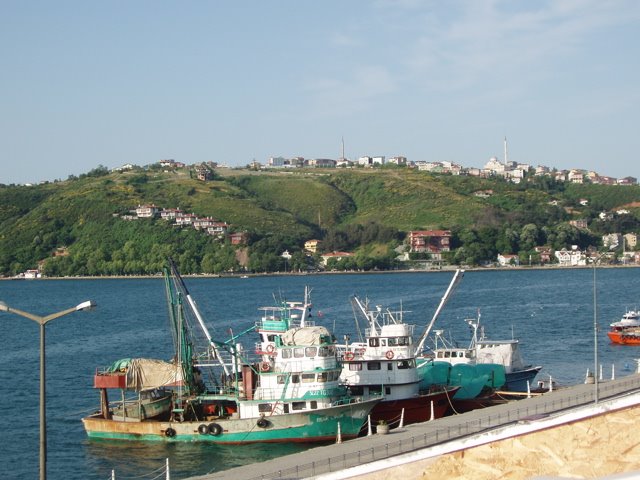
I love the way he describes the city: I could often picture the places where actions occurred, based on my visits to Istanbul. I especially remember watching the ships on the Bosphorous (above) and seeing the bridge where some of the action takes place (top of post).

Ben Cohen (March 18, 1951)


Along with Jerry Greenfield (birthday March 14), Ben Cohen founded Ben and Jerry's ice cream. It's now owned by some big corporation, but I always loved the ice cream and admired the spirit of fanciful names and ice cream loaded with goodies. Cherry Garcia was always one of my favorites. It's sad that they are no longer natural and organic, but the ice cream still tastes very good to me.

Friday, March 16, 2012

David Liss (March 16, 1966)

I'm a big fan of the historical mystery novels -- mainly with Jewish characters of themes -- of David Liss. I've read all the ones depicted at right.

I was reading historic accounts of the Jewish communities of Amsterdam (in The Coffee Trader) and London (A Conspiracy of Paper) in the 17th and 18th century before he started to publish. I was delighted by his vivid characters, who considerably increased my ability to picture life in those times and places. His plots are good, and I especially appreciate his success at depicting the invention of stock markets and other economic innovations that were going on at the time, as well as of the conditions of life for Jews in those eras.

I'm a little less fond of The Whiskey Rebels, about the Whiskey Rebellion shortly after the American Revolution and the founding of the Federal Reserve system.

Wednesday, March 14, 2012

Jerry Greenfield (March 14, 1951)

Along with Ben Cohen, Jerry Greenfield founded Ben and Jerry's ice cream. I have no idea of their Jewish identity or practice, but I did hear once that during the air raids in Tel Aviv in the first Iraq War, when people were truly terrified and much damage was done, if you were caught in a Ben and Jerry's your ice cream was free.

Sunday, March 11, 2012

Ezra Jack Keats (March 11, 1916)

Ezra Jack Keats was the author of “The Snowy Day,” a beautiful picture book about a little boy named Peter. This is considered the first children’s book to depict a black child as the main character without irony or making fun of him. I had always assumed that the author was himself black, but in fact, he was an eccentric Jewish illustrator. Some say that in 1962 when he wrote and illustrated the book it would not have been possible for a black author to have such a work published.

Keats's view of religion was interesting:
“When Keats did write about religion, he sought universality rather than Jewish specificity. In 1966 he illustrated a book called God Is in the Mountain, for which he created paintings to accompany a wide array of religious quotations from the Bhagavad-Gita and the Quran to Lao-tzu to Rabbi Hillel. ‘I am in every religion as a thread through a string of pearls,’ was one of his Hindu selections.

“Universality characterizes most of Keats’ work, a development some critics found problematic, most notably in his depiction of Peter, who became a recurring character for Keats. These critics felt that Peter had little African-American identity beyond the color of his skin. Keats’ response in 1965 in a letter to the editor of the Saturday Review addressing one critic: ‘Might I suggest armbands?’” *

Tuesday, February 28, 2012

Zero Mostel (February 28, 1915)

Zero Mostel is most famous for his Broadway portrayal of Tevye in "Fiddler on the Roof," which ran from September 22, 1964, until July 2, 1972. Otherwise not much about him is important to me. He wasn't in the movie, so I never saw him do it.

Monday, February 27, 2012

Michel de Montaigne (February 28, 1533)

Michel de Montaigne, the essayist and inventor of the essay form, lived his life as a French nobleman. And a fascinating life it was!

I loved the book How to Live or A Life of Montaigne in one question and twenty attempts at an answer by Sarah Bakewell. This book provides me with my main information about Montaigne. I had heard that his maternal ancestors were Jewish. People who are eager to know who was a Jew have ferreted through his works looking for evidence that he acknowledged this. They don't find much. For me, this means the topic should be dropped, but I find Bakewell's summary too interesting to leave it out of this blog. She writes:
"If his father's background was murky, a more significant secret apparently lurked in the family of his mother, Antoinette de Louppes de Villeneuve. Her ancestors were merchants; they were also immigrants from Spain, which, in the context of the time, strongly suggests that they were Jewish refugees, Like many others, they converted to Christianity under duress, and left following thee persecution of Jews on the peninsula in the late fifteenth century."

"Montaigne may not have realized that he was of Jewish origin, if indeed he was. He showed no more than mild interest in the subject, mentioning Jews only occasionally in the Essays, usually either neutrally or with sympathy, but never in a way that suggested he felt personally involved. ... "

"He also expressed a wry skepticism about the 'conversions' of some recent refugees -- reasonably enough, since the act was not done by choice. If, as some have speculated, this was meant as a subtle dig at his mother's family, it would not be surprising." (p. 43-44)


In my opinion, the efforts to demonstrate consciousness of his Jewish background (if he had one) are misplaced, and end up showing more about the person speculating than about this fascinating author. I think Bakewell's treatment of the question is level-headed, and I'll leave it at that.

Friday, February 24, 2012

Irene Nemirovsky (February 24,1903)

Irene Nemirovsky's book Suite Française became widely popular after its very delayed publication in around 2006. The story of the author's efforts to escape the Holocaust were both dramatic and depressing (well, all Holocaust stories are depressing). The New York Times review of the book is summarized thus:
"Born in Ukraine, Irène Némirovsky had lived in France since 1919 and had established herself in her adopted country's literary community, publishing nine novels and a biography of Chekhov. She composed "Suite Française" in the village of Issy-l'Evêque, where she, her husband and two young daughters had settled after fleeing Paris. On July 13, 1942, French policemen, enforcing the German race laws, arrested Némirovsky as "a stateless person of Jewish descent." She was transported to Auschwitz, where she died in the infirmary on Aug. 17." (See "As France Burned" by Paul Gray)
I read Suite Française during its period of popularity, and like the Times reviewer, was impressed by the insightful and compact nature of the stories, and agree that "a knowledge of its history heightens the wonder and awe of reading it."

Now one question: how do I feel about Nemirovsky's clear distaste for her fellow Russian Jews, a distaste that was much more expressed in her earlier books? I'm really quite uncomfortable about it, although I understand how it was a product of the times. I can't help thinking other Jewish authors were able to write with both artistic and material success about their experiences without such self-hatred, despite what was going on in France at the time. At the time I read the earlier book was only accessible in French, in the first edition from the 1920s, having been (perhaps justifiably) forgotten. Her savage depiction of greedy rich Jews was in my mind a bit shameful; what a waste of her capabilities. I believe it has been published in English since then, but I don't feel like exploring the topic further.

Monday, February 20, 2012

"A Nervous Splendor"

Frederic Morton's book A Nervous Splendor: Vienna 1888/1889 zeros in on a tiny time-slice of the history of Vienna. As the several other books I've read, this one confronts the rising antisemitism that was just beginning to dominate Viennese life, and contrasts it to the rising activity of Jewish intellectuals. The major focus of the book is the Imperial court, especially the suicide of Crown Prince Rudolf at his estate Meyerling at the end of January 1889. The frenzy of public mourning after his death, and the cover up of his relationship with the woman who jointly committed suicide with him are also presented within the context of Viennese life at the time.

Rudolf was an ineffective and extremely frustrated man without any power. His titles were meaningless, and his liberal political views inexpressible within the constraints of his life. Morton contrasts Rudolph's helplessness at age 30, and the futility of his liberalism, with the early lives of several men not far from his age: Sigmund Freud, Hugo Wolfe, Arthur Schnitzler, Gustav Mahler, Theodor Herzl, Anton Bruckner; and Karl Lueger, the antisemite. Also present, representing an older generation, Johannes Brahms and others. Morton also describes the lives of several lower-class (and never subsequently famous) families and individuals as they live through the last half of 1888 and the beginning of 1889.

I found most fascinating the author's description of how a number of individuals and families celebrated Christmas. Morton describes several of these events in detail. The well-off secular-Jewish families of Arthur Schnitzler and Theodor Herzl were decorating their Christmas trees. Not so the Freud family, who didn't participate in the holiday. Anton Bruckner played the organ for a monastic midnight mass outside of town. The poor family that figures throughout the book could afford to buy and decorate only a branch from a tree; they presented one another with second-hand goods for gifts. Gustav Klimt, Hugo Wolf, and others had conventional celebrations. Brahms enjoyed the praise of his latest work as published in the Neue Freie Presse, but kept to his usual schedule of lunch in his habitual restaurant followed by a nap at his cafe. Through these descriptions Morton clarifies the way these people viewed Christianity and its role in their lives. (p. 181-184)

As I read, I felt that every event and detail assumed a broader significance, to portend what would come after. However, Morton refuses to speculate -- as many did then and have done since -- as to how Rudolf might have altered later history had he survived and found a way to implement his liberal views. For one thing, his father, the Emperor, lived and ruled until World War I was almost over, so it's far from clear that Rudolf's pessimism about his future was unfounded.

And the last paragraph of the book reads:
"On Saturday, April 20, the day before Easter, at 4 P.M., Mozart's 'Te Deum' was sung in the court Chapel, a few yards from Rudolf's old apartment. Professor Anton Bruckner drew great chords and holy harmonies from the organ to celebrate the Resurrection. While the master's august music rose among the vaultings, a different sound was heard in Bruckner's native Upper Austria at Braunau. It was the thin cry of a baby born that afternoon. The parents were Alois and Klara Hitler. They named their little one Adolph." (p. 317)
Did Hitler's thought have roots in the Viennese currents of ideas that were swirling through the lives and times that Morton described? He definitely made a case for such roots.

Friday, February 17, 2012

Adele Bloch-Bauer

Yesterday I mentioned Adele Bloch-Bauer, whose portrait by Gustav Klimt became even more famous in 2005 when her niece recovered it from the Austrians. (They had stolen it in 1938, and successfully refused to return it for the ensuing decades.) The Bloch-Bauer family were wealthy; her father was in banking and railroads and her husband was in manufacturing. Adele had a salon in Vienna.

One thing about the Viennese intelligentsia: they were close-knit group and mixed practitioners and theorists from many disciplines. Adele's salon is an example of this interaction among the arts and political life in Vienna:
"Among the prominent guests in her salon were the composers Gustav Mahler (1860–1911) and Richard Strauss (1864–1949), Alma Mahler-Werfel (1879–1964), the authors Stefan Zweig (1881–1942) and Jakob Wassermann (1873–1934), artists from the circle of Gustav Klimt, actors from the Burgtheater, and after WWI, the Socialists Karl Renner (1870–1950) and Julius Tandler (1869–1936)." (See this article.)
Note: Klimt painted two portraits of Adele;
the earlier one accompanied my post yesterday,
and the second is above.

Thursday, February 16, 2012

Vienna and Antisemitism

In reading about Vienna in the 19th century, I've become aware of the simultaneous development of two groups emerging together. I meant to focus on the secular-Jewish intellectual class, which included some of the wealthy bankers as well as middle-class Jews. But it seems that you can't learn about this fascinating Jewish community without also being aware of a political, populist Austrian-German nationalism with a strong antisemitic bias as well as a bias against many of the non-German nationalities of the Austrian empire.

From the 1890s, anti-liberal leaders assumed a great deal of political power, especially the antisemite Karl Lueger who was elected mayor of Vienna in 1895, and despite the Emperor's efforts to block him from office, became mayor in 1897. Antisemitic theories and actions became widely accepted and influential. After World War I they grew predominant in both Austria and Germany as is very well known. Less well known: their origin in Austrian 19th century policies and politics and the interplay between the conservative and Jew-hating ideas with the earlier liberal thought, Jewish intellectual and commercial success, and conservative antisemitic thought.

One thing I find disturbing is that every Jewish success was spun into a negative stereotype by the antisemites of the time. Jews were blamed for success in owning and running banks (the antisemites founded their own alternative postal savings bank). Jews received opprobrium for being writers or for owning newspapers. Most hated was the liberal and influential Neue Freie Presse, founded in 1864, edited from 1908 to 1920 by Moriz Benedikt, and ultimately put out of business by the Nazis when they took over Vienna in 1938. The antisemites criticized Jewish doctors (who perhaps became doctors because not all professions were open to Jews). Jewish university students were attacked and expelled from fraternities and other organizations that had formerly permitted them; Jews had a hard time rising in academic professions and musical institutions.

Yet many Jews put aside their Jewish identity when they wrote poetry or stories, composed music or plays, conducted, developed philosophic or other academic theories, or patronized a variety of arts. They led a normal, secular life, attempting to work around the forces that excluded them, marginalized them, or attacked them.

Despite the danger of the stereotypes, I am going to mention a few of the famous members of the Viennese intellectual community in its great times, with an extremely brief summary of how antisemitism affected them. I'm not an expert, I'm just beginning to read about this.

Sigmund Freud grew up in the secular-Jewish middle class. His intellectual leadership in developing theories about the human mind is still acknowledged even if the details have been revised or rejected. In reading the chapter on Freud in Fin-De-Siecle Vienna: Politics and Culture by Carl E. Schorske, I learned how important to Freud was discrimination against Jews, both in terms of his career and his personal development.

Stefan Zweig was a widely-read and very popular author. His autobiography, The World of Yesterday, written when he was in flight from the Nazis and in despair about the loss of everything he had cherished, painted a fascinating nostalgic portrait of the atmosphere of Vienna before the Nazis. He put it in the best possible light, attempting to show, I think, that the Jewish writers and thinkers were able to overcome the forces that attacked them -- at least until the final disaster overtook them. Zweig's works seem to be undergoing a reevaluation: for a long time, he seemed dated, and now people are republishing and reading his novels and stories.

Theodor Herzl, a journalist for the
Neue Freie Presse, is now of course mainly known for the invention of political Zionism and his pursuit of support for his dream of a homeland for the Jews. While he was originally rather indifferent to his Jewish identity (according to a number of things I've read), the ascent of Lueger in Vienna and the Dreyfus case, which he covered as the Paris correspondent of the NFP, caused him to rethink what he'd believed. His realization was a fascinating development in the context of the freedom that Jews had thought they possessed. He was ahead of his time in recognizing the force of antisemitism in many parts of Europe. Interestingly, according to Zweig, his newspaper, which had a general following, did not allow him to publish anything about Zionism.

Gustav Mahler, composer and conductor, accepted conversion to Catholicism in 1897 perhaps as the price for advancement in his career as a conductor. In that year, he was appointed as Kappelmeister in Vienna. His enemies continued to attack him, though I think it's fair to say that his music transcends all this.

Gustav Klimt, surely the most famous artist from pre-World War I Vienna, became a victim of antisemites without even being Jewish. According to Schorske, his dramatically original work was at first accepted, but soon became very controversial, and in a fight about murals to be installed at the university, he was the victim of a lot of vicious anti-modern sentiment, including being accused of siding with the Jews.

Klimt's two portraits of Adele Bloch-Bauer (who belonged to the Jewish community, which often patronized his art work) received a great deal of attention a few years ago when Adele's niece won a judgement that returned several paintings to her that had been among the ill-gotten gains from Jewish victims of the Holocaust.

The people I've named are only a few of the famous figures living in Vienna who made important contributions, including many others from the secular-Jewish community. For some, identity was very complex, as there had been intermarriages and conversions for several generations (but antisemites might not have cared) -- examples are Ludwig Wittgenstein and Hugo von Hoffmannsthal.

Lueger, when challenged for having Jewish friends, evidently said that it was up to him to decide who was Jewish. I'm not sure what exactly that meant. All I know is that Hitler thought he was fabulous.

Tuesday, February 14, 2012

Nightmares

Events in The Hare with Amber Eyes (which I started to discuss yesterday) eventually come to the Nazi takeover of Vienna in 1938 as experienced by the author's great grandparents and grandmother Elizabeth. De Waal explains how a long-employed family servant named Anna hid the collection of Netsuke (center of the story) a few at a time, so that these relatively insignificant items from the large and valuable stores of family possessions were the only ones rescued.

The Holocaust victims' shock of being deprived of all dignity and human rights is agonizing to read about no matter how many stories I've read before. Why had they not sent their money out of the country and fled before the inevitable happened? They were loyal and trusting citizens, up until then with equal rights despite the growing hatred of Jews. They were highly assimilated, Jewish but with a secular lifestyle. They saw themselves as real Austrians, and valued their position in Viennese society. However, the Viennese welcomed the Nazis with huge enthusiasm.

On a trip there, I once visited the home of Sigmund Freud, whose relatively modest apartment De Waal points out was very close to his family's palatial home in Vienna -- a video tape of the German victory parade was showing as a loop on a small TV set in Freud's one-time study, with the voice of his daughter Anna describing their shock at the frenzied anti-Jewish and pro-Nazi crowds. I thought of this as I read about the same parades, the same shock, the same sense of having been betrayed.

Elizabeth had earlier earned a doctorate in law from the University of Vienna, and with extreme bravery came to Vienna to help her parents to safety away from the Nazis. With her knowledge of the law, even in its eviscerated form, she was able to extricate her parents, who were desperately trying to escape. Her parents' first escape location was at a family vacation home in Czechoslovakia -- not safe enough. Her mother died at this once-happy refuge, but Elizabeth managed to get her father to England, where she and her husband and children were living, and where her son and grandson (the author) have spent their lives.

Later, after the war, Elizabeth tried to repossess some of the family's art collections and other property, but it was futile. The Austrians were successful in preventing Jews from returning or reclaiming what had been taken from them. I felt that the net result has this conclusion: the Holocaust was a great success. Where many Jews of all social classes and levels of accomplishment once lived peacefully in Vienna (and many other places of course), there are now virtually none, and those that survived had to start their lives over from zero.

The story is told in painful detail. Vivid and unbearable, the author makes you go through the suffering and desperate times with the family members and ask yourself for the millionth time, how did this happen?

The collection of Netsuke, small and resilient, made to be used as toggles for clothing, once used as playthings by the children of the family, survived better than many of the family members, and the post-war story is happier.

Monday, February 13, 2012

Vienna

The Hare with Amber Eyes by Edmund de Waal describes his exploration and discovery of his forbears, the vastly rich Ephrussi family. I am enjoying this best-selling book enormously, and using it to form my picture of secular-Jewish Paris before and during the Dreyfus affair and of secular-Jewish Vienna in the early 20th century, at least of certain high social strata of the cities.

The first prominent Ephrussi escaped his Shtetl origins and made a fortune by dealing grain in Odessa in the mid-19th century. Contemplating a financial and trading network, his descendants set up businesses and palatial homes in Paris and Vienna, where they lived in a world of wealth and culture.

A tiny carving of a rabbit (left) is one of several hundred Netsuke statuettes from Japan from the was acquired first by De Waal's Parisian art-collecting great-uncle, an art patron and friend of the Impressionists. By tracing the family members who later owned the Netsuke collection and the motives for its original acquisition, De Waal has created the fascinating story of these immensely wealthy members of a certain segment of Parisian Jews and Viennese Jews in the 19th and early 20th centuries.

Needless to say, the ending of the family's fortunes in 1938, when the Nazis marched into Vienna, looms over the story.

In addition, as I explore my topic of secular Jewish Vienna, I'm reading The World of Yesterday by Stefan Zweig. He begins with a fascinating portrait of late-19th century Vienna and its Jewish cultural atmosphere and numerous accomplished Jewish citizens, and continues with his life as an author and cultural observer. This autobiography, even more than De Waal's book, is dominated by the Nazi destruction of the world that he had known. Zweig wrote it during his last year, before he committed suicide in despair.

Thus I continue my travels in secular Jewish cities, and will write more about both Vienna and later Paris.

Monday, February 6, 2012

"Klezmer" by Joann Sfar

Joann Sfar's Klezmer is a graphic novel about some very unlucky and also rebellious Jews approximately 100 years ago. They wander around, hungry and cold, betrayed by friends or victimized by enemies until they come to where? ODESSA! When I picked up the book I had no idea this was their destiny. Here's Sfar's imaginary scene of the Odessa they see:


As the musicians catch sight of the city, Sfar draws a series of images with quotations from Isaac Babel's description, "Odessa is a horrible town. It's common knowledge that people there butcher the Russian language," he wrote. "And yet I feel that there are quite a few good things one can say about this important town, the most charming city of the Russian Empire. If you think about it, it is a town in which you can live free and easy. Half the population is made up of Jews... "

And here we see how Sfar imagines it. I also enjoyed his quotations from many Klezmer songs, as the musicians entertain first one another, and then begin to perform for audiences in little towns. I also liked the sort of philosophical aspects of the musicians' struggle with their own misfortunes and their lost faith, though sometimes Sfar is a little too clever about this.

Thursday, February 2, 2012

Norton Simon (February 2, 1907)

The Norton Simon Museum in Pasadena is one of my favorite museums anywhere. The gardens, interior spaces, and collections -- especially the Asian art and Impressionists -- are all splendid, and the size makes it very accessible. As I understand it, the collections very much reflect the taste and actions of the founder, Norton Simon and his wife Jennifer Jones (the actress).

Simon came from a West-Coast Jewish family. However, his Jewish background seems to have little or nothing to do with either his great success as a businessman or as an art collector. According to the museum website, "In 1929, at the start of the Great Depression, Norton Simon invested $7,000 in a floundering juice bottling company. He eventually turned his investment into the highly prosperous Hunt Foods, Inc. ... He built Norton Simon Inc., a multi-industry, multinational corporation that included Hunt-Wesson Foods, McCall’s Publishing, Saturday Review of Literature, Canada Dry Corporation, Max Factor cosmetics, and Avis Car Rental."

I place Norton Simon on my hero list because I really respect his accomplishment in developing the Norton Simon Museum. The museum website offers this quote, which I quite like:
"I am not essentially a religious person, but my feeling about a museum is that it can serve as a substitute for a house of worship. It is a place to respect man's creativity and to sense a continuity with the past. It is a place to give us a feeling of the dignity of man and to help us to strive towards our own creativity and fulfillment. - Norton Simon, 1974"

Tuesday, January 31, 2012

Food can be funny

Anything – even hunger -- can be funny in Ilya Ilf and Evgeny Petrov’s sprawling satire of early Soviet times, The Little Golden Calf. Bumbling bureaucrats, resource shortages, redistribution of possessions, and redefined relationships on all levels provided the two writers ample opportunities for broad humor. The novel is episodic: more or less centered around an informal group of con men and opportunistic thieves who take to the road in a car called the Antelope-Gnu. Published in 1936, and now somewhat culturally a bit alien, the novel is still full of really funny scenes.

Some chapters in The Little Golden Calf consist of sketches involving other people besides the road trippers -- people who are about to come in contact with the main group. One such diversion is titled “Vasisualy Lokhankin and His Role in the Russian Revolution” (The Little Golden Calf, transl. Fisher, p. 170 -177) It begins: “At exactly four-forty in the afternoon, Vasisualy Lokhankin went on a hunger strike.”

Vasisualy’s cause was simple: his wife Varvara had just told him she was leaving him with her lover, Pitburdukov. He says she can’t: “One person can’t leave another person if the other person loves her.” Varvara’s response: “She can too.” He vowed not to eat until she comes back, not “for a whole day. A week. A year. … I’ll lie here just like this, in my suspenders, until I die.”

She began to walk away: “I’m leaving. Farewell, Vaisisualy I’m leaving your booklet of bread vouchers on the table.” Now things are clearer even to a 21st century American: food was rationed, but he was going on a hunger strike. As she walked toward the door, he ripped up the booklet and shouted “Save me!” She began to take him seriously: “Don’t you dare keep on this hunger strike! … This is stupid Vaisisualy. This is rebellious individualism.”

He replied, “You don’t fully comprehend the meaning of individualism, or of the intelligentsia in general.” In response, she took off her hat “and quickly made an open-faced sandwich with eggplant caviar, muttering ‘crazed animal,’ ‘tyrant,’ and ‘private property owner’ all the while.”

She demanded that he eat the sandwich. He refused. “Taking advantage of the hunger-striker’s momentarily open mouth, Varvara deftly shoved the open-faced sandwich into the aperture between his little pharaonic beard and trim Moscow-style mustache.” He spits it out. “Eat, you good-for-nothing!... You intellectual!”

Wait a minute, 21st century reader. How did such political jargon get into a quarrel between a couple as they are splitting up? What’s really behind this? Lokhankin’s next gesture, while brushing the crumbs out of his beard, was to lie back down on the couch: “He really did not want to part with his wife. As well as a multitude of shortcomings, Varvara had two key advantages: a large white bosom and a job. Vasisualy himself had never worked anywhere. Work would have kept him from thinking about the significance of the Russian intelligentsia, a social group of which he considered himself a member. Thus Lohankin’s extensive ponderings all came back to the same pleasant and deeply personal theme: ‘Vasisualy Lokhankin and his significance,’ ‘Lokhankin and the tragedy of Russian liberalism,’ ‘Lokhankin and his role in the Russian Revolution.’”

Later that evening, Varvara’s lover Ptiburdukov arrived, determined to convince her to leave despite the hunger strike. She explained: “There he is! Just lying there! Animal! Vile private property owner! The thing is that this feudal landlord, this serf-owner, has gone on a hunger strike because I want to leave him.” She tried and again failed to force the now-stale eggplant-caviar sandwich on him: “Eat, you vile man. Eat, you serf-owner.”

The next morning, he said: “There, now the sharp pains in the stomach have started. … And then there’ll be scurvy caused by malnutrition, with loss of hair and teeth.” Wait a minute, modern reader! We are picking up a reference to the real results of real starvation; such starvation had been widespread during the growing pains of the Soviet system a few years before this publication.

Ptiburdukov’s brother, a doctor, was called in for a visit. His recommendation: “the patient didn’t need to adhere to any particular diet. He could eat everything. Soup, for example, or meatballs, or compote. He could also have bread, vegetables, and fruits. Fish was also a possibility. He could smoke, within reason, of course. He wouldn’t recommend that the patient start drinking, but it wouldn’t be a bad idea to introduce a shot of good port into his system... the doctor didn’t really understand the Lokhankins’ spiritual drama. Puffing up importantly and treading heavily in his boots, he left, declaring in parting that the patient was also not prohibited from bathing in the ocean or riding a bicycle.”

How do we read this? Surely we are being told that the doctor is not only not understanding the family drama, but also not understanding what foods would be available even if the “patient” were not on a hunger strike.

As time passed, the hunger strike continued. Varvara continued to stay in the apartment with her husband instead of running away. But one night she awakened from a bad dream about the doctor and discovered Vasisualy “standing in front of the open cupboard of the buffet, his back to the bed, chomping loudly. … Having ravaged an entire jar of preserves, he carefully took the lid off the pot, plunged his fingers into the cold borscht, and extracted a piece of meat from it. Even if Varvara had caught her husband at this game during the happiest days of their marriage, Vasisualy would’ve had a bad time of it. Now, however, his fate was sealed.”

She left him for good. “Lokhankin suffered openly and majestically. He luxuriated in his woe… His great sorrow gave him the chance to devote even more thought to the significance of the Russian intelligentsia, as well as to the tragedy of Russian liberalism.”

I wrote this for my food blog, but have posted it here as the final Odessa post.

Monday, January 30, 2012

Saul Alinsky (January 30, 1909)

In general, I'm not repeating the posts from last year, but Saul Alinsky is in the news again, thanks to Newt Gingrich, who refers to him often, claiming that he had a strong influence on Obama. See Gingrich’s Anti-Semitic Dog Whistle: Saul Alinsky in the Forward for an extreme interpretation of Gingrich's actions -- probably too extreme! Or the most recent Gail Collins column in the New York Times:
"Maybe, despite his blah debate performances in Florida, Newt will do well in this week’s primary, and go on to win the nomination, become president and build lots of moon colonies while saving America from Shariah law and the corrosive effects of the writing of Saul Alinsky."
As I wrote last year, Saul Alinsky was a founder of modern community organizing. He wrote several books on the subject, and was the head of an influential community organization in Chicago. The commitment to social justice that inspired many secular Jews in the past -- and still does, I would say -- is among my greatest criteria for choosing my heroes.

I consider it to their credit that Obama and Hillary Clinton were associated with Alinsky's group. The fact that extreme right wing nuts find that alarming just makes me like Alinsky (and Obama and Clinton) better. Hillary Clinton received a job offer from Alinsky in 1968 when she was in college; she turned it down, though she wrote her senior thesis about him. Obama worked for an offshoot of Alinsky's group; however, Alinsky had died by the time Obama arrived in Chicago.

Alinsky, according to Marian Wright Edelman, the Children's Defense Fund leader, "was brilliant. He was working for underdogs. He was trying to empower communities, which we still need to do. He spoke plainly. He had his outrageous side, but he also had his pragmatic side. Both Hillary and Barack reflect that understanding of community-organizing strategy. Both just know how to leverage power." (Quote from "For Clinton and Obama, a Common Ideological Touchstone," Washington Post, March 25, 2007.)

I don't ordinarily use Wikipedia, but I found it interesting regarding his view of his Jewish background. According to what I found there, Alinsky considered himself to be a devout Jew until the age of 12, after which time he began to fear that his parents would force him to become a rabbi. "I went through some pretty rapid withdrawal symptoms and kicked the habit. . . . But I'll tell you one thing about religious identity," he added. "Whenever anyone asks me my religion, I always say—and always will say—Jewish."

Saturday, January 28, 2012

Odessa Wrap Up

Exactly a century ago, in 1912 Leon Trotsky was living in Vienna publishing a paper called Pravda – his Pravda folded in April, 1912; for Trotsky it was a year of rivalry with Lenin and the Bolsheviks. Trotsky, born Lev Davidovich Bronshtein, lived in Odessa during his school years, from age 9 until around 16; in his autobiography he describes how the cultural atmosphere affected him, such as inspiring him to become a fan of Italian opera. In 1896, Trotsky committed to work towards revolution; by 1898 he was sent to Siberia. Several historians find Trotsky's Jewish-Odessa background relevant to his later life. Having surveyed several other famous Odessans, I thought I should mention him, the most revolutionary of the nonconformists from there.

Evidently, 1912 was an interesting year in Odessa. In Tales of Old Odessa by Roshanna Sylvester, events and conditions in 1912 often features in her narrative. Here are a few examples:

"I.P. fon-Kliugel'gen, head of the local investigative police squad, declared in 1912 that more than thirty thousand 'suspicious characters' lurked in Odessa. While 'shady types' could be found 'in every quarter of the city,' the chief inspector continued, they lived 'primarily in Moldavanka,' where on some blocks 'ever single resident is a criminal.' Moldavanka -- if even a tiny fraction of the stories were true it was unsavory terrain, a quarter filled with dark alleys, filthy streets, crumbling buildings, and violence." (p. 48)

"Old Free Port was one of Odessa's most important avenues, having until the mid-nineteenth century marked the edge of the city limits. In 1912, Old Free Port was the site of 'a mass of charities and other civic establishments that follow each other endlessly around it.' ... the Sretenskii Philanthropic Society.., the city almshouse, the foundling home, the Massovskii night shelter, more than a dozen schools, the civic auditorium, a children's clinic and other such establishments." (p. 50)

"In his 1913 guide to the city, Grigorii Moskvich wrote that the dream of the'essential Odessan' was to strike it rich and immediately acquire a house, a carriage, and eveything else he needed in order to 'transform himself (by appearance, of course) into an impeccable British gentleman or blue-blooded Viennese aristocrat." (p. 106)

"... in the fall of 1912 ... Odessans were treated to an unusual entertainment event involving fifty-five 'Somalians' who arrived in town for a month-long engagement at the club Oginski. Even though Odessans were used to a great deal of diversity in their cosmopolitan city, the presence of the Somalians added to the mix an element of racial difference to which they wre less accustomed." (p. 126)

All the examples play up the wide social variety in the city, including character of the many neighborhoods, inner-city and suburbs; the contrast between those who saw themselves as intellectuals or as westernized Europeans and those who were still Russian; differences between the rich and the poor, and variance between the honest and the criminal. The short era between the 1905 violence and the drastic end of Tsarist times was a fascinating one in the city.

The books I read about Odessa continue the story through World War I, the Russian Revolution, the early Soviet era, and World War II. The large and assimilated Jewish community continued to be productive until the Nazi takeover during the war. The Nazis put the Romanians in charge of the city and in charge of the liquidation of the Jewish community, which was done quite efficiently, as documented in Charles King's book Odessa: Genius and Death in a City of Dreams.

As for my reading project, I enjoyed the rewards of reading the historic background before trying to read the famous works of fiction by Odessa authors Babel, Jabotinsky, Ilf, and Petrov. I also feel as if I received some new insights into a sort of experiment in old Russia – what would shtetl Jews have done differently if given more freedom within their native land? The answer is they responded pretty much the way they did when they immigrated to other places, especially to the US. It’s pretty clear that the old regime in Russia didn’t have the potential to sustain a free society within its severe limitations. And I really don’t understand all the things that happened in Russia later. However, I liked my exploration of the Odessa community a century ago and the writers that emerged from it.