Thursday, December 8, 2016

Simon Dubnow (died December 8, 1941)

Simon Dubnow -- from Britannica.com
In Ha'aretz today: a brief biography of Simon Dubnow.

Dubnow was the author of A World History of the Jewish People, a pioneering book, which was published between 1925 and 1929. Born in 1860 in what is now Belarus, Dubnow acquired a secular/Russian education. He resided at various times in St. Petersburg, Odessa, Berlin, and Riga, depending on where he could have the freedom to live and write.

From the article -- "This Day in Jewish History 1941: Nazis Murder a Great Historian in the Street" -- a few paragraphs:
"After the post-1881 crackdown on Jews in the empire, ... Dubnow began to educate himself, reading widely in philosophy and economics. While still young, he realized he did not believe in God, though later as a historian, he would recognize religion's role in preserving Jewish identity. Only in 1887, however, did he decide to focus on Jewish history. ... 
"The Russian Revolutions of 1905 and 1917 initially gave him optimism that Jews could be accepted into society, but ongoing anti-Semitism made him consider a solution other than integration. Though sympathetic to Zionism – a “beautiful messianic dream,” he called it – Dubnow was sure that large numbers of Jews would never agree to move to Palestine. Neither did he believe that salvation would come via either socialism or assimilation. .... 
Dubnow... was murdered ... either by a Latvian guard or a Gestapo officer who, according to one version, was a former student of his. The legend says that the great historian, just before his death, turned to other Jews surrounding him and implored them: 'If you survive, never forget what is happening here, give evidence, write and rewrite, keep alive each word and each gesture, each cry and each tear!'"

Tuesday, December 6, 2016

Are We White?

The Atlantic online is running two articles by Emma Green:
Both are full of excellent observations of modern society, the particular situation of Jews at this moment of increased antisemitism, and historical material. The author explores just where American Jews have stood as a particular type of minority and how they have progressed from a truly marginal status to a much more mainstream position where Jews hold power -- power that's usually reserved for "white" people. From Are Jews White:
Over time, though, they assimilated. Just like other white people, they fled to the suburbs. They took advantage of educational opportunities like the G.I. bill. They became middle class. “They thought they were becoming white,” said Lewis Gordon, a professor of philosophy at the University of Connecticut. “Many of them stopped speaking Yiddish. Many of them stopped going to synagogue. Many of them stopped wearing the accoutrements of Jewishness.”
Jews think about questions of race in their own lives with incredible diversity. There are many different kinds of Jews: Orthodox, secular, Reform; Jews by birth, Jews by choice, Jews by conversion. Some Jews who aren’t particularly religious may identify as white, but others may feel that their Jewishness is specifically linked to their ethnic inheritance. “If you’re a secular Jew, how are you a Jew? It has to be through your cultural or ethnic identity,” said Gordon. “Whereas if you’re a religious Jew, you would argue that you’re a Jew primarily through your religious practices.” As Jews assimilated into American culture, “ironically, investment in religiosity paved the way for greater white identification of many Jews,” he said, allowing more religiously observant Jews to think of themselves as white, rather than ethnically Jewish.
Both articles are worth reading, and I can't begin to summarize their many insights.


We Live in a Dystopia

A fictional dystopia is a frightening place. Some authors or script-writers have depicted dystopian societies with little or no government -- thus, chaos or control by opportunists or thugs. Other authors envision totalitarian nightmares. Leaders with evocative personalities are often part of these chilling environments. Strange technologies may disrupt normal behavior of the residents; some dystopian fiction is outright sci-fi. Lies supplant truth in many dystopias, and challenge the equilibrium of the characters. Imagined dystopian life often includes an abnormal or overwhelming setting, with too much to look at and nothing to make sense of.

Recently, American life that I see in the newspapers -- and I mean the mainstream press -- is all too much like a fictional dystopia. Here are some examples.

The Ghost Ship

A room in the Ghost Ship: "The Oakland warehouse and
art collective was full of collectibles, instruments and
art projects that had been amassed over its existence
from across the world." -- Rolling Stone.
We learned Sunday of a dreamscape of antique and junk furniture, exotic ethnic artworks, new artworks in progress, artists and musicians creating visionary projects including concerts. The labyrinthine network of artist studios and performance spaces in a former warehouse in Oakland, California, was called "The Ghost Ship." A strange and troubling man was the impresario and creator, and collected money from the residents and concert-goers.

It must have been beautiful. Rolling Stone reports: "Artists lived in the warehouse and built lofts that existed between the first and second floors. Partitions between the lofts were made of pallets, two-by-fours and other types of wood while all the floors were covered in carpet." (source)

But people knew there were problems, according to CNN:
"On November 13, the city received complaints of blight and unpermitted interior construction at the building and sent an investigator to the property on November 17. The inspector verified the blight complaint but could not gain access to the building to confirm the unpermitted construction complaint, leaving the investigation open, the city said.... 
"Most of the time it served as a "live-work" warehouse: part commune, part artists collective. Photos posted online show a space with a ceiling resembling a ship's hull, covered wall to wall with furniture, instruments and tools of the artists' trades." (source)
Until Saturday night, no one seemed to take seriously that all the beautiful artistic atmosphere was accompanied by makeshift construction, rickety stairways, lack of exits, open-flame propane heaters, illegal dwelling places, flammable collections, etc. Residents were afraid to complain, for fear the dream would end with eviction from the illegal space.

Yes, it ended. Headlines for the last two days have described how the Ghost Ship, hosting a concert on the nearly inaccessible second floor, became an inferno. Over 35 people died a terrible death. Utopia became dystopia in seconds.

Attack on a Pizza Parlor

A pleasant neighborhood restaurant in Washington D.C. inexplicably was chosen by bizarre conspiracy theorists as the site where criminal activity was alleged without any. Utterly unfounded accusations included tales of secret tunnels underneath the restaurant's dining room, and fantasies that Hillary Clinton and her associates tortured children there.

Sunday, a self-appointed "investigator" showed up at the D.C. restaurant threatening people with an assault rifle and other weapons, shooting a hole in the ceiling. Somehow the patrons and employees -- all of course completely innocent of the ridiculous fabrications -- escaped being shot, but there was a really horrifying scene while the intruder was being pacified. This violent act "quickly became a symbol of the powerful and dangerous potential impact of rumors and conspiracy theories have taken on during a volatile election." Other businesses were also targeted by the fabulists -- "Business owners initially tried to ignore the false claims, but in recent weeks have been frightened by harassment and violent threats." (source)

"That an insane online conspiracy theory brought violence to a neighborhood business five miles from the White House is mind-boggling. Even worse is that similar fake stories involving Mrs. Clinton and pedophilia have been promoted by Lt. Gen. Michael Flynn, President-elect Trump’s choice for national security adviser." (source)

Again, for totally different reasons, a delightful place where families gathered for pizza, ping-pong, and neighborhood get-togethers turned from utopia to dystopia.

Politics -- our dystopian direction

Our politicians have abdicated a commitment to truth as we used to know it. "Post-truth" is even the word of the year chosen by the Oxford English Dictionary. Margaret Sullivan in the Washington Post wrote a column titled "The post-truth world of the Trump administration is scarier than you think." She warns:
"It’s time to dust off your old copy of '1984' by George Orwell and recall this passage: 'The Ministry of Peace concerns itself with war, the Ministry of Truth with lies, the Ministry of Love with torture and the Ministry of Plenty with starvation. These contradictions are not accidental, nor do they result from ordinary hypocrisy: they are deliberate exercises in doublethink.' 
"And be vigilant."
An interview in Vox about the "post-truth" environment puts it this way, beginning with a quote: "'Besides, as the vilest Writer has his Readers, so the greatest Liar has his Believers; and it often happens, that if a Lie be believ’d only for an Hour, it has done its Work, and there is no farther occasion for it. Falsehood flies, and the Truth comes limping after it.' -- Jonathan Swift... As the Swift quote suggests, lies travel faster than truths, which makes the internet a reservoir of misinformation. Because anyone anywhere can propagate a lie at practically no cost or risk, there is really no containing the amount of bullshit percolating online."

Numerous recent articles have summarized the "post-truth" era not only in politics, but also in science, with a reading public eager to be misled about issues of nutrition, vaccines, climate change, and many more areas. Dystopian, yes, but I have no time to expand on this aspect of the situation.

In brief, here are a few more dystopian features of our political situation:
  • Pretending to attack "political correctness" provides an excuse for speech and behavior that used to be held unacceptable.
  • Police are not held accountable when they shoot innocent people, especially innocent Black people. Acquittal of police officers who have killed seems to be a daily news article. Living in an atmosphere where one can be shot at any time obviously puts Black people in a much worse dystopia than whites.
  • A majority of votes does not determine which candidates for office become our elected officials. Most obviously, the losing candidate for President received approximately 2.5 million more votes than the elected candidate, but statewide elections also return large majorities of State and National Representatives of the opposite party to that which received the popular vote, thanks to gerrymandering and other electoral frauds. The certainty of being elected without popular support has enabled totalitarian behavior among many state officials, and appears to be about to enable such behavior nationally as well.

Racism and Antisemitism

Cartoon from L.A.Times
Racist attacks and racially-motivated violence have increased throughout our society, especially in schools. Racism has become "normal" thanks to campaign talk of locking up and/or deporting individuals with specified religions or national origins, another dystopian element of the current political atmosphere.

"Xenophobia" is the word of the year at dictionary.com -- which cited "anti-immigrant rhetoric of U.S. President-elect Donald Trump and the United Kingdom's Brexit vote to leave the European Union as reasons for its choice." (source)

Overt antisemitic statements and gestures have become almost routine, up to and including Nazi salutes. The antisemitic participants in the incoming administration represent a very pressing concern in the areas I've been covering in this blog, which is why I'm writing here.

From the New York Times: "a brick thrown through the window of a Muslim-owned restaurant in Kansas, apartments of Muslim families in Virginia hit with eggs and graffiti, swastikas scrawled on synagogues and in a playground in New York." (source)

From the Southern Poverty Law Center: "In the ten days following the election, there were almost 900 reports of harassment and intimidation from across the nation. Many harassers invoked Trump’s name during assaults, making it clear that the outbreak of hate stemmed in large part from his electoral success." (source)

From Ha'aretz: "The New York Police Department said it has seen a dramatic rise in hate crimes following the election of Donald Trump, with the majority of incidents directed at Jews." (source)

From the L.A.Times: "'The truth is, the alt-right is a new buzzword that made it appear as if these white supremacists have something different to offer,' said Oren Segal, director of the Anti-Defamation League’s Center on Extremism. 'The name is an alternative to "white supremacy." They just want to make it more acceptable, digestible to white people.' Segal added, 'There’s nothing new there.'" (source)

Social Media

The use or misuse of social media (Facebook, Reddit, Twitter, Snapchat...) is held responsible for much of the enabling and inspiring of thuggish elements in our society -- such as the man with the gun in the neighborhood restaurant. In totalitarian nightmare societies of the past plenty of low-tech capabilities allowed this type of destruction of the social contract. Information control by totalitarians is also a frequent element in fictional dystopias.

Author Kenan Malik writes of the new life of lies:
"Lies masquerading as news are as old as news itself. ... In the past, governments, mainstream institutions and newspapers manipulated news and information. Today, anyone with a Facebook account can do it. Instead of the carefully organized fake news of old, there is now an anarchic outflow of lies. What has changed is not that news is faked, but that the old gatekeepers of news have lost their power. Just as elite institutions have lost their grip over the electorate, so their ability to define what is and is not news has also eroded." (source)

Friday, December 2, 2016

"It Can't Happen Here" by Sinclair Lewis

Suddenly last month, Sinclair Lewis's eighty-year-old book It Can't Happen Here became a best seller. I don't know how many of the numerous recent purchasers have finished reading it, but I managed to read the whole thing. It's very depressing, and without giving away the ending, I think I can say it has no brighter side.

Bust of Sinclair Lewis
by Jo Davidson,
National Portrait Gallery,
Washington, D.C.
Paul Krugman says:
"So how bad will the effects of Trump-era corruption be? The best guess is, worse than you can possibly imagine." (Why Corruption Matters)
This could easily be the theme of Lewis's book, which of course did not turn out to be prophetic of his own time. He starts with an imaginary scenario of the American election of 1936, which was the immediate future when he wrote. His scenario takes full account of the current situation in Germany at the time, of America's fragile situation in the Depression, and of America's potential to mirror the escalating Nazi horror show.

It Can't Happen Here projects the election of fictitious candidates in 1936 and the aftermath of this election until around 1940. The candidate, a charismatic demagogue with an even more sinister collaborator, promises prosperity to the masses. He also promises persecution and maltreatment of hated minorities such as Jews and blacks, superpatriotism, glorious conquest of other countries, suspension of civil rights and other rights, and cancellation of democracy by removing the powers of Congress and other means. The candidate is elected by the masses of (white) people, many motivated by his promise to give each of them (the white people only) $5000, which was a lot of money in 1936.

Immediately upon taking office, the new President suspends all democracy by empowering the thugs and rabble as "Minute Men," arming them, and allowing them to terrorize the population. Soon the Minute Men are everywhere, often killing people without consequences. Concentration camps are set up for anyone who objects or belongs to an unwanted race, political party, or ethnic group. The novel is full of vivid descriptions of how this happens, while all along people say "It can't happen here," or more frequently, "It can't be happening here."

The events are seen through the life of one Vermont newspaper owner, Doremus Jessup. Lewis, already a Nobel Prize Winner when he wrote the book, was a fantastic portrayer of ordinary people and had an incredible way of showing how a specific individuals were typical. In reading, one can't help realizing how his characters in one small Vermont town still share so many features of today's Americans 80 years later.

The Jessup family's struggle -- and that of their friends and neighbors -- illustrates the impact of the disaster of totalitarianism and the way that people can be manipulated through their own prejudices and weaknesses. As I said: depressing. I'm sure many others will be or have been writing about this all-too-frightening characterization of American vulnerability and its results. And how much the people can still embrace hatred as an American value. I had chosen some apt quotations from Lewis, but I don't feel as if I need them to recommend this book -- if you want to be horrified, or maybe surprised that maybe we relied on our better nature for so long.

Sunday, November 27, 2016

Vera Weizmann (November 27, 1881)

The living room of the home of Vera and Chaim Weizmann on the campus of the Weizmann Institute, Rehovot, Israel.
In 2006, I toured this home, designed by architect Eric Mendelsohn with a large input from Vera Weizmann.


Vera Weizmann ( November 27, 1881 – September 24, 1966), neè Chatzman, was born in Rostov northeast of Moscow. She was raised in a surprisingly secular way, as she went to elite non-Jewish schools and was not taught either Hebrew or Yiddish. Her father had been a military officer, and was allowed to live in an area not normally open to Jews and allowed to educate his daughters in this unusual way.

Vera Weizmann studied medicine in Geneva, Switzerland, when women were rarely allowed to do so. During this time, she became a member of Jewish student organizations, where she met Chaim Weizmann.  (Chaim Weizmann's entry in this blog is here.) They married in 1906, and soon moved to Manchester, England, where she began her medical career:
"In 1913 she successfully passed the British medical certification examination, after having studied medicine for two years in Manchester in addition to her studies in Geneva. Vera Weizmann received a temporary posting as a physician in the Manchester slums, where she was in charge of seven clinics for pregnant women and infants to the age of one year. She was later awarded a permanent appointment as a physician in a public clinic for pregnant women. As one of the first women to be employed as a physician in Manchester during this period, her work consisted primarily of developing advanced methods for monitoring infant nutrition and weight." (source)
Both Chaim Weizmann and Vera Weizmann were leaders of Zionism throughout their lives. His role in Zionism is very well-known; she participated in the founding of the Women's International Zionist Organization (WIZO) and served as its president over many years.Though they lived in England most of the time until after World War II, they played an important role in founding the Hebrew University and the Seiff Institute in Rehovot which became the Weizmann Institute. During the Israeli war of Independence, Vera treated injured soldiers, later founded medical centers for wounded veterans' rehabilitation, and was active in many volunteer organizations.
"After her husband’s death in 1952, Vera Weizmann devoted even more of her time and energy to social work on behalf of Youth Aliyah, the rehabilitation of those disabled in the war and the Magen David Adom organization, serving as its president. In 1954 she conducted a fund-raising campaign in South America for Israel Bonds and the Weizmann Institute. After visiting Argentina, Chile and Brazil, she went with her secretary to Russia, which she had left forty years earlier. She was also very active in arranging the Weizmann archives." (source)

The tomb of Vera and Chaim Weizmann, near their house in Rehovot.

Monday, November 21, 2016

"One Night, Markovitch"

I cannot remember how I heard of the recent Israeli novel One Night, Markovitch by Ayelet Gundar-Goshen. I bought it in September, and just finished reading it this weekend. If you want a complete review, I suggest this one from the Telegraph. I agree with the final statement of this review:
One Night, Markovitch,
published January, 2015.
"This is a fable for the 21st century, and Gundar-Goshen a writer whose dexterity proclaims her one to watch."
Two things make this book seem like a fable to me. One is the simple way the characters are presented and described, as if they were not entirely real. The other is the way they are both generalized and also particular: as if the reader is somehow expected to find each one to be a type of person, a type of pre-state Israeli, not just an individual. I was never sure how to map each character onto a such a type, but it seemed plausible.

Sometimes as I read I felt as if I were reading not just a fable but a ghost story: the ghosts of the Israeli past, the ghosts of the idealism and heroism that are attributed to the original fighters, villagers, farmers, and leaders. Each character's traits, passions, and actions seem exaggerated in order to illustrate the challenges of life in Israel during this critical era.

Another review of the book  in the Guardian viewed the novel in quite a different way than I do: "Ayelet Gundar-Goshen’s lush first novel ... seems to take inspiration from the magical-realist traditions of Gabriel García Márquez and Isabel Allende. ... Eternal themes of love and longing, sex and marriage take priority."

One Night, Markovitch is an interesting book whether one reads it as historical fiction, a fable about Israeli history, a magical-realist story of eternal themes, or a bit of all three.

Sunday, November 20, 2016

Pnina Grynszpan-Frymer (1922-2016)

From today's Ha'aretz: the obituary of Pnina Grynszpan-Frymer, among the last survivors of the Warsaw Ghetto struggle against the Nazis. When the war ended, and she discovered that her entire family had been murdered in the Holocaust, she came to Israel and lived on a kibbutz and in Tel Aviv, where she married and raised a family. 

Pnina Grynszpan-Frymer
from Ha'aretz
From the obituary:
"Grynszpan-Frymer was born in 1922 in the town of Nowy Dwór Mazowiecki near Warsaw. When World War II broke out in 1939 with Germany's invasion of Poland, she joined Eyal, the Jewish Fighting Organization, also widely known by its Polish initials, ŻOB. 
"She fought the Germans in the 1943 Warsaw Ghetto Uprising, fled the burning ruins through the sewage tunnels and joined the partisans in the forests. A year later she returned to Warsaw, where she was hidden by Poles and took part in the 1944 Warsaw Uprising." (link)
When I read about freedom fighters and resistants, I'm always struck by their subsequent lives -- if they survived, of course. They almost always returned to a much less exciting, much more "normal" and usually middle-class life, and when I think about it, I realize that this was what these heros were fighting for.

Monday, November 14, 2016

Fritz Stern

Fritz Stern, from the NYT Obituary.
Fritz Stern (1926-2016) was a historian of German culture and a professor of history at Columbia University. He served as provost of Columbia from 1980 to 1983. His interest in the deep roots of Nazi culture have more resonance now than I would like to think about. He wrote: "I was born into a world on the cusp of avoidable disaster.... The fragility of freedom is the simplest and deepest lesson of my life and work."

The decline of German cultural leadership, according to Stern, dated to 1914, when German intellectuals signed the "Manifesto of the 93" declaring loyalty to the German war effort. Stern wrote:
"Most of these men had once cherished German scholarship and had admired a country that in so many ways had been full of promise, with its astounding creativity in the sciences and its legacy of music and the arts. In truth, Germany had been a country of thinkers and poets. But the old bonds snapped in October 1914, when ninety-three of Germany's leading artists, scholars, and scientists signed the Manifesto of the 93, defiantly addressed 'to the Kulturwelt,' proclaiming German innocence, insisting on the absolute identity of German culture and German militarism, defending Germany's invasion of Belgium, and denying all allegations of atrocities." (Einstein's German World, p. 210)
From Stern's obituary in the New York Times, May 18, 2016:
"Like many German historians of his generation, Professor Stern sought to explain the causes behind the events that upended his own life and that of his family, Jews who lived a prosperous, assimilated life in Breslau until oppressive conditions forced them to emigrate to the United States in 1938.

"'Though I lived in National Socialist Germany for only five years, that brief period saddled me with the burning question that I have spent my professional life trying to answer: Why and how did the universal potential for evil become an actuality in Germany?' he wrote in the introduction to 'Five Germanys I Have Known,' a blend of memoir and history published in 2006."
I've recently been reading Stern's book Einstein's German World (1999), where he describes the lives of several important scientists and others who were Einstein's acquaintances. He knew several of them personally, as his father, a physician, was their friend and in some cases their doctor. He points out that by the time he was writing, few people still had direct memories of the time and of the people in his book, which makes it all the more interesting.

I've enjoyed my reading so far, and I hope to read other books by Stern.

Saturday, November 12, 2016

Fritz Haber

Fritz Haber, 1919. From Wikipedia.
Fritz Haber (1868-1934) is in my view, an antihero; I have not classified many of my subjects in this blog in this way. Haber was an important scientist in pre-World-War-I Germany. An enthusiastic patriot, he invented an important industrial process for manufacturing ammonia, which had many uses. It was needed for fertilizer that Germany needed to be more self-sufficient in food production, as well as for explosives.

In my own view, I mainly remember him for his development of poison gas that was used on the battlefields of World War I under his direction. He's thus known as the "father of chemical warfare." Historian Fritz Stern in Einstein's German World, described Haber's participation in World War I as follows:
"During and after the war, Haber tried to explain his work in developing a weapon that outraged many people -- in Germany, but especially abroad. The Hague Conventions of 1899 and 1907 had prohibited the use of poisoned weapons. Haber believed that the use of gas would bring the war to a quick conclusion; he argued that the gas, which immobilized but usually did not kill, was a more humane weapon than the artillery bombardments that had become routine; he pointed out that the Allies had their own plans for introducing gas warfare, and Germany had merely anticipated them. It would appear that neither Haber nor those closest to him, like Willstätter, worried about the legal and moral issues involved, such was the brutish atmosphere of war. Gas warfare did not prove decisive, though its horror -- the terrifying choking, the blinding, the deaths, the experience even for survivors of a living death -- has become an inextinguishable part of our collective memory, an early instance of science put to satanic service. (p. 120)
The industrial work continued after World War I. Haber was head of the prestigious Kaiser Wilhelm Institute for Physical Chemistry and Electrochemistry. Although the Nazis would have at least temporarily allowed him to stay in his position despite being Jewish (though a convert to Christianity like many ambitious German scientists), he resigned when it became obvious that he would be required to fire all his Jewish subordinates. He left Germany, but died soon afterwards.

There's much more to say about Haber, his life, and his work. I only mention that one of his commercially-produced types of poison gas was Zyklon B, used in the gas chambers.

Friday, November 11, 2016

It Just Happened Here?

Thinking about books that remind me of our time. When I googled these titles, several of them have already appeared in headlines this week:
  • Sinclair Lewis, It Can't Happen Here, 1935. A hypothetical takeover of America by fascists. Update: it's currently a best-seller at amazon.com.
  • Philip Roth, The Plot Against America, 2004. A counter factual history of the era of FDR.
  • Eugène Ionesco, Rhinoceros, 1959. Allegory of fascism as people of a town each become a rhinoceros.
  • Bram Stoker, Dracula, 1897. Original book can be read as allegorical as people become vampires. (Some films don't really have an allegorical side.)
  • H.P.Lovecraft, stories about the takeover of human minds by dark forces. He feared Jews and minorities, and his horrors feature this fear. I blogged about it here: Embracing Lord Cthulhu
  • Walter Wanger, producer: "Invasion of the Body Snatchers," 1956. Allegory of fascism.

Update: Scene from "Invasion of the Body Snatchers."

Thursday, November 10, 2016

Erich Mendelsohn

Erich Mendelsohn (March 21, 1887 – September 15, 1953) was a well-known architect whose severe modern style was typical of the German Expressionist movement as well as functionalism. He designed a number of very famous buildings in Germany in the early decades of the twentieth century. Fearing for his future because he was Jewish, Mendelsohn fled from Germany in 1933.

Mendelsohn was a leader in the Modernist school, which included Le Corbusier, Mies van der Rohe, and Walter Gropius. His early works were designed and built in Germany. After leaving Germany, he also designed pre-war buildings in Jerusalem and for the Weizmann House and the campus of the Weizmann Institute in Rehovoth, Israel. After 1940, he designed several synagogues and other buildings in the US, including a synagogue very close to where I grew up in University City, Missouri. When I was young, I knew the building was unusual, but I was unaware of the fame of its architect.

Photos of the few buildings by Mendelsohn that I've seen:

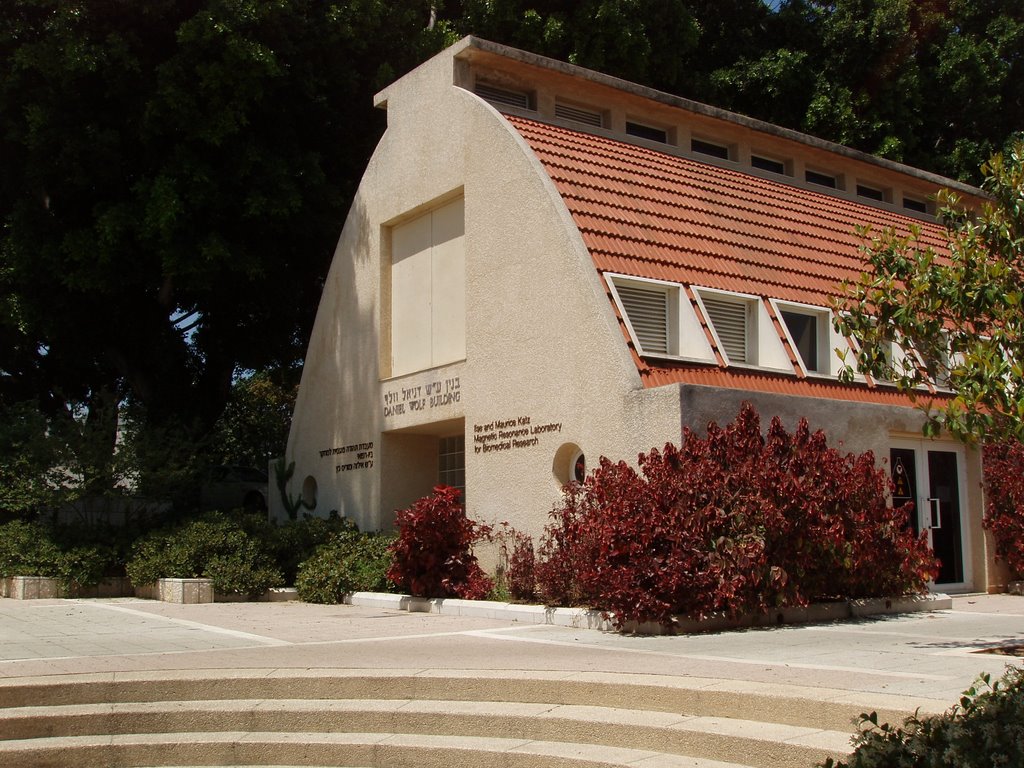
Mendelsohn building on the campus of the Weizmann Institute.
We visited there and took the photos in 2006, soon after a major
restoration of the building.
Weizmann building.
Weizmann House, Rehovot, Israel, visited 2006.
Erich Mendelsohn designed the Weizmann house near the Rehovot campus in the late 1930s, working closely with Vera Wiezmann, wife of the famous Zionist leader and founder of Israel, Chaim Weizmann. It was very unusual for an Israeli house: a trivial example -- the GE refrigerator still in the kitchen is said to have been the first refrigerator in Israel!

Kitchen of the Weizmann house.
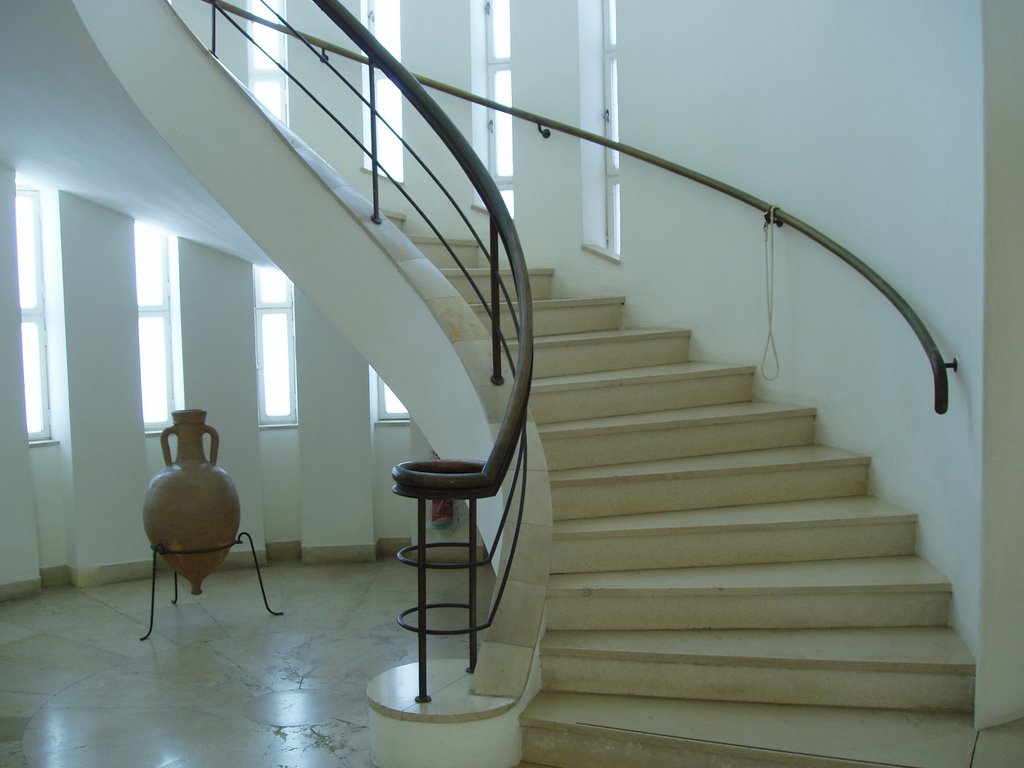
Staircase of the Weizmann house.
In 2008, we walked around the area of University City where the building Mendelsohn designed still stands. No longer used as a synagogue, the building now houses a performance arts school.

Former B'nai Amoona Synagoge,
University City, Mo.
Side view of synagogue, showing small round
windows often seen in Mendelsohn's designs.

Friday, November 4, 2016

France Bloch-Sérazin

France Bloch-Sérazin
             -- Wikipedia
France Bloch-Sérazin (1913-1943) was a hero of the French Resistance. I heard about her from her brother, Michel, whom I met in 1989 through Michel's son   -- our friend Laurent Bloch. At the time, the story of her heroic life and early death were very obscure, but now, I have learned, there are several schools and a street named for her, and she's recognized in both France and Germany with plaques commemorating her life and death.

France Bloch-Sérazin was born and spent her youth in Poitiers in a large house called La Mérigote overlooking a beautiful valley. Her brother reminisced that in his youth he and his siblings would joke about how strategic the location was, with such a view of the railroad in the valley. Unfortunately this was prophetic -- the Nazi occupiers took over the house from the family, headed by then-well-known author Jean-Richard Bloch (1884-1947) and his wife, Marguerite Herzog. (The elder Blochs escaped to Russia where they spent the war. During the war years, Laurent's father was imprisoned in the South of France where, from time to time, he told me, someone would say -- your father is alive, I heard him on clandestine radio.)

France, by then a trained chemist, spent the early part of the occupation in Paris, hiding from the Nazis as she was both Jewish and a member of the Communist Party. She became a founding member of the resistance at the very beginning of its existence. Using her skills as a chemist, she became a bomb maker. She also restored weapons that other members of the resistance retrieved from the sewers of Paris -- people would throw them away fearing discovery by the Nazis.

In May, 1942, she was arrested and taken to prison in Germany in "night and fog" -- that is, deep secrecy. I remember her brother's quavering voice saying "nuit et brouillard," or in German "Nacht und Nebel." Her family didn't know her fate until after the war: she was executed in February, 1943. Her husband, Frédéric Sérazin -- called Frédo -- had been arrested in 1940, and also was executed. When she was arrested, her small son Roland disappeared, and the family thought he was lost. After the war, however, the maid/nanny reappeared at their home with the boy whom she had managed to smuggle to her home town and hide throughout the war years.

The French Wikipedia article contains much more information than the English page -- I used both sources. The French article includes links to two films about France Bloch-Sérazin by filmmakers Loretta Walz and Marie Cristiani.

Tuesday, October 11, 2016

Objects of Interest in the British Museum

Late Roman objects with images of Menorah:


Falasha dolls from Ethiopia, early 20th century:


Thursday, September 1, 2016

A Cookbook from Palestine 80 years ago

"An Early Taste of Zionism: Published 80 years ago, Palestine’s first Jewish cookbook brought politics into the kitchen, along with new ideas about Jewish food and vegetarian cuisine" -- I'm intrigued by this review by Dana Kessler in Tablet Magazine.

From Martinelli's article in Forward:
the cover of Meyer's book.
I had never heard of this classic and would love to obtain a copy. A search of online sellers isn't productive at the moment, but perhaps I'll persist!

From the article:
“'What shall I cook? This problem, the concern of housewives the world over, is particularly acute in our country. The differences in climate and the necessary adjustments arising out of these differences compel the European housewife to make many drastic changes, particularly in her cooking.' 
"With these words, Dr. Erna Meyer introduced her cookbook, How to Cook in Palestine, which was published in Palestine in the mid-1930s in Hebrew, English, and German. 'We housewives must take an attempt to free our kitchens from European customs which are not applicable to Palestine. We should wholeheartedly stand in favor of healthy Palestine cooking,' writes Meyer, urging new Jewish immigrants to Palestine to shed their European identity and reinvent themselves according to the Zionist ideology. 'We should foster these ideas not merely because we are compelled to do so, but because we realize that this will help us more than anything else in becoming acclimatized to our old-new homeland.' 
"Meyer’s book is widely considered the first Jewish cookbook printed in Palestine during the British Mandate."
A more complete review appeared in Forward a few years ago: "Lessons From the First Israeli Cookbook" by Katherine Martinelli. From this review:
"Meyer repeatedly recommends making vegetables more central to every meal and offers meat substitutes for a variety of dishes from 'liver' made out of eggplant to 'meatballs' made out of soaked bread. Although her suggestions came from a place of economy rather than sustainability, they’d fit right in with Mark Bittman and Michael Pollan’s contemporary cries to consume less meat."
One can only hope that a facsimile edition will become available!

Monday, June 27, 2016

Samuel Tolkowsky, June 27, 1886 - December 19, 1965

Library copy of Hesperides.
Hesperides: A History of the Culture and Use of Citrus Fruits by Samuel Tolkowsky is hard to find, though fortunately for me, I have checked out the library copy shown above. This blog post is taken from my other blog, maefood.blogspot.com, because I think Tolkowsky is a very interesting secular Jewish figure.

Title page.
I find the obscurity of this book surprising, as it's full of fascinating and useful information. John McPhee cites it in his book Oranges; in fact, I think he used a variety of information from it in his historical section. Tolkowsky begins in ancient times, with the origins of citrus trees on the slopes of the Himalayas and in the boundary areas between India and China, and a grapefruit-like fruit in the Malay archipelago. The earliest written records of citrus are in China in a compendium dated around 500 BCE, including a number of older works that refer to the fruit. (p. 6)

Citrus spread through Asia and North Africa, and eventually to Europe, as Tolkowsky documents in several chapters. I found the descriptions of the introduction of citrus fruits into ancient Israel especially interesting. Tolkowsky traces the customs of the holiday of Succoth -- the Feast of Tabernacles -- to the influence of the Persians during their exile in the sixth century, and the introduction of these customs when they returned thanks to the decree of Cyrus. At this point, as the citron was as yet not known in Babylonia, the fruit that served in the ritual was not an etrog (citron), but a cedar cone, which appears in a number of images from that era.

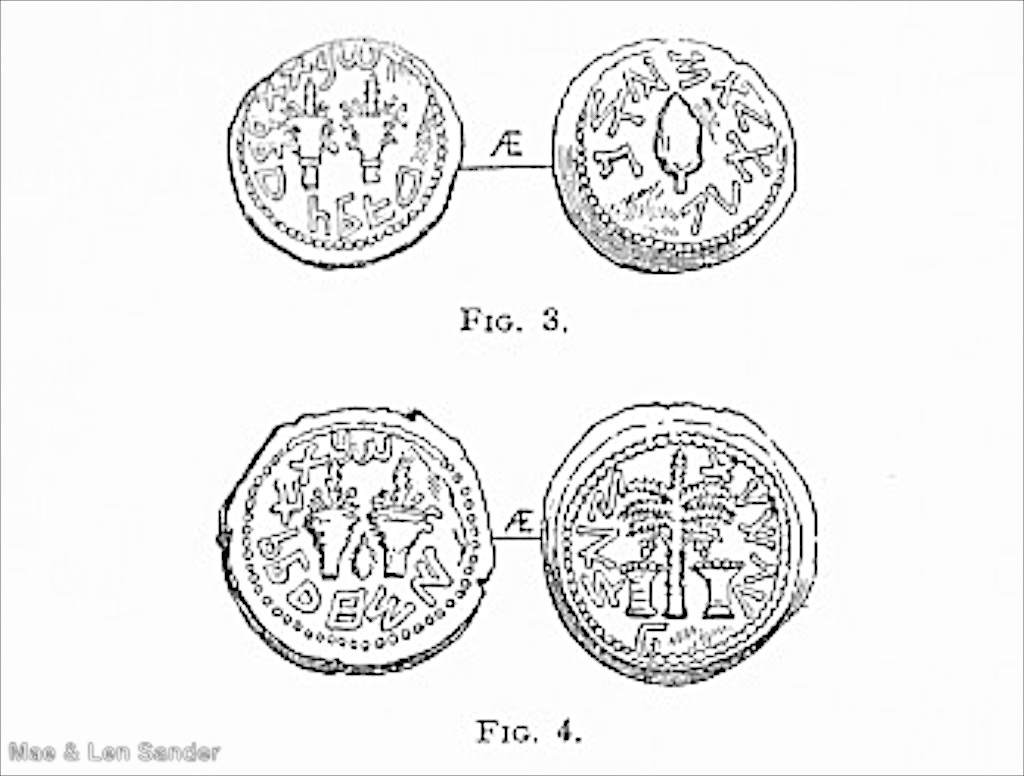
By the second century of this era, the Jewish writings in the Mishnah definitely interpret the ritual fruit as an etrog; the Jewish-Roman historian Josephus also says this, saying "it was the 'Persian apple' that was used by the Jews during the Feast of Tabernacles." Tolkowsky continues the story: "The very earliest documentary evidence of the citron in Jewish sources is found in the representation of this fruit on coins struck by Simon the Maccabee in the fourth year of the 'Redemption of Zion,' that is, in 136 BC. If citrons were extensively grown in Palestine at the time, it seems probable that the center of the industry was at Jaffa." (p. 53)

Simon the Maccabee issued copper coins (above) bearing the picture of a citron
together with the bundle of myrtle, willow and palm branches prescribed
for use at the Feast of Tabernacles.  
Because Simon the Maccabee was the only Jewish ruler who depicted the etrog on his coins, Tolkowsky believes that Simon was the one who introduced the citron in place of the cedar cone.
Above: a bronze seal with Jewish symbols including an etrog. Below: a decorated glass vase including
an etrog and other fruits. From the Roman era.
Citrons were the earliest citrus fruits introduced into Europe, and Tolkowsky includes several chapters describing how later, oranges and lemons arrived in Roman times. Tolkowsky's illustrations include many Roman mosaics and other art works depicting oranges and lemons.

A detail of a mosaic from Pompeii.
Several chapters describe the ways that citrus fruits appear symbolically and literally in European art and literature from Roman times until the Renaissance and early modern period. The development of culinary uses for the fruits are very interesting also. Hesperides is rich in historical information that's not easy to find.

Some notes on Tolkowsky:

I managed to find a brief memoir of Samuel Tolkowsky and his family in Raphael Patai's memoir Journeyman in Jerusalem: Memories and Letters, 1933-1947. Patai (a well-known author) describes the "at home" Fridays at the home of Samuel Tolkowsky and his wife, beginning in 1933. Patai, a young man newly arrived in Jerusalem, met the family in 1933, when Samuel Tolkowsky was 47 years old. Tolkowsky, Patai says, was born in Belgium to Polish-Jewish parents, served as a member of the Zionist Political Committee under Chaim Weizmann in London during World War I, and settled in Palestine in 1919. During World War II, he headed the Citrus Control and Marketing Board set up by the British government there. Patai eventually married Naomi, the Tolkowsky's daughter. (source)

A family tree posted at Geni gives Tolkowsky's dates as June 27, 1886, to December 19, 1965, and lists his parents, wife, and children.

Tolkowsky was the author of a number of other books that are even more obscure than Hesperides. Examples from google book search: The Gateway of Palestine: A History of Jaffa (1925) and The Jewish Colonisation in Palestine, Its History and Its Prospects (1914).

Even Wikipedia seems to have nothing about Hesperides or its author! Several years ago, Hesperides was listed in amazon.com but no longer seems to be there, as I guess they never had a copy come up for sale. A few years ago one sold at Bonham's for £312 (US$ 443), according to the Bonham's website.

Monday, April 18, 2016

Franz Werfel and "The Forty Days of Musa Dagh" -- New Information

I wrote about The Forty Days of Musa Dagh a few years ago when I read the book. Today I read a fascinating study of this book's influence: "From Musa Dagh to Masada: How Franz Werfel’s novel about the Armenian Genocide inspired the Warsaw Ghetto fighters and the Zionist resistance" by Stefan Ihrig in Tablet magazine.

This article describes how the book intentionally created parallels between the Armenian genocide (not yet called that) and the coming Jewish disaster. The book was too late to serve its intended purpose as a warning to the Germans because the Nazis suppressed and burned it immediately after its publication. However, it influenced the Jews in Palestine at the time -- a quote from the article:
Werfel’s book was translated into Hebrew as early as 1934. In an early review from the Yishuv (the Jewish community in Palestine) Dov Kimchi wrote extensively of the forthcoming book, based on excerpts published abroad. He wrote, among other things, that “we Hebrew readers … read into this book on the Armenians our very own tragedy.” A year later, in 1934, another review, by R. Seligmann in The Young Worker (Ha-Poel Ha-Tzair), expressed similar sentiments, observing, “The book is very interesting for the educated reader in general, but the Jewish reader will find it of special interest. The fate of this Armenian tribe recalls, in several important details, the fate of the people of Israel, and not surprisingly the Jewish reader will discover several familiar motifs, so well known to him from the life and history of his people.” In 1936, Moshe Beilinson wrote a more critical review. He was irritated by the fact that a Jew would erect such a monument to the suffering of another people. But he, at least partially, understood Werfel’s intentions: “This is no more than a shell, for in truth this is a Jewish book, not only because it was written by a Jew, but in a less abstract sense, simpler and more concrete, the author speaks of us, of our fate, of our struggle.”


Friday, March 4, 2016

Umberto Eco: "The Prague Cemetery"

Umberto Eco died last month. In remembering him, I decided to read The Prague Cemetery(published 2011). The book is full of fascinating illustrations, using etchings and other contemporary material from Eco's collection. I had the feeling that the author's imagination was stimulated by these images; I have reproduced several of them below.
Actual French journal from time of Dreyfus case.
(From The Prague Cemetery).

Normally I would write about the very large number of food descriptions in the book. The main narrator LOVES food, and describes many meals including French cuisine, Italian and Sicilian cooking. Food of the richest and poorest classes of society illustrate their fortunes and misfortunes. Equally interesting was Eco's vast knowledge of the city of Paris in the 19th century -- the streets, the sewers, the restaurants, the neighborhoods, and more. These descriptions were somewhat spoiled for me by the revolting antisemitism and visciousness of the central character and narrator, Simonini.

Here is an example of Simonini's love of fine French food and its setting in 19th century Paris -- the reader is expected to know the names of the dishes in French:
"The first place I wanted to indulge myself was Le Grand Véfour, in the arcades of the Palais-Royal. Though it was extremely expensive, I had heard it praised even in Turin, and Victor Hugo apparently used to go there to eat breast of mutton with haricot beans. The other place that had immediately seduced me was the Café Anglais, on the corner of rue de Gramont and boulevard des Italiens. It had once been a restaurant for coachmen and servants and now served le tout Paris at its tables. There I discovered pommes Anna, écrevisses bordelaises, mousses de volaille, mauviettes en cerises, petites timbales à la Pompadour, cimier de chevreuil, fonds d’artichauts à la jardinière and champagne sorbets. The mere mention of these names makes me feel that life is worth living." (The Prague Cemetery, Kindle Locations 2196-2202)
At the young-people's hostel.
The simultaneously racist and gourmet Simonini also writes about the terrible food of poor people when he is forced to deal with them. For example, this description of a hostel for poor students:
"As you entered, you were hit by the asphyxiating stench of rancid grease and mildew, and of soup that had been cooked and recooked over the years, leaving tangible traces on those greasy walls— though there was no apparent reason for this, since you had to bring your own food with you, and the house offered wine and plates only." (Kindle Locations 4771-4773)
Or in another passage, where he is entertaining a Russian business acquaintance (more about the business later):
"With a feeling of relief I invited Golovinsky to dinner at Paillard, on the corner of rue de la Chaussée d’Antin and boulevard des Italiens. Expensive, but superb. Golovinsky clearly appreciated the poulet à l’archiduc and the canard à la presse. But someone who came from the Steppes may well have tucked into choucroute with the same enthusiasm. It would have cost me less, and I could have avoided the waiters’ suspicious looks at a customer who masticated so noisily." (Kindle Locations 5717-5720)
Like most of Eco's books The Prague Cemetery is terribly complicated, and made even more challenging by the expectation that the reader would be familiar with a fairly high level of detail about the liberation of Italy, Napoleon III, the 1871 war between France and Germany, the Paris Commune, the Dreyfus affair, and other events of that era, as well as food names in original languages. 

Further, a Jewish reader like me needs a thick skin to handle all the antisemitic stereotypes expressed by Simonini. Eco makes Simonini clearly despicable as well as self-absorbed -- including his utter lack of principles in all the political sides he pretends to take, his hatred of Jews, and several murders that he committed or claimed to have committed in the course of his unsavory life. Some of the illustrations are especially offensive -- the one at right is moderate in comparison. Still, it's a hard book to read.

Umberto Eco-style details add to the challenges. There are at least three narrators, mostly unreliable. In particular, the reader has to deal with the ambiguity of identity of Simonini and his double, a Catholic Abbé. Maybe the Abbé is just another character or maybe Simonini has some kind of split-personality disorder or maybe something else that I missed, though it's all finally explained towards the end (if you believe the explanation). In the final chapter of the book, Eco explains that Simonini is the only fictition of the book: all other events and characters are, he says, closely based on actual history. 

The character/narrator Simonini was ambiguously both Italian and French, having been born in a region on the border that was alternately a possession of each nationality. His profession was being a spy, a double agent, and above all a forger of documents. Among his invented documents he specialized in anti-Jewish and anti-Masonic ones, including a secret meeting of Jewish elders in the Prague cemetery (hence the title); a precursor to the Protocols of the Elders of Zion. This fictitious character then wrote the actual Protocols (which he was selling to the Russian he entertained at dinner). He also forged the papers that incriminated the innocent Dreyfus, and many others.

Obviously the way this fictitious character ties together many of the antisemitic inventions of the century is Eco's clever way of exploring the historic circumstances that created twentieth-century antisemitism, and continues to feed twenty-first century antisemitism. The play between real history and fiction is full of irony and fraught with Eco's knowledge of what happened to Simonini's creations after the end of the book.

Reviewer Rebecca Goldstein wrote the following in the New York Times:
"Umberto Eco’s latest fiction, 'The Prague Cemetery,' is choreographed by a truth that is itself so strange a novelist need hardly expand on it to produce a wondrous tale. Eco forthrightly explains that all his major characters but one are historical figures; but a reader unaware of how close to the truth Eco is hewing might be inclined to award him more points for inventiveness than he earns. This is not to say that Eco doesn’t earn points for inventiveness, nor that a novel can’t succeed on other grounds. It is just to say that sometimes truth is stranger than fiction." Umberto Eco and the Elders of Zion, NYT, November 18, 2011.

The historic "reality" reflected in the book isn't really the main key to what Eco was trying to do, I think. His handling of the details of life (like food, streets, military events, etc.) that would resonate with twenty-first century readers and his constant anticipation of the consequences of the ideas he explores make The Prague Cemetery a very complicated historical novel. All historical novels invent characters, actions, and circumstances to stand against the "real" historical background; this one does it in an exceptional way.

Note: this is also posted at maefood.blogspot.com, my other blog.

Monday, February 1, 2016

Langston Hughes and Frederick Douglass


Born on this date in 1902: Langston Hughes, poet and writer of short sketches about Simple, a simple man. I'm a fan of Langston Hughes! See this biography. 


Born in February, 1818 and subject of today's google doodle: Frederick Douglass, advocate of freedom. See this biography. The doodle made me think about these two men, both heroic!


Friday, January 8, 2016

Another Poet to Read: Joseph Brodsky

In a review of a new theater piece/ballet about Joseph Brodsky in the New York Review of Books, Joan Accocella wrote about Brodsky's departure from Russia and how he came to Ann Arbor --
"When literary dignitaries came to Russia, he was often the person they wanted to meet. But he could not get a poem published in the Soviet Union, not to speak of obtaining permission to attend literary conferences outside the Soviet Union. This is the sort of tragicomedy in which the USSR specialized. The authorities eventually tired of it, though, and one day, in June 1972, he was simply taken to the airport and put on a plane.
"He did not know whether the plane was going east or west. It went west, to Vienna, and at the airport he was met by the American Slavist Carl Proffer, whom he knew, and whose small press, Ardis, in Ann Arbor, Michigan, would publish a number of his writings in Russian. Auden had a second home outside Vienna, and the day after Brodsky’s arrival Proffer rented a car and deposited Brodsky there, to what was apparently Auden’s surprise. Brodsky stayed for four weeks. Auden got him some money and called various people to say that he was coming.
"Proffer arranged for him to be given a job as poet in residence at the University of Michigan, where he himself taught."
Brodsky's Ann Arbor lodgings were just up the street from where I live, though, as I wrote in a previous post on Brodsky,  I never knowingly saw him. I found Acocella's biographical sketch very intriguing. While I rarely read poetry, I think I'll add Brodsky to my list for the coming year, which so far includes the poet Yehuda Amichai. In fact, I ordered a book of Amichai's poems today. The third poet on the list will be Robert Hayden (1913-1980).

From the New York Review of Books article titled "A Ghost Story" --


Thursday, December 31, 2015

Is it a New Year?

For me, it's definitely a New Year, 2016, though I am aware that it's not a new year for orthodox Jews, who only live within Jewish tradition. I believe that even religious Jews in the more liberal traditions think this is a New Year... not only those who see themselves as secular.

SO HAPPY NEW YEAR, AND A WONDERFUL 2016!

And here's a reading resolution: more poetry by Yehuda Amichai, who received a very appealing write-up in the New Yorker here:
Like a Prayer The poetry of Yehuda Amichai: by