Friday, July 29, 2011

"The Ornament of the World"

The Ornament of the World by Maria Rosa Menocal documents the transition in medieval Iberia from a multi-cultural society to a repressive culture that persecuted all but the most accepted Catholics. Beginning in the tenth century, small Islamic states provided an environment where both Jews and Christians had unusual rights to worship and to follow intellectual pursuits of their own choosing. And for a time, the re-conquering Christian kings established similarly tolerant states where Muslims and Jews enjoyed unusual rights. These rights were unusual in medieval times -- though of course not comparable to the rights of minorities in modern democracies.

Menocal concentrates on the achievements of the three communities in establishing written vernacular languages, preserving and disseminating Greek learning, advancing scientific and philosophic knowledge, and developing literary forms in Castilian, Arabic, and Hebrew. I find particularly interesting her exploration of the combination of secular and religious thought that developed in both Christian and Muslim enclaves, and subsequently was destroyed by religious fanaticism.

She writes, for example, of the Jews of Cordova in the twelfth century:
"The Jews understood themselves to be Andalusians and Cordobans, much as the German Jews of the late-nineteenth century -- Marx and Freud most prominent among them -- considered themselves Germans, or the American Jews in the second half of the twentieth century, who helped define the intellectual and literary qualities of their time, never thought twice about calling themselves Americans. But unlike many later European and American Jews, the Andalusian Jews had not had to abandon their orthodoxy to be fully a part of the body politic and culture of their place and time. The Jews of al-Andalus wre able to openly observe and eventually enrich their Judaic and Hebrew heritage and at the same time fully participat in the general cultural and intellectual scene. They could be the Cardozas and the Trillins [I fear that she means Lionel, not Calvin Trillin] and the Salks of their times because they were citizens of a relilgious polity -- or tather, of this particular religious polity. The Umayyads ... had created a universe of Musllims where piety and observance were not seen as inimical to an intellectual and 'secular' life and society." (p. 86-87)

She documents this duality of religious and secular thought and intellectual activity, as well as the political struggles between Islamic groups with different commitments to tolerance or intolerance, and then the fossilization of Christian thought that ended in the expulsion of Jews and Muslims and the totalitarian rule of the Inquisition. "As time went by," she wrote, "there was a growning sense of the showdown between faith and reason, to put the matter at its most blunt and simplistic..." (p. 207)

Judah Halevi, whom I wrote about a few days ago, was an important focus for some of her thoughts, as he participated in the most idealized environment for the combination of faith and philosophy, and wrote The Kuzari as a dialog exploring where this duality could lead. Then, of course, he concluded that his religious commitment could only require him to leave the open atmosphere of his home, which he found corrupting, and seek a different world by going to Jerusalem.

Menocal's book contains much more than I can possibly say here. The history of Convivencia (the name often given to the tolerant and open atmosphere of medieval Iberia, which disappeared when Ferdinand and Isabella created a united, monolithic Spain) is fascinating in its own right, not just because of its parallels to modern times, including the vexing question of Christianity vs. Islam or of the role of Jews in a non-Jewish society.

Monday, July 25, 2011

Amy Winehouse: Anti-Hero

So Amy Winehouse, who died this weekend at the age of 27, frequently called herself a “nice Jewish girl,” particularly "when she was questioned about her out-of-control persona." (At least according to an article a few months ago). No one accused her of being religious -- her famous work "Back to Black" was set partly in a cemetery full of crosses, anyway. I'm sure the death of any talented young person who throws away opportunities as she did is tragic. But really, what a shame to try to make something of her having been Jewish in some sense or other.

Arthur James Balfour (July 25, 1848)

Balfour was a British diplomat and the author of the extremely important Balfour Declaration of 1917. This declaration stated:
"His Majesty's Government view with favor the establishment in Palestine of a national home for the Jewish people, and will use their best endeavors to facilitate the achievement of this object, it being clearly understood that nothing shall be done which may prejudice the civil and religious rights of existing non-Jewish communities in Palestine, or the rights and political status enjoyed by Jews in any other country."

Friday, July 22, 2011

"Yehuda Halevi" by Hillel Halkin

Hillel Halkin's portrait of medieval poet Yehuda Halevi* depicts a deeply religious man. Halkin offers religious motives (as well as others) for his own interest in Halevi as well. Halkin presents an introduction to Halevi's poetry in his connection with the autobiography of the poet. He describes the situation of Jews in Muslim Spain in Halevi's lifetime. He gives an interpretation of Halevi's famous work The Kuzari -- "a defense of Judaism written in the form of a dialogue between a Khazar king and the rabbi who converts him." Altogether, I found the book challenging but very interesting, especially the study of the end of the poet's life.

Halevi's extraordinary commitment to traveling to Jerusalem, Halkin points out, was one of the signs of Halevi's faith. In around 1140, at close to 70 years old, Halevi left a safe life as a highly admired poet in the most sophisticated and luxurious environment available in his time. He chose to make the pilgrimage about which he had written. The long sea voyage to the east was arduous even if the traveler avoided pirates and storms. As he traveled, Halevi wrote a number of poems about his sea voyage.

Jerusalem, Halevi's destination, was ruled by brutal Crusaders, making the final steps of the voyage totally dangerous for a Jewish pilgrim. Halkin uses letters and documents from the Cairo Geniza to detail the final days and the death of Halevi in or near Jerusalem, as well as explaining Halevi's interpretation of Jewish tradition and law to show why he felt that he and his fellow Jews had an obligation to go there. Halkin also presents a brief overview of the influence Halevi had on subsequent Jewish writers down to our own day and to modern Zionism.

Halevi's poetry, Halkin points out, included both secular and religious poetry. While some authors stress the secular side of Jewish life in medieval Spain, Halkin stresses the dualism of this era. He writes:
"On the whole, secularism did not mean to Hebrew poets of Halevi's age... what it menas today. It implied not a rejection of religion, but the acceptance of another, parallel domanin of experience and an exploration of the tensions between the two. These tensions were considered natural because the human life was viewed dualistically, as the union of a mortal body and an immortal soul that collaborated at times and were in conflict at others. Each had its claims and responsibilities, and a poet cold, at different moments, take the side of either or both." (p. 101)
Halevi innovated poetic forms, introducing certain elements and themes from Arab poetry into both his religious and his secular works. Religious poetry was intended to be integrated into worship and the synagogue liturgy; secular poetry, whatever its subject matter, was not so intended. Dualism went further than that. The contrast to modern views is made most vividly.

*Hillel Halkin, Yehuda Halevi, Nextbook/Schocken, 2010

Thursday, July 21, 2011

Lucian Freud (died July 20, 2011)


Lucian Freud the renowned painter died last night at age 88. Born in Berlin, in 1922, he fled from the Nazis with his family, including his famous grandfather Sigmund Freud. He was educated in English schools, worked in England all his life, and was a naturalized English citizen. It's not clear to me if his roots in successful German and Austrian Jewish families were important in his work, which was extremely original and based in quite a few modern art ideas.

The New York Times obituary gives this biographical detail: "Mr. Freud was a bohemian of the old school. He set up his studios in squalid neighborhoods, developed a Byronic reputation as a rake and gambled recklessly ('debit stimulates me,' he once said). In 1948, he married Kitty Garman, the daughter of the sculptor Jacob Epstein." Later, he divorced his wife and had many subsequent relationships.

Of his work the Times says: "Mr. Freud’s dingy studio became his artistic universe, a grim theater in which his subjects, stripped bare and therefore unidentifiable by class, thrust into contorted positions, submitted to the artist’s unblinking, merciless inspection."

Update: Forward has an article titled: Was There Anything Jewish About Lucian Freud? Quote: "Mainly, the Jewishness of Freud’s career exemplifies modern diasporic success: acculturation, secularism, national recognition and international acclaim."

Paul Wellstone (July 21, 1944)

Wellstone was a rare senator: truly progressive and oriented to the kind of human services and humane rule of law that I would ideally like to see implemented in our country. His death was a tragedy.

Wednesday, July 20, 2011

Judy Chicago (July 20, 1939)

Judy Chicago: another Jewish feminist and artist. Her project of which I'm most aware is titled "The Dinner Party." Currently it's installed at the Brooklyn Museum, whose website notes:
"The Dinner Party, an important icon of 1970s feminist art and a milestone in twentieth-century art, is presented as the centerpiece around which the Elizabeth A. Sackler Center for Feminist Art is organized. The Dinner Party comprises a massive ceremonial banquet, arranged on a triangular table with a total of thirty-nine place settings, each commemorating an important woman from history. The settings consist of embroidered runners, gold chalices and utensils, and china-painted porcelain plates with raised central motifs that are based on vulvar and butterfly forms and rendered in styles appropriate to the individual women being honored. The names of another 999 women are inscribed in gold on the white tile floor below the triangular table. This permanent installation is enhanced by rotating Herstory Gallery exhibitions relating to the 1,038 women honored at the table."*

Thomas Friedman (July 20, 1953)

He done us wrong. We believed him when he promoted the war in Iraq because his international affairs columns had been so insightful in the 90s. I thought his book about Israel-Arab relations was penetrating, as were his ideas about globalization before around 2001. That was then. And now I see him first as an anti-hero and also as a no-longer interesting or relevant commentator.

Monday, July 18, 2011

Religious feelings: hard wired?

Here's a penetrating article on the neuroscience of belief: "Science and religion: God didn't make man; man made gods" (L.A. Times, July 18, 2011)

It begins by quoting the song "Imagine" by John Lennon: ""no heaven … / no hell below us …/ and no religion too." But the article continues with a discussion of why our brains can't do that. Some of the obstacles:
Scientists have so far identified about 20 hard-wired, evolved "adaptations" as the building blocks of religion. Like attachment, they are mechanisms that underlie human interactions: Brain-imaging studies at the National Institutes of Health showed that when test subjects were read statements about religion and asked to agree or disagree, the same brain networks that process human social behavior — our ability to negotiate relationships with others — were engaged.

Among the psychological adaptations related to religion are our need for reciprocity, our tendency to attribute unknown events to human agency, our capacity for romantic love, our fierce "out-group" hatreds and just as fierce loyalties to the in groups of kin and allies. Religion hijacks these traits. The rivalry between Sunni and Shiite Muslims, for example, or the doctrinal battles between Protestant and Catholic reflect our "groupish" tendencies.

Saturday, July 16, 2011

Bess Myerson (July 16, 1924)

Bess Myerson was the first Jewish Miss America in 1945. To date she is still the only Jewish Miss America.

Subsequently, she remained in the public eye, appearing on TV shows, writing a newspaper column, and participating in New York politics. My own memory is of her role as a consumer advocate, heading the New York city department of Consumer Affairs.

Her own summary:
“My Department of Consumer Affairs really fought for the consumer. We passed a consumer-protection act that really protected; we passed unit pricing; we raided supermarkets. With the help of an outstanding staff, we accomplished a great deal. And I campaigned for Hubert Humphrey for president in 1968, and for Senator Henry Jackson in his 1976 presidential bid, and for Senator Patrick Moynihan’s race in 1976. I’m a registered Democrat and I would say a moderate centrist, if we use labels. But, above all, I’m issue oriented. …”*

Friday, July 15, 2011

Jacques Derrida (July 15, 1930)

Derrida is known as a leading proponent of the very obscure deconstructionist philosophy. I heard a lecture by him in 2003, but I felt I couldn't understand anything he said. Of course I recognize that he's very famous as a philosopher; indeed, he's characterized as a media celebrity. I am inadequate.

When reading about Derrida's life, I learned about his reactions to antisemitism that he experienced, and his development of a broader secular philosophy. A native of a Jewish suburb of Algiers, at age 12 he experienced French fascism: the collaborating French officials in World War II expelled all the Jewish students from the school that he attended. He left North Africa to study in Paris in 1949, where he experienced antisemitism as well. He wrote to one French acquaintance: "French anti-Semites are only anti-Semitic with Jews whom they do not know personally.” To another: “As soon as an anti-Semite is intelligent, he no longer believes in his anti-Semitism.”

Derrida's philosophy was detached from anything as specific as religion, including Judaism:
“When Derrida was buried, his elder brother, René, wore a tallit at the suburban French cemetery and recited the Kaddish to himself inwardly, since Jacques had asked for no public prayers. This discreet, highly personal, yet emotionally and spiritually meaningful approach to recognizing Derrida’s Judaism seems emblematic of this complex, imperfect, yet valuably nuanced thinker.”*

Walter Benjamin (July 15, 1892)

I've always found it challenging to understand exactly what Walter Benjamin did to deserve his highly admired status. Here's a paragraph from Tablet Magazine that deals with this challenge:
“It’s always been hard to pin Benjamin down. Aberrant Marxist, heretical Jew, maverick social theorist, deconstructive spirit—he has been many things to many people. It is equally hard to describe what he did, in part because Americans don’t really make intellectuals like him. Benjamin, whose most important work was written in Berlin during the ’20s and then in Paris during the ’30s, wasn’t just a book reviewer, although he wanted to be the best one in Germany. He was hardly a journalist, but a good deal of his considerable production was written for newspapers. He was not a philosopher, but he is treated like one. To use a quaint expression, he was a man of letters. Even that does not do him justice.”
Benjamin's friendships with other famous (but easier to understand) figures in pre-war Germany and his suicide while trying to flee from the Nazis create an aura for him -- as a result, he's he subject of an enormous number of recent books and studies. His relationship with Judaism fascinates many people, as it appears emblematic of the problem of secular Jews in the interwar era in Germany. Without any grounding in the religion, Jews seemed anyway to live in a social ghetto (before the establishment of the much more real ghettos etc). "As his friend Gershom Scholem, a product of a similar background, would note, it was quite normal for assimilated German Jews never to enter a Gentile home or invite a Gentile to theirs. Jewish identity was much more durable than Jewish belief."*

Hero? I guess so.

Thursday, July 14, 2011

Bastille Day

Bastille day signifies the liberation and emancipation of many individuals and groups as a result of the exuberant spirit of the French Revolution. Although the destruction of the Bastille Prison may not have special meaning for Jews, the result of both the revolution and the era of Napoleon was extraordinary change in the situation of Jews and Jewish communities throughout Europe. The debate about the inclusion of Jews in the "rights of men" included the immigrant Jewish spokesman Zalkind Hourwitz and the Abbe Grégoire. Their advocacy contributed to the creation of secular Judaism, as well as to the status and rights of Jewish individuals.

Jerry Rubin (July 14, 1938)

To Jerry Rubin belongs the credit for the watchword of the sixties political activist thought: “Never trust anyone over 30.”
UPDATE: This turns out to have been said by Jack Wineberg, a much less famous participant in the Free Speech Movement of 1964. I wonder if I'm the only one who misattributed this saying that's outlived its originator's fame.

Rubin was an activist in Berkeley when huge public opinion was turned toward the protests there. Today, secular Jews (and everyone else) may have forgotten the counterculture movement and the New Left, but they seemed a real part of a certain sort of Jewish life in the sixties.

Rubin was one of the Chicago Seven -- activists tried for conspiracy and inciting to riot during the 1968 Democratic Convention. Along with Abbie Hoffman and Paul Krassner, Rubin founded the Yippies. Later Rubin was known for becoming a respectable investor type, leaving many of his followers with a sense of betrayal or at least confusion.

Wednesday, July 13, 2011

Isaak Babel (July 13, 1894)

Babel was born in Odessa, Ukraine, and some of his most famous stories are about the Jewish underworld of Odessa. Babel was alternately the darling of Soviet literature in his early years; an outcast (the Soviet authorities executed him in 1940); and a rehabilitated hero in 1954. His work is fascinating as both Russian and Russian-Jewish history, and as well-crafted stories.

George Lang (July 13, 1924)

The New York Times last week published the obituary of George Lang, a cookbook author and an impressario of restaurants, most famously the Cafe des Artistes in New York, and the post-communist reincarnation of the historic restaurant Gundel in Budapest. Lang was born on July 13, 1924, in Szekesfehervar, Hungary, and died July 5 in New York. He originally studied music, and intended to be a musician. His first deviation from his plan was to be in the resistance in World War II after escaping from a Nazi prison camp. As a Jew, he had little choice but resistance, but by joining the fascist Arrow Cross militia was able to assist other Jews in hiding. His parents died in Auschwitz.

Lang escaped to New York and resumed his intended career as a musician, but eventually discovered his talent for designing and running restaurants and also for writing cookbooks. The Cuisine of Hungary is one of my favorite ethnic cookbooks, which the obituary says was the first Hungarian cookbook in English.

According to the Times:
"Mr. Lang often enjoyed constructing fantasy meals, including his last. The ideal final meal, he told The Village Voice in 2007, would include some of the great dishes from his restaurant career but above all his Hungarian favorites: fisherman’s soup, stuffed goose neck, sour cherry soup, layered cabbage, stuffed peppers, plum dumplings, pancakes with apple meringue, and whipped-cream strudel.

"'And then I will have what it takes to get to another world,' he said."

Tuesday, July 12, 2011

Amedeo Modigliani ( July 12, 1884)


Was Modigliani's Sephardic Jewish heritage important to him? His family belonged to the Sephardic elite: he was born in Livorno, Italy, a Sephardic center. Modigliani left home for the art world in Paris, where he received little recognition for his now-iconic paintings. At first he managed to live well, using family resources, but slowly descended into poverty, drug-taking, and desperation. He had been infected with TB since childhood, and became more and more ill, no doubt made worse by his bohemian environment. All the time, he continued to paint and create the works that he's now so respected for. Although Jewish advocates try to place his art in some kind of Jewish framework, I suspect that he was simply a secular Jew in the Paris art world.

Sunday, July 10, 2011

The Scopes Trial (July 10 to 21, 1925)

There's no particularly Jewish angle to the Scopes trial, but the fundamental issues of religious separation from government and academic freedom are of great interest to any secular citizen of the US, and to many others also who believe strongly in keeping religion out of government and its institutions.

Scopes, the teacher who defied the Tennessee anti-evolution law, was defended by the relatively new ACLU. The ACLU (which had been founded during World War I and renamed American Civil Liberties Union in 1920) had advertised that it would fund a challenge to the anti-evolution law; Scopes accepted the offer. Clarence Darrow defended Scopes's right to academic freedom in the public school system. It is said that the play "Inherit the Wind" has created a somewhat fictitious general idea of the trial in most people now, nearly 90 years later.

To me it's painful that this issue is not dead, but needs to be fought again and again, as discussed by Stephen Jay Gould in several books.

Saturday, July 9, 2011

Franz Boas (July 9, 1858)

Boas was born in Minden, Westphalia, Germany. As a cultural outsider, he was one of the inventors of modern anthropology, study of outsiders.

"His liberal Jewish parents held a disdain for dogma, religious or otherwise. And as a result Boas was allowed to think for himself and pursue his own interests unhindered," wrote a rather mysterious website called NNDB. "It was Boas who gave modern anthropology its rigorous scientific methodology, patterned after the natural sciences, and it was Boas who originated the notion of 'culture' as learned behaviors. His emphasis on research first, followed by generalizations, stood in marked contrast to the British school of anthropology which emphasized the creation of grand theories (which were only after tested through field work)."

Oliver Sacks (July 9, 1933)

I'm fascinated by Oliver Sacks' books, which are enlightening about the normal human mind through understanding of the damaged or exceptional human mind. His relationship with his Jewish background is complex, but whatever it is, I think he's a hero in my sense.

Thursday, July 7, 2011

Gustav Mahler (July 7, 1860)

Mahler is a complex figure -- his origins were Jewish but he converted to Catholicism, and much effort has been made to find his Jewish and non-Jewish identity reflected in his music. Here is what I find an interesting quote from an interview with Daniel Barenboim:
"... One only talks about Mahler’s Jewish origins, and the Klezmer music, and the psychoanalysis and all these things, but basically, without Wagner there would have been no Mahler. And the most interesting thing about Mahler is that he really had one foot in the past and one in the future, that he had one foot in Wagner and the other foot in Schönberg, and as such was a great transitional figure. ... So, in effect, the complexity of Mahler, and its greatest appeal to me, is that it is, in a way, the affirmation of three centuries of musical thinking. ...

"There is a very beautiful, very poetic, video document with Leonard Bernstein, called The Little Drummer Boy, where he talks all about the Jewish background, and all that, and that Mahler had this feeling of guilt of having been Jewish. It’s very lovely and it’s very poetic, but it doesn’t help to understand the music one bit, in my view, not one bit."

Abraham Cahan (July 7, 1860)

Founder of the secular Yiddish-language Forward, which is still in business over 100 years later, Cahan was its guiding force for generations. Further, he wrote stories and novels in English that are still readable and interesting to students. Though his purpose was to educate and Americanize his audience, his paper is now a source of information about the Jewish immigrant experience in New York and to some extent throughout the country.

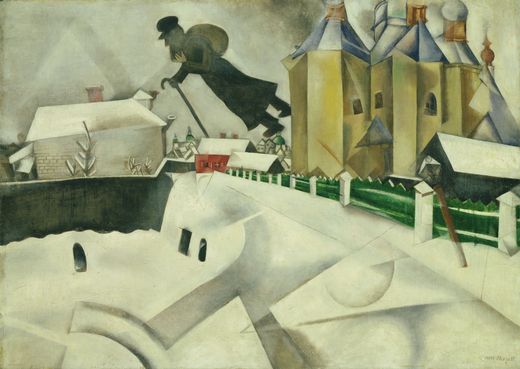
Marc Chagall (July 7, 1887)

Where do you get your visual image of the shtetl, the place in which, perhaps, your ancestors lived a century or so ago? Chances are, a major contribution comes from the work of Marc Chagall and his lifelong reimagining of his home town, Vitebsk. That's all I feel the need to say: he's a hero to anyone who needs to imagine recent Jewish history through the lens of modernism.

Wednesday, July 6, 2011

Frida Kahlo de Rivera (July 6, 1907)


Above, Frida Kalho's painting "My Grandparents, My Parents, and I." This painting shows the relationship of Frida as a child to her ancestors; on her father's side, the grandparents were Jakob and Henriette Kaufmann, German-Hungarian Jews. Their son Wilhelm (Frida's father), born in 1872, had immigrated to Mexico and changed his name to Guillermo, but never lost his accent or love of German culture. Her mother, Matilde Calderon, had Latina and native-Mexican roots. Kalho's background and identity were mixed -- she was known for her Latina clothing and expressiveness, while more quietly reading Yiddish poetry and many other types of works.

According to reviewer Leslie Camhi writing in "Beyond Mexicanidad: The Other Roots of Frida Kalho's Identity" --
"The composition, painted in 1936 — during Germany’s implementation of the Nuremberg racial laws — closely follows the Nazi genealogical charts that by then had made their way into Mexico’s German immigrant community. But Kahlo, an ardent anti-fascist, adapted them to her own purposes. Among the work’s other sources are an obstetrical manual found in her library and a book by the Yiddish poet and Mexican immigrant Isaac Berliner, which Rivera had illustrated."
Kalho was far from a realist; this painting mixes surrealism and realism. She was little recognized in her lifetime other than as the wife of Diego Rivera, though surrealist painters André Breton and Marcel Duchamp helped arrange exhibits of her work in the United States and Europe. Her posthumous fame focuses mainly on the self-expressive and surrealist edge of her work, not on the identity part that's exceptionally captured in this genealogical and personally symbolic painting.

Monday, July 4, 2011

Abigail Van Buren and Ann Landers (July 4, 1918)

For a while in the mid-20th century, Dear Abby and Dear Ann Landers, the two rival newspaper advice columns, dictated matters of morals, customs, and propriety. For example, which way should the toilet paper roll unfurl, from the top or the bottom? What's the best way to make meatloaf? Should you break up with your husband -- or reconcile? Do you need to seek professional help for your problems? They had opinions, advice, and referrals to various helping organizations. They received queries from the masses, they talked to the masses, and the masses said "yes." People talked about the issues they dealt with, and argued about their views. I think the place of the advice column was eventually replaced by Oprah and other TV deities. I suspect that currently there's a transition to web-based advice sources.

Ann and Abby, the two rival advice-givers were twins, born in Sioux City, Iowa, into a Jewish family. Esther Pauline Lederer (née Friedman) wrote as Ann Landers, and eventually used the name as her own. Her twin sister Pauline Esther Friedman Phillips wrote the Dear Abby column.

Did their Jewish background have anything to do with their success? Maybe, maybe not. Their predecessors included the famous "Bintel Brief" advice column in the Yiddish Daily Forward, but I have no idea if they were influenced by it. Are they heroes or anti heroes? Maybe some of each.

Sunday, July 3, 2011

Michael Milken (July 4, 1946)

Now here's an anti-hero, you may think. Michael Milken was the "Junk Bond King" of 1980’s Wall Street. First he was widely acclaimed for his financial genius in inventing new investment instruments, and then was sent to jail because he crossed the line from vastly imaginative into actually illegal. He came out of jail still owning enough money to put him in world's top 500 richest people, and engaged in charitable endeavors. Now some people say he was really a financial genius who became the victim of injustice, and call him a hero.

And all the time, everyone knew he was Jewish.

Hero or anti-hero?

Saturday, July 2, 2011

André Kertész (July 2, 1894)


I've recently seen several exhibits of photos by André Kertész, and I marvel at his skill and imagination as a photographer. One of these was "On Reading," which included the image above. I saw this show at the Carnegie Museum in Pittsburgh last year; the exhibit was reviewed when it showed in London: "Opening the book on modern photography." From the review:
"With his Leica camera in hand, André Kertész wandered city streets, photographing people going about their daily lives. It helped him, he felt, come to terms with being an outsider, first as a Jew in early 20th-century Hungary, then as a émigré in Paris between the wars, and then in New York.

"...Reading formed an integral part of Kertész’s own life. According to Colin Ford, a friend and founding head of the National Media Museum in Yorkshire: 'André’s father was a bookseller. From the age of six or seven, he used to pore over magazines.'

"His interest in reading was also inspired by his Jewish background and its culture of praying and learning — one of the images in the show is of a couple walking past a painting of an Orthodox boy studying.

Kertész never forgot his background. 'His life as a Jewish exile was part of his melancholia, creating the feeling that ‘I’m in a place where I wish I wasn’t, that I’m not home.’ There is a sense of loneliness and alienation throughout his pictures,' says Ford."


More recently, I saw "An Intuitive Eye: André Kertész Photographs 1914-1969" at the Detroit Institute of Arts. As in "On Reading" I was overawed by his mastery of light and shadow, and by the drama he puts into every photo.

I don't see anything specifically Jewish in his work or know about his religious commitments (which appear to have been private), though I am aware that many of the great early-20th century photographers were, in fact, Jewish. I see him, thus, as a secular Jewish hero.

Monday, June 27, 2011

Elaine Brown

Happy birthday to my sister Elaine! She's a hero because she can stand on her head and because she reads all my blogs. My earliest memory is waiting with my aunt and uncle in the park across from the hospital where she was born while my father picked up my mother and my brand new sister.

Sunday, June 26, 2011

Emma Goldman (June 27, 1869)

Emma Goldman's powerful critical and analytic skills and her speaking ability (in several languages) allowed her to be an effective leader of disaffected workers. There's no doubt that her leadership was important to them, but I find her radical ideas go a bit too far for my views.

Saturday, June 25, 2011

Israeli History

I grapple with the question of how the idealism of the Zionists has become the difficult situation of the current Israelis, and how propaganda to delegitimize Israel and accept only a pro-palestinian narrative has muddied the wathers of history. An article in the current Ha'aretz presents a useful summary about how the past is relevant to the present. "A still-relevant miracle" by Fania Oz-Salzberger makes the point that "Today's Israel -- depending on your preference, a regional superpower, a fast-tracking start-up nation or the bane of the Middle East -- germinated in a process so swift, dramatic and inventive, that it defies comparison with any other nation-building module in modern times."

Key quote:
"Is Israel's pre-state miracle relevant, in any way, to its present-day economic miracle - or to its less-than-miraculous political inability to attain peace with the Palestinians and Syria?

"I believe it is deeply relevant. Not for the sake of triumphalism. Not in order to reiterate, for the umpteenth time, that post-Holocaust Jews played their meager historical cards far better than pre-Nakba Palestinians. Today's Palestinians have a right to claim the sovereign state that their grandfathers threw to the winds, although the lines of division will differ a great deal from the old UN partition map.

"But no historical narrative upholding Palestinian hopes and suffering can dispense with Jewish hopes and suffering. Zionism was an authentic national movement, and any attempt to demonize it (and denounce the State of Israel ) while otherwise "having nothing against" the Jewish people (and disclaiming anti-Semitism ) is a historical non sequitur. Only a serious engagement with the human energies, accomplishments and failures of the pre-Israeli Zionist movement can explain the tenacity, success and shortcomings of Israel. Israelis, in particular, must shun the politics of despair sometimes heard in political discourse. Existential panic and cynicism have never been part of the Zionist ethos. Sowing seeds in dry soil, peace-seeking self-defense, hoping and building - these were the true hallmarks of Israel's grassroots founders."

Friday, June 24, 2011

Sailing to Gaza

Howard Jacobson has written a really penetrating explanation about what's wrong with the Gaza Flotilla -- even though the participants claim "good intentions." On CNN: "Why Alice Walker Shouldn't Sail to Gaza."

Best quote:
"Even before the deed, Alice Walker has her language of outraged moral purity prepared -- 'but if they insist on attacking us, wounding us, even murdering us...' The Israeli response is thus already an act of unprovoked murder, no matter that the flotilla is by its very essence a provocation. Whatever its cargo, by luring the Israeli military into action which can be represented as brutal, the flotilla is engaged in an entirely political act. To call it by any other name is the grossest hypocrisy.

"Alice Walker might be feeling good about herself, but by giving the Palestinians the same old false comfort we've been doling out for more than half a century, and by allowing the Israelis to dismiss it as yet another act of misguided and uncomprehending adventurism -- further evidence that its fears go unheeded - her political gesture only worsens the situation. The parties to this conflict need to be brought together not divided: but those who speak disingenuously of love will engender only further hatred."

Wednesday, June 22, 2011

Dianne Feinstein (June 22, 1933)

Diane Feinstein, a politician and Senator from California, is a purely secular Jew, having never practiced the religion nor (as far as I can tell) discussed it much in her public life. Her political accomplishments are impressive!

Tuesday, June 21, 2011

Jean-Paul Sartre (June 21, 1905)

Sartre -- "the best known European public intellectual of the twentieth century" -- was the author of a classic on the topic of antisemitism, Anti-Semite and Jew. This work was "a blistering criticism of French complicity in the Holocaust" and "the first of many works analyzing moral responsibility for oppression."

I find Sartre's analysis very insightful and helpful in my life: that antisemitism isn't based on any objective facts about Jews or features of Jews, and thus can't be refuted by rational arguments. His description of the mental processes and ethical weaknesses of antisemites unfortunately continues to apply to many individuals today as well as it did when he wrote.

A summary:
"Sartre’s analysis works particularly well at diagnosing attitudes of racial superiority. An anti-Semite bases his self-image on the fact that he is not-a-Jew, but in so doing, he becomes dependent upon the Jewish other from whom he claims total independence. Ultimately, the racist receives no satisfaction from domination because he solicits recognition from someone he denigrates."
Quotes from "Sartre's Political Philosophy."

Monday, June 20, 2011

Jacques Offenbach (June 20, 1819)

Chances are that you can hum at least one melody by Jacques Offenbach. Probably you can whistle the iconic tune that signifies naughty 19th century Paris: the Can-Can -- if you can whistle. Maybe you know the Barcarole from The Tales of Hoffman. Maybe you can sing a song from one of his many other operettas (he's credited with inventing the operetta form). In all, he wrote over 100 musical works for the stage.

Offenbach was born into a Jewish family in Cologne, Germany, but made his name in Paris as a performer (cello) and composer. When he married, he converted to Catholicism. Despite his German accent and Jewish heritage, he created the musical voice of his era in Paris. This is especially true for his work La Vie Parisiennne. In it, according to the description by the American Symphony Orchestra: "Offenbach holds up the mirror to his times... . And what does his mirror reflect? The excitement, the giddiness that Paris inspires in its visitors. The work's theme is simple: everyone wants to go to Paris, live in Paris, love in Paris."

Recently, Bartlett Sher, director of a recent production of Tales of Hoffman at the Met in New York commented on Offenbach's sense of being an outsider. An article on the Met web page explains how at the end of his life, Offenbach determined to write a serious opera -- "and chose the fantastical and often enigmatic stories of German writer E.T.A. Hoffmann as his material. As a creator of light entertainment, Offenbach longed to find a place in the world of high art. As a German Jew living in Paris, he was an outsider in another way—just like the protagonist of ... Les Contes d’Hoffmann."

“Why, so late in his career, did Offenbach feel this need to be accepted?” asked Sher... "That led me to consider Offenbach’s sense of being Jewish and an outsider. Whatever group he was in, he always appears as an outsider who never feels like he belongs, never feels like he’s connected."

Sher compared Hoffman to Franz Kafka: "another German Jew, living in Prague. In both E.T.A. Hoffmann and Kafka’s work, sinister, shadowy powers haunt the lead characters. And in each of Hoffmann’s tales that make up the opera’s three acts, the protagonist tries to break into what seems to be a closed world." Sher explains: "It’s a matter of how an artist can feel accepted and rejected at the same time."

Sunday, June 19, 2011

Lillian Hellman (June 20, 1905)

Lillian Hellman's parents were German Jews, who lived in New Orleans at the time of her birth, and later moved the family to New York. Hellman's plays have little or nothing of Jewish themes, though her extreme left-wing political views give her something in common with other secular Jews of her era. The controversies over whether her claims to have been an anti-Nazi spy are problematic, though her account of these possibly fictitious events are a good read!

About her Jewish identity (or lack of it) here is the explanation in article in the Jewish Women's Archive:
"The importance of Judaism and Jewish culture in Hellman’s life is ambiguous. She rarely wrote about Jewish themes in her plays and certainly never from the stance of an observant Jew. To the extent that leftist intellectual liberalism has been marked by a Jewish presence, Hellman fits into that tradition comfortably. In her memoirs, she addresses her Jewish heritage as part of a cultural background. Even here, she notes that the fact of her Jewishness didn’t fully hit her until she was confronted with antisemitism in the national socialism of Germany during a trip there in 1929. Being a woman and being a southerner seemed more important texts of identity for Hellman than being Jewish. In interviews, she remarked that southern Jews tended to downplay their Jewishness. If one only read Hellman’s plays, one would not necessarily guess that she was Jewish. And, while her memoirs do address this part of her identity, it is clear that Jewish life was not central to her sense of self, at least the self that was an artist and the self that she constructed in her memoirs. Indeed, Meyer Levin felt that Hellman was instrumental in blocking the production of his dramatization of Anne Frank: The Diary of a Young Girl because Levin’s play was 'too Jewish' in its depiction of Jewish religious practices and in its articulation of Anne Frank’s Zionist sympathies."
I find this description to be too insistent -- its attitude seems to imply that she had an obligation to have a strong Jewish identity. I think she accomplished a great deal, and I admire her. And I think there's room for a fully secular Jewish life without being Jewish.

Friday, June 17, 2011

“The Golem” Computer

“The Golem” computer was dedicated at Weizmann Institute on June 17, 1965. The dedication ceremony for this new marvel of technology included a lecture by Gershom Scholem on the history of the Golem and parallels to the computer.

One quote from the very long comparison:
What makes the Golem work? In both cases it is energy. In the old Golem it was the energy of speech, in the new one it is electronic energy. In the case of the Kabbalists it was the Shem ha-Mephorash, the fully-interpreted and expressed and differentiated name of God. Now, it is still differentiation according to a given system and interpretation of signs and ciphers which makes the Golem work.

Thursday, June 16, 2011

Bloomsday (June 16, 1904)

Why did James Joyce, the quintessential Irishman, make his quintessential outsider a secular Jew, Leopold Bloom? Are Jews generally quintessential outsiders in 20th Century literature? I have nothing but questions. Yes, I know he had a professional relationship with Italo Svevo, an Italian Jew, while living in Trieste. Yes, I know that a Jew is a good candidate for alienation. But still...

For the 100th anniversary a few years ago, I read Ulysses, and really enjoyed it. Yes, Joyce is a hero.

Monday, June 13, 2011

French Secular Intellectual Jews

In the Forward this week is an interesting article: "Building a Collective Consciousness on a National Scale: Jewish Historian Pierre Nora Defined What’s Quintessentially French." This article by Benjamin Ivry reviews a new biography of Nora by François Dosse. Nora, Ivry explains, is an important writer and editor for major French publishers and a member of l’Académie Française, and he has played a major role in French intellectual life. His most famous accomplishment was as editor of the series titled “Lieux de Mémoire” from the publisher Gallimard.

Nora's linked French and Jewish identities and his relationships with many other prominent French-Jewish intellectuals are interestingly explored in the article. A key passage:
"Pierre Nora has, over the decades, labored mightily to keep Jewish thought and history at the center of French intellectual life. Among his earliest publishing successes was 'Archives,' a series of annotated historical source material launched in the early 1960s and including, among dozens of titles, volumes on the Dreyfus Affair and on the Warsaw Ghetto uprising, and a 1986 volume, 'Mémoires Juives.' Translated as 'Jewish Memories' and published in 1991 by the University of California Press, the volume assembles accounts of little-known European Jews who had moved to France. By commissioning and publishing these books, Nora made it possible for French readers to follow his historical experience. And his focus was not only on world leaders or people of action; in the world of Nora’s 'Archives' series, intellectuals also play a prominent role."

In connection with the recent ugly affair of Dominique Strauss-Kahn and his French defenders, it's been noted that Jews are disproportionately represented among French public intellectuals. (See "So, You're a French Intellectual, Eh?") The really offensive statements by the likes of Bernard-Henri Levi and others left me very uncomfortable. This article doesn't mention any of that, but in what it says, makes me feel more positive.

The review concludes: "As chairman of the international association Liberté pour l’Histoire (Freedom for History), Nora, who will be 80 in November, continues to defend historians’ freedom of expression against political intervention. His massive contributions to French thought, as instigator and enabler as well as author, make him a unique figure on Europe’s intellectual landscape."

Sunday, June 12, 2011

Weegee (June 12, 1899)

Weegee, a New York newspaper photographer, was born Usher Fellig in Austrian Gallicia, and immigrated with his family to the Lower East Side of New York as a child. His images were impressive because he often found a different way to illustrate reality, especially dramatic moments such as fires or accidents.

A summary of his accomplishments:
"Weegee’s work tended to champion the underdog, whether within the Jewish community or among the African-Americans in Harlem. 'He shows the common person with a sense of dignity and empathy for humanity. And he treated the criminals in the same non-discriminatory way,' says Howard Greenberg, owner of the prestigious Howard Greenberg Gallery which specialises in street photography.

"The city’s Yiddish theatre scene which was flourishing at the time, also shaped the photographer’s work. ...

"Weegee was attracted to anything bizarre and extreme. “He got the images of weird New York unlike anyone else. With his use of the open flash, he froze moments where the elements of the photograph took on a surrealist look, such as the street scene where a mannequin looks like a dead body,” says Greenberg." -- from Weegee's New Yorkers in The Jewish Chronicle.
During his New York years, Weegee was recognized for the quality and uniqueness of his work; he was featured by the Museum of Modern art and in other exhibits. After World War II Weegee moved to Hollywood and worked in film, for which he's less well known than for his New York photos. He died in 1968.

Friday, June 10, 2011

Maurice Sendak (June 10, 1928)

I once saw an exhibit at the Skirball Center in L.A. about In the Night Kitchen; they showed the milk-carton landscape juxtaposed with Sendak’s native Brooklyn skyline. And I was made aware, this is a Jewish writer when I’ve only thought I was reading imaginary children’s stories. In Where the Wild Things Are, writes Illan Stavans, “Jewishness is implied … Max inhabits his own universe; he resists outside authority; he arrives in alien lands but assimilates the inhabitants’ culture so well that he becomes a leader. Most of all, he longs for a return to his origins, the only place he feels truly at home.” (In “Vilde Khaye,” Pakn Treger, Fall, 2010, number 62, p. 16-19)

Saul Bellow (June 10, 1915)

I love Saul Bellow's books. He is so famous I need not say more.

Thursday, June 9, 2011

Natalie Portman (June 9, 1981)

Natalie Portman has been in some really good movies!

Since she's originally Israeli -- born in Jerusalem -- I guess she's probably a secular Jew, though she told the Jewish Chronicle she was following Jewish superstitions in not finding out in advance if her baby (coming soon now) is a boy or a girl: "I'm Jewish and I think in Judaism, there's a lot of superstition around not doing too much before the baby comes."

She also told another interviewer: "I've always tried to stay away from playing Jews... I get like 20 Holocaust scripts a month, but I hate the genre."

Wednesday, June 8, 2011

Gabrielle Giffords (June 8, 1970)

Gabrielle Giffords is still struggling to recover from the horrifying assassination attempt last January; her assailant has recently been found incompetent to be tried. The forces in society that inspired his presumably insane attack haven't changed in 6 months either. Here's what I wrote at the time of the attack: Gabrielle Giffords.

Monday, June 6, 2011

Shavout

The holiday of Shavout begins this evening. The LA Times ran a very interesting article about foods for the holiday: "Shavout: A Feast for Body and Soul." One of my interests as a secular Jew is the history of foods for Jewish holidays and celebrations -- and also cooking and eating them. Shavout, a grain-and-fruit-harvest festival, has an especially rich tradition of foods and complex history of what and why people chose them.

In Biblical times, bread was the main food for Shavout. After the Temple fell, Rabbinic scholars shifted the significance of the holiday to a celebration of the giving of the Torah: "Searching through the Bible like employees at a 'CSI' crime lab, they found clues that proved to them that the ancient harvest festival had actually coincided with a crucial 'spiritual harvest' as well: What the Israelites 'reaped' at Shavuot was the giving of the Torah to Moses on Mt. Sinai."

Still later, the Shavout food tradition morphed again, and dairy foods appeared as the centerpiece of the holiday table. As a secular Jew, I enjoy the complicated explanations for why this is the tradition (as well as liking to eat them). For example, it's said that the Jews waiting for Moses didn't know about dietary laws until the Torah was delivered. To celebrate, they had to make a kosher meal -- but had no time for kosher slaughter that had just been explained to them. What to do? Eat blintzes.

I also like the more historic explanations, such as those in the L.A. Times article.

Jason Isaacs (June 6, 1963)

You may know the actor Jason Isaacs only through his most famous role: Lucius Malfoy in the Harry Potter films. How interesting that a Jewish actor should play the one character with what I would call serious meaning for secular Jews. Malfoy of course is a wizard aristocrat who – along with arch-villain Lord Voldemort – is obsessed with “pure blood.”

If there is any political allegory in the Harry Potter books, it lies in the way author J.K.Rowling (as well as the writers of the film scripts) dealt with the snobbery and fixations of wizards like Malfoy and how their obsession lures them into the worst evil and power madness. The entire treatment points to the way that English aristocratic obsessions have affected English Jews, as well as darker hints about a comparison to the Nazis. Isaacs' creation of the Malfoy role has seemingly underscored this comparison. I can't help comparing the Malfoy theme with themes of English-Jewish life, as presented by authors like Linda Grant and Howard Jacobson.

Isaacs has had many other roles as well as Malfoy. For example, he played Maurice in the film "Good." In the film, according to an article in the Forward, Maurice is a secular Jewish psychiatrist in pre-war Nazi Germany. "He’s the film’s moral center, despite the fact that — or perhaps because — Maurice is a secular Jew (who doesn’t like Jews) who is also an unapologetic bon vivant. As a self-proclaimed 'Jewish man who does almost nothing Jewish in his life,' Issacs said he could relate."

Sunday, June 5, 2011

Gertrude Stein in the News

Two current art exhibits in the San Francisco Bay area feature Gertrude Stein. A review titled "Modern Is Modern Is ..." in today's New York Times explores her efforts to be a pop-star-hero. I find this very interesting, as it explores what it might mean for her to be a hero:
[The Autobiography of Alice B. Toklas] became a best seller in the United States, the land to which Stein, after 30 years in Europe, maintained a vehemently patriotic attachment. And she became what she had long desperately wanted to be: a cultural hero, a pop star.

For better and for worse the pop-star Stein ... is the one people have an easy time loving: the funny, feisty, bohemian mover and shaker who looks like a butch Buddha and is good for a quotation or two.

But if we accept that Stein as our hero, what do lose? We lose Stein the great writer. And we lose the truth about the history of which she was a part.

The two remarkable Stein-related exhibitions, just a few blocks apart, try to restore some of that truth by approaching her from two angles: as an art patron in one case, and as a social personality in the other. Both shows seriously question Stein’s own solitary-genius account of herself in these roles.

Friday, June 3, 2011

Allen Ginsberg (June 3, 1926)


OK, Allen Ginsberg was a Buddhist by faith and practice. Somehow he still belongs to secular Judaism, at least considering that his poem "Kaddish" is dedicated to his mother, Naomi Ginsberg (1894—1956). Really, doesn't writing about your Jewish mother make you a hero?
"...as I walk toward the Lower East Side—where you walked 50 years ago, little girl—from Russia, eating the first poisonous tomatoes of America—frightened on the dock—
then struggling in the crowds of Orchard Street toward what?—toward Newark—
toward candy store, first home-made sodas of the century, hand-churned ice cream in backroom on musty brownfloor boards—
Toward education marriage nervous breakdown, operation, teaching school, and learning to be mad, in a dream—what is this life?"


I heard Ginsberg read the poem once. His readings were powerful, emotional. I respect the way he used all his experiences, all his religions, in poetry.

Wednesday, June 1, 2011

June 1938: Comic Book History

June 1938 was the date on the first Superman comic, price 10 cents. Its creators were Jerry Siegel and Joe Shuster who like many super-hero creators were both Jewish. There's lots of speculation and insightful writing about why Jews create super hero literature, but I'll let that alone.

More famous Jewish comic-book authors Stan Lee and Jack Kirby created the Fantastic Four comic series in 1961 for Marvel Comics; their creations included Spider-Man, the Hulk, Thor, Iron Man, and X-Men.

Tuesday, May 31, 2011

Jerusalem Day (May 31, 2011)

The Israelis celebrate their capital and its long historical significance on May 31 this year. To celebrate, here is the oldest Zionist poem by Judah Halevi, who probably died soon after arriving in Jerusalem in the twelfth century.
My Heart is in the East by Judah Halevi
My heart is in the east, and I in the uttermost west--
How can I find savor in food? How shall it be sweet to me?
How shall I render my vows and my bonds, while yet
Zion lies beneath the fetter of Edom, and I in Arab chains?
A light thing would it seem to me to leave all the good things of Spain--
Seeing how precious in mine eyes to behold the dust of the desolate sanctuary


UPDATE: The Israelis have a lot of controversy over Jerusalem Day, based of course in the controversy over Jerusalem itself. See, for example,
Jerusalem Day celebrations will not cover up the city's rot and discrimination: Jerusalem Day is an 'artificial celebration'; Jerusalem is the most ultra-Orthodox city, the most Arab, plagued by negative migration. By Yossi Sarid

Saturday, May 28, 2011

Linda Grant: "We Had It So Good"

Time goes by. You're young and have no serious plans. You establish something: a marriage? A job? A life? Suddenly you are aging, or just plain old. Strangers clearly see that you aren't you. But you know you are really the same person you have always been.

Fleeting perceptions that current reality isn't reality are indescribable. But in her latest novel We Had It So Good Linda Grant perfectly captures this sense of time flying by, of change and permanence in conflict. She describes Stephen Newman, her main character in the 1950s: a child in Los Angeles playing in his father's fur-storage business. It's the 60s/70s: Stephen goes to England on a Rhodes scholarship, meets a group of hippie types, is "sent down" from Oxford for making LSD in a research lab. He lives in a "squat." Before he can think, years pass and he and his wife -- one of the girls from the group -- have a beautiful house, children, and a better-than-middle class lifestyle. His wife becomes a psychoanalyst; he becomes a BBC producer. How has he stayed in England so long?

Stephen, the displaced American, has a Jewish immigrant father who came through Ellis Island and a Cuban mother who regrets the way her native land must have changed. His main sense of them is of their great love for him: the English girls he meets have no similar family memory. His mother never goes back to Cuba, but his father at age 90 takes him on a trip to the village in Poland where he lived 80 years before; eventually his father shares a long-concealed truth about his origins and the story he's always told, but not with Stephen, rather with his wife.

Historic events that we readers recognize take their toll. It's the 90s: a man that Stephen once met on the way to be a Rhodes scholar is President of the US. It's the 00s: he thinks his friends have all escaped the terrorist bombing on the London tube, but his daughter is devastated by its effect on her secret lover. His friend from hippie days is a very rich man thanks to an investment guy in New York that never loses money. At the end of the book we can see what's coming to him. We can see so much.

Linda Grant -- already one of my "heroes" -- does it all through her wonderful characterization of Stephen, his wife, their friends, their two children, their parents, and the world that they live in. The whirl of time flying by is remarkably portrayed. Her book When I Lived in Modern Times captured a historical moment effectively and vividly, and she's now done it again.

Friday, May 27, 2011

David Liss: "The Ethical Assassin"

The Ethical Assassin by David Liss is a suspense novel in which a naive character, 17-year-old Lemul Altick suddenly finds himself threatened by bizarre criminals and corrupt policemen in the heat and misery of 1980s Florida. Lem -- whose name is coincidentally the same as Swift's Lemuel Gulliver -- grows up and learns a great deal in his strange voyage of saving himself from a variety of dangers. He learns to deal with strange circumstances, with dishonest employers in his job selling encyclopedias door-to-door, with bullying from his age peers and others, and with ambiguity about which people he can believe or trust. It's not quite as excellent as some novels in this style (like by Graham Greene) but it's good.

The "ethical assassin" of the title is a stealthy, weird-looking, and mysterious character named Melford who offers long discourses on veganism and saving animals from human cruelty. Melford insists on the ethical imperative of his views; his persuasiveness pulls in Lem and at least one other character. Despite all the discussion of the wrongs of eating meat, food in the sense that I usually write about it hardly plays a role in this book.

Lem, attempting to skip meat thanks to Melford's discourses, dislikes the dairy-free bowl of oatmeal that's his only choice at an IHOP; he eats fruit when his hunger tempts him otherwise, and he also resists temptation from a girl who tries to lure him to eat a hamburger -- but this book is truly not about food in the style of many works of detective fiction. Melford's obsession with the ethics of eating meat plays a large role in the unfolding suspense -- making the discussions relevant without (in my opinion) turning this into a philosophic novel. It would in fact be perverse to read this as a tract about "meat is murder" though some of the amazon.com reviewers did read it this way. It's about a bizarre character whose quirk is animal rights.

Lem Altick, like the central characters in Liss's other novels, is a Jew. For Lem, being Jewish has no stated religious or ethical content, it's just one of many taunts from the bullies of his school days and his experiences in the narrative. The extent to which Jewishness has no meaning for Lem is a bit extreme. In Liss's other books, which are set in the sixteenth and seventeenth centuries, the key Jewish characters (the ones who have to get themselves out of dangerous and strange situations) are not practicing their religion; they nevertheless are very conscious of its meaning and customs and how it affects the lives of their Jewish relatives. For Lem, it's nothing but another reason to pick on him, like being overweight (which he had been a few years before).

Since the publication of The Ethical Assassin, Liss has returned to publishing historical fiction, and also seems to be collaborating on some graphic novels. I've read the rest of his novels to date, and liked them. I would judge this the weakest though it's a good read. The historical content of the others gives them a greater depth than this one; the variety of really oddball characters in this one doesn't make up for this lack of depth. I'm looking forward to Liss's new historical novel, scheduled to appear in August.

I wrote this review for my food blog -- "The Ethical Assassin"

Henry Kissinger (May 27, 1923)

Of course I never liked Kissinger's role in the Nixon administration and the Viet Nam war, but recent revelations have made him seem worse than he did before. Consider this excerpt from a recent New York Times article, "In Tapes, Nixon Rails About Jews and Blacks" --
An indication of Nixon’s complex relationship with Jews came the afternoon Golda Meir, the Israeli prime minister, came to visit on March 1, 1973. The tapes capture Meir offering warm and effusive thanks to Nixon for the way he had treated her and Israel.

But moments after she left, Nixon and Mr. Kissinger were brutally dismissive in response to requests that the United States press the Soviet Union to permit Jews to emigrate and escape persecution there.

“The emigration of Jews from the Soviet Union is not an objective of American foreign policy,” Mr. Kissinger said. “And if they put Jews into gas chambers in the Soviet Union, it is not an American concern. Maybe a humanitarian concern.”

“I know,” Nixon responded. “We can’t blow up the world because of it.”

Tuesday, May 24, 2011

Operation Solomon (May 24, 1991)

Operation Solomon was the name given to the rescue of 14,324 Ethiopian Jews by Israeli forces on May 24, 1991. After much negotiation with Ethiopian authorities (and payment of a large sum of money), the Israelis were allowed a very limited time to evacuate the Jewish-Ethiopian refugees from small backwards villages who were waiting to immigrate to Israel. El Al jumbo jets and Hercules C-130s flew in and out of Ethiopia non-stop for 36 hours. This was an even bigger effort than Operation Moses a few years earlier, which flew around 8,000 Ethiopian Jews to Israel.

In my opinion, despite many setbacks, the Israelis' ongoing commitment to these immigrants is also heroic. I have seen early childhood programs, education for young mothers, and other efforts to assimilate them into modern life. Clearly there are many problems, but I respect the efforts.

Sunday, May 22, 2011

Charles Aznavour (May 22, 1924)

Charles Aznavour, the famous French singer and actor, was born in Paris to Armenian immigrant parents fleeing from Turkey. He grew up in the Marais, the Jewish neighborhood. He said: "'All my childhood friends are Jews. … I was brought up among them. I finished up having the same gestures, the same way of talking, the same way of joking. During the German occupation, I was arrested several times for being Jewish. Shall we say, I don't have a very Catholic appearance. They'd take me to the command post. I'd show my baptism certificate, but they didn't believe me. They'd make me take down my trousers. As I tell my friends, I am the only Ashkenazi goy in France.'" See "Aznavour, The Last Chanteur"

Saturday, May 21, 2011

Al Franken (May 21, 1951)

Now that he’s in politics it’s probably not possible to know if he’s a secular Jew. But he’s surely a hero to secular Jews for bringing humor and politics together in a most unusual way.

Friday, May 20, 2011

Bob Dylan (May 24, 1941)

I really don't see how Bob Dylan, much as I like his music, can mean much as a Jew when he can't seem to make up his mind what religion to be. I think I decided this when I heard his Christmas album a couple of years ago. I thought it was terribly unmusical, really a travesty on his early work. As a reviewer in Intelligent Life Magazine put it: "As he wheezed through “Hark the Herald Angels Sing”, he sounded more than ever like a croaking drone."

I agree with the Intelligent Life summary of Dylan:
"He has spent a lifetime defying expectations. When the fans wanted him to remain a folkie, he went electric. When they prized his presumed atheism, he went Christian. When they turn up hoping for folk anthems, he gives them the blues. Inside the old man, a sullen teenager is still trying to get out. As he said himself: forever young."

Thursday, May 19, 2011

Michael Chabon (May 24, 1963)

--Michael Chabon on the Simpsons

"I saw my first golem in 1968, in Flushing, New York, shortly before my fifth birthday," Michael Chabon wrote in "Golems I Have Known...A Trickster's Memoir." The last sentence of this essay is: "And, naturally, I'm still telling lies." In the essay, Chabon describes his direct encounters with clay statues created by possibly practicing Kabbalists -- and also claims to be related to Rabbi Loewe of Prague, most famous golem creator. He also describes the progress of his awareness of both the Holocaust and the American civil rights struggle through his experiences with various people during his youth: these things are knit together in the memoir.

Chabon explains that a golem is among other things (and especially for modern or post-moderns) a metaphor for artistic and literary creation. Originally, the kabbalists made golems as an imitation of god's work creating Adam, also from clay. God animated the inert clay Adam; thus, the rabbis pretended or imitated him in the incantations they used over their statues. Of course the legends had it that they were sometimes successful, and the statues really came to life. After a childhood of encounters with golems, Chabon used the story of Rabbi Loewe and his golem in his Pulitzer-prize-winning novel The Amazing Adventures of Kavalier & Clay. The Holocaust played a role in that book, as it did in the memoir.

I'm a big fan of Chabon. Besides Kavalier & Clay, I loved his book The Yiddish Policemen's Union, an alternate, comic, ironic history of the Jews in the twentieth century where settlement in Alaska takes place instead of the Holocaust and the founding of Israel. His playful treatment of Jewish history and identity really appeals to me. I'm especially amused by the fact that the essay, which ends "I'm still telling lies" has been attacked for being false.

Wednesday, May 18, 2011

Joseph Brodsky (May 24, 1940)

Joseph Brodsky is one of the many modern Russian-Jewish-emigre poets whose works I have not read. He's special to me because for a short time he was a poet in residence at the University of Michigan and lived less than a block from my house. I never knowingly saw him. He did not like it much in our town. In a poem about Ann Arbor he wrote:
“In the country of dentists, whose daughters order clothes /
from London catalogues, . . . /
I, whose mouth houses ruins /
more total than the Parthenon’s, /
a spy, an interloper, /
the fifth column of a rotten civilization..." -- From a New Yorker review of Brodsky: A Literary Life, May 23, 2011
On the complex question of Brodsky’s Jewishness:
“In one sense, Brodsky is unequivocal on this subject: ‘I’m a Jew. One hundred percent. You can’t be more Jewish than I am,’ he told an interviewer. Yet he was typical of his Soviet Jewish generation in having absolutely no knowledge of Judaism—apparently he did not even read the Bible until he was in his twenties—and his understanding of Jewishness seems to have been passive and minimal. ‘When anybody asked what my ethnic background was, I of course answered Jewish,’ he explained, ‘but that didn’t happen often. There was really no need to ask. I can’t say a Russian r.’ Brodsky saw Jewishness in terms of such details of speech and appearance, like his prominent nose and pale skin. It could also be a cause of (fairly minor) discrimination: He recalled being teased by classmates and having his application to the Naval Academy rejected because of anti-Semitism.” From Another review of the same book, "Nowhere Man" by Adam Kirsch.

Monday, May 16, 2011

Studs Terkel (May 16, 1912)

Terkel was a prize-winning author and radio broadcast personality who spoke for the common man by interviewing many of them. He described himself in many interviews at the end of his very long life (1912-2008)

About religion he said: “I happen to be an agnostic. You know what an agnostic is, don't you? A cowardly atheist. I, myself, don't believe in any afterlife. I do believe in this life, and what you do in this life is what it's all about.” -- from an NPR broadcast.

About his background he said, “My mother came from Bialystock, near the Russo-Polish border, a very cosmopolitan town decimated by the Nazis. My father came from a suburb [and was] a tailor.”

And about whether his Jewish background influenced him: “Of course it has. That’s a baby’s question. Of course it played a tremendous role. My father voted for [Socialist Party candidate] Eugene V. Debs for president. Of course, there’s anti-Semitism. Of course, there’s anti-everything. There’s always nativism. At the moment, it seems to be more [about] color, than anything else.” – from an article in the Jewish Journal.

Sunday, May 15, 2011

Madeleine Albright (May 15, 1937)

Madeleine Albright never knew that her parents were Jewish until hearings were being held for her appointment as Secretary of State. Or at least that's what she said. She had no Jewish identity whatsoever, though seemed more gracious about discovering one. The public was nevertheless content to view her as Jewish, showing something about what that means. Does that make her a secular Jew? I'm not sure.

She told Time magazine in 2006 “I have a somewhat confused religious background.”

Saturday, May 14, 2011

Mark Zuckerberg (May 14, 1984)

Do you think founding Facebook makes Zuckerberg into a hero? Or do you think Facebook policies make him an anti-hero? My list wouldn't be complete without this current center of public interest. I’m a Facebook user, but I’m really not that interested in gossip about the founder, movies about the founder, or whatever about the founder.

Friday, May 13, 2011

Zalkind Hourwitz

I recently read A Jew in the French Revolution: The Life of Zalkind Hourwitz. In it, the author, Frances Malino, analyzes the effect of the French Revolution on the various Jewish communities in France at the time. By careful scholarship on Hourwitz's participation in the Revolution, she clarifies the Revolutionary-era issues of the nature of citizenship, the full meaning of the "rights of man" and who was entitled to these rights, and how civil liberties such as voting could be assigned or withheld. Hourwitz, a self-educated Polish Jew who arrived in France just before the Revolution, makes a perfect example for exploring these issues. His views foreshadowed the famous revolutionary formulation that "it is necessary to refuse everything to the Jews as a nation and accord everything to Jews as individuals." (Clermont-Tonnerre, cited by Malino p. 81)

The questions of Jewish participation in French civic life first arose during the initial meetings of the Estates General at the end of the French monarchy, and continued until Napoleon took over and created a new definition of the Jewish community. Throughout Hourwitz played a serious role. At the center of the debate was the conflict between the existing autonomous Jewish communities in France -- which paid collective taxes, were run by rabbis, and often suppressed the wishes of their members -- and individual Jews who wanted to be independent without giving up their faith. (It's amazing how different this was from the simultaneous recognition of the rights of Jews in the United States, for whom an autonomous community without individual rights would have been unthinkable, and who received the rights of citizens under the constitution without debate.)

A contest in Metz -- home to one of the poorest and most despised autonomous Jewish communities -- was Hourwitz's first appearance in the intellectual life of France. Although he was a recent immigrant with somewhat limited skills, he wrote an essay to answer the contest question: how could the Jews of France be made more useful and happier? His essay, an "Apology for the Jews," won the prize jointly with the Abbe Grégoire and another entrant. Both of them had far more prestige and higher formal qualifications.

His simple answer to the question was: “The means to make the Jews happy and useful? Here it is, cease to make them unhappy and useless, in giving them, or rather returning to them, the rights of citizenship.” (Malino p. 18)

Hourwitz, born in 1751 near Lublin, immigrated to France in around 1787. He lived there until his death in 1812; after years of participation in French civic life, taking the citizens' oath, serving in the national guard, and engaging with the experts in the continuing debate over the rights of Jews and other issues, he finally was allowed to become a citizen in the later part of the Revolutionary era. Besides his prize-wining “Apology” for the Jews, he also worked for the Biblioteque Nationale and wrote several books on language and linguistics.

Hourwitz was always faithful to his ideals: his Jewish identity and the revolutionary principals of equality and liberty. For much of his life he was a poor and disfranchised alien and often had to make a living selling old clothes. He managed to obtain and keep the respect of his revolutionary colleagues who were eligible to vote and often served in the Revolutionary government. Above all, he was a survivor during the time when many fell to the guillotine.

The ability of modern Jews to make the choice to be secular or religious was first being explored by Hourwitz and his contemporaries, so the book touches on issues that are important to my efforts here.

Wednesday, May 11, 2011

Richard Feynman (May 11, 1918)

Feynman was an undisputed genius in physics and other sciences, with many solid accomplishments and a Nobel Prize. People who watched the hearings investigating the Challenger disaster are unlikely to forget the way he convinced everyone that there was a real cause being hidden by NASA: the O-rings that didn't stand up to take-off conditions.

Sometimes I wonder why Feynman had to write books like Surely You're Joking, Mr. Feynman, inventing a clever, quirky, irreverent persona to go with these solid accomplishments. Bongo drums. Lock picking. Rejecting Japanese because different people had to use different levels of language. All kinds of bad-boy stuff. (A really good read!)

Feynman's self-characterization includes being a secular Jew: completely non-believing and non-observant. When he was applying to college in 1939, anti-Jewish quotas in Ivy League schools meant he couldn't get in to many if them, despite his obvious gifts -- he received his education at MIT. Perhaps his flamboyant self-image later in his books owes something to having been rejected earlier. Perhaps not.

Mort Sahl (May 11, 1927)

Does anyone remember Mort Sahl? He's credited in some places with inventing stand-up comedy. Someone invented it? Who knew? I thought it was invented by Jews in the Catskills long before he was born. Well, I include him because he was such a model of hipness when I was impressionable.

Irving Berlin (May 11, 1888)

Jews, the cultural athletes, seem to define everything. And when you bring up the subject don’t forget the Jew who wrote the songs that define so much that's American: “White Christmas,” “God Bless America,” “Puttin on the Ritz,” and “In your Easter Bonnet.” Hundreds more, of course.

Tuesday, May 10, 2011

Daniel Bell (May 10, 1919)

At the time of Daniel Bell's death in January of this year, I learned quite a bit about his influence and accomplishments, of which I had little prior awareness. He was a member of a circle of American Jewish intellectuals including Irving Kristol, Irving Howe, and Nathan Glazer.

According to his obituary in the New York Times, Bell had the religious trajectory typical of many intellectual Jews in his generation: he became a nonbeliever and a socialist at the time of his Bar Mitzvah, and later became part of a secular Marxist leftist Jewish circle at City College of New York including Kristol, Howe, and Glazer.

The Times Literary Supplement (London) ranked two of Bell’s books, “The End of Ideology” and the “Cultural Contradictions of Capitalism” among the 100 most influential books since World War II. He was a leader in liberal and left-wing thought for many years, and participated in active discussions of ideology as the prominent associates of his youth moved far to the right.

From his obituary:

"Indeed, for all the ideological wars he had witnessed, Mr. Bell disdained labels, particularly as they were applied to him. Over the years he would offer his own political profile, declaring what he called his 'triune' view of himself: 'a socialist in economics, a liberal in politics and a conservative in culture.'"

Monday, May 9, 2011

Israel Independence Day

Israel's Independence Day falls on various dates, according to the Jewish calendar: 5 Iyer, this year, today May 9. The official declaration of a Jewish state was May 14, 1948.

After more than 60 years, many Jews feel conflicted about issues to do with Israel. Many things have changed; public opinion has changed. Israel has become a touchstone for anti-Jewish hatred, on the rise again. In 1948, much was different.

I can only imagine the range of emotions that were felt in 1948 by American Jews who were still dealing with the full revelation of the Holocaust. In trying to imagine what the state of Israel meant to them, I find insight in this poem by Karl Shapiro:

Israel
When I think of the liberation of Palestine,
When my eye conceives the great black English line
Spanning world news of two thousand years,
My heart leaps forward like a hungry dog,
My heart is thrown back in its tangled chain,
My soul is hangdog in a Western chair.

When I think of the battle for Zion I hear
The drop of chains, the starting forth of feet,
And I remain chained in a Western chair.
My blood beats like a bird against a wall,
I feel the weight of prisons in my skull
Falling away; my forebears stare through stone.

When I see the name of Israel high in print
The fences crumble in my flesh;
I sink Deep in a Western chair and rest my soul.
I look the stranger clear to the blue depths
Of his unclouded eye. I say my name
Aloud for the first time unconsciously.

Speak of the tillage of a million heads
No more. Speak of the evil myth no more
Of one who harried Jesus on his way
Saying, Go faster. Speak no more
Of the Yellow badge, secta nefaria.
Speak only the name of the living land.

Sunday, May 8, 2011

Mordecai Anielewicz: Died May 8, 1943

Mordecai Anielewicz died May 8, 1943 in the final stages of the Warsaw Ghetto, whose defense he helped to organize. His exact date of birth and probably his exact religious feelings are unknown. But he’s a hero to anyone Jewish for leading the struggle against the Nazis, who elsewhere encountered so little opposition.

Here is an excerpt from a letter he wrote shortly before his death and the fall of the ghetto:
"It is impossible to put into words what we have been through. One thing is clear, what happened exceeded our boldest dreams. The Germans ran twice from the ghetto. One of our companies held out for 40 minutes and another for more than 6 hours. The mine set in the 'brushmakers' area exploded. Several of our companies attacked the dispersing Germans. Our losses in manpower are minimal. That is also an achievement. Y. [Yechiel] fell. He fell a hero, at the machine-gun. I feel that great things are happening and what we dared do is of great, enormous importance...."

"It is impossible to describe the conditions under which the Jews of the ghetto are now living. Only a few will be able to hold out. The remainder will die sooner or later. Their fate is decided. In almost all the hiding places in which thousands are concealing themselves it is not possible to light a candle for lack of air."

"...The dream of my life has risen to become fact. Self-defense in the ghetto will have been a reality. Jewish armed resistance and revenge are facts. I have been a witness to the magnificent, heroic fighting of Jewish men in battle." -- Letter of April 23, 1943

Saturday, May 7, 2011

"Mona in the Promised Land" Published May 7, 1996

Author Gish Jen published the novel Mona in the Promised Land on May 7, 1996. Mona, the title character, is the daughter of two Chinese immigrants, but she decides to become Jewish, as most of her friends are. Mona's parents have already bought a home in a Jewish suburb because they think that Chinese are the “new Jews” and that by sending their children to the schools there they will give them a better education. It's a very funny and also insightful book.

Jen’s birth name was Lillian, but she renamed herself Gish in honor of Lillian Gish – another reason to like her! I can't find Gish Jen's birthday, though she appears to have been born in 1955.

Friday, May 6, 2011

Sigmund Freud (May 6, 1856)

From time to time in recent years I’ve read articles saying how important Freud still is, how influential, how pervasively his thought colors our culture. Then the authors or journalists writing the articles suggest that no one reads his works or follows his example as a psychoanalyst any more. For one thing, health insurance companies no longer accept resposibility for endless 1-hour sessions on the couch. If anyone has a couch. Some studies may show that a "talking cure" is still effective, but it's so much more costly than a pill, they all point out, that no one cares if it's better or not.

Freudian thought and philosophy, as I understand them, reflect his nonreligious Jewish identity – he created a way of thinking about the human mind for the 20th century. Maybe Freud is a model secular Jew. Suppose that Freud did change some of the jokes in his famous joke book, and take out the Yiddish punch lines and make them supposedly more universal -- at least I heard a lecture that demonstrated this. So what?

I once visited Freud’s house in Vienna – now a museum – and was impressed by the old films that were being shown, in which the Nazis marched down the very street where his home stood. The film included the voice of his daughter describing how the family felt when they saw the storm troops marching and their fellow citizens applauding and adoring them including all that adoration meant. The Nazis in fact classified all psychoanalysis as Jewish aberration, and tried to remake a pure Nazi version. Freud had to flee. His couch is not in the museum in Vienna, it's in London where he was exiled. Anti-Jewish Freud hating is more subtle now but far from nonexistent.

None of this changes Freud's accomplishment, especially his central influence on early 20th century European writers. When I try to understand his importance, my admiration rises. However, Freud is neither anti-hero nor to me. I just don’t think about him very often, any more than I think about Marx -- coincidentally separate in birthday by only one day.

Thursday, May 5, 2011

Karl Marx (May 5, 1818)

Hero or antihero? I really don’t think about Marx much, and I don’t know if he can be held responsible for the 20th century excesses done in his name. He was a definite Jewish antisemite, which makes me lean towards antihero.

Wednesday, May 4, 2011

Amos Oz (May 4, 1939)

Amos Oz is one of my favorite Israeli authors. His autobiographical work A Tale of Love and Darkness clarified my understanding of the history of Israel. His work in favor of a peaceful solution to the violence and ill-will between Israelis and Palestinians is idealistic -- maybe too idealistic for my analysis of the increasingly bad situation.

Tuesday, May 3, 2011

Golda Meir (May 3, 1898)

Golda Meir started out the same as many of our grandmothers or great-grandmothers: she came to the United States with her parents, seeking a better life. But she became an American-style activist. Then she became a committed Zionist, moved on to Israel, and became a political leader and head of state. Hero!

Monday, May 2, 2011

Holocaust Martyrs and Heroes Day

Today is Holocaust memorial day in Israel. The editorial in Haaretz reminds readers of the moral lessons of the Holocaust as well as the lessons Israelis have learned about having a strong state of one's own.

"One [moral] lesson must be that such horrors can arise within a purportedly enlightened society, even one with a democratic government, and that it is perilous to overlook worrying signs - such as incipient indications of nationalism or damages caused by racism - that presage a descent down a slippery slope with all the attendant consequences.

"From this standpoint, there is reason for concern in Israel. From one Holocaust Remembrance Day to the next, our society has deteriorated, as seen in the appearance of worrying indications of hatred of foreigners and the oppression of the 'other,' along with palpable cracks in the resilience of democratic governance here. This must be of concern to each Israeli every day of the year, but on Holocaust Remembrance Day, it takes on special significance." -- Israel should have learned the Holocaust's lessons of nationalism

This suggestion can apply anywhere in any democracy, I think. And I believe that one can honor the 6,000,000 while still trying to see a broader lesson in the horrors of those events.

Sunday, May 1, 2011

Joseph Heller (May 1, 1923)

Catch 22 is Heller’s most famous book, and the one that will probably be best remembered. His characters are vivid, as is his description of the futility felt by soldiers in a war. It was famous, but did anyone learn anything about futility? Can one learn?  

Good as Gold is a book about New York Jews that I think has already been forgotten, because who can follow a satire about Henry Kissinger and the Nixon era any more?

May Day

What did the labor movement mean to Jews in the first half of the 20th century? Jewish Socialists, International Labor activists, Communists, Yiddish socialists, Russian Jews, the Bundt -- so many secularizing Jews were leftists who saw May 1 as the international day to celebrate labor. Now much is forgotten, and we don’t even remember it on May 1.